It’s been some time since I’ve published any material. A big part of that was probably graduate school. But I’m done now. I got my Master’s degree in Materials Science and Engineering, which was very interesting education and stuff I’m continuing to work on and learn about. But I thought it would be fun, with getting back into publishing material, to do something in a completely different subject but one that I also find very interesting and that is the Hebrew Bible and the Hebrew language.
I love reading and talking about the Hebrew Bible and especially doing it in Hebrew. I’ve talked to a lot of people who are also interested in both the Hebrew Bible and the Hebrew language, though most I’ve talked to haven’t learned a lot of Hebrew. Yet. I thought I’d put together some preliminary material to introduce the basics of the language and provide some recommendations for resources for further study. I also want to teach my kids Hebrew so I want to make a few videos that are accessible enough for children. But after those preliminaries I’ll just dig into the text and let people do enough self-study of the language to learn as we go.
I’d like to say a word about my motivation and perspective on the Hebrew Bible and why I take the effort to study it in Hebrew. I have a very high view of scripture as the inspired word of God. That’s not to ignore the historically rooted and human element of it. But it is to say that scripture is a unique kind of text in that it is revelation. It comes from God. So it’s really important and it’s important to understand it correctly. If there’s any text that is worth all the effort of learning a language to read it it’s scripture. And this gives Biblical Hebrew and Koine Greek special importance.
I want to focus mostly on reading scripture with language study being more supplementary to that. But I would like to recommend some excellent resources that I have found very useful and always recommend to people when this subject comes up.
The first is a series of video lectures offered by The Great Courses. Biblical Hebrew: Learning a Sacred Language by Michael Carasik, who is a professor of Biblical Hebrew at the University of Pennsylvania. This course is fantastic. It’s amazing how comprehensive it is and how much Carasik is able to cover in 36 lectures.
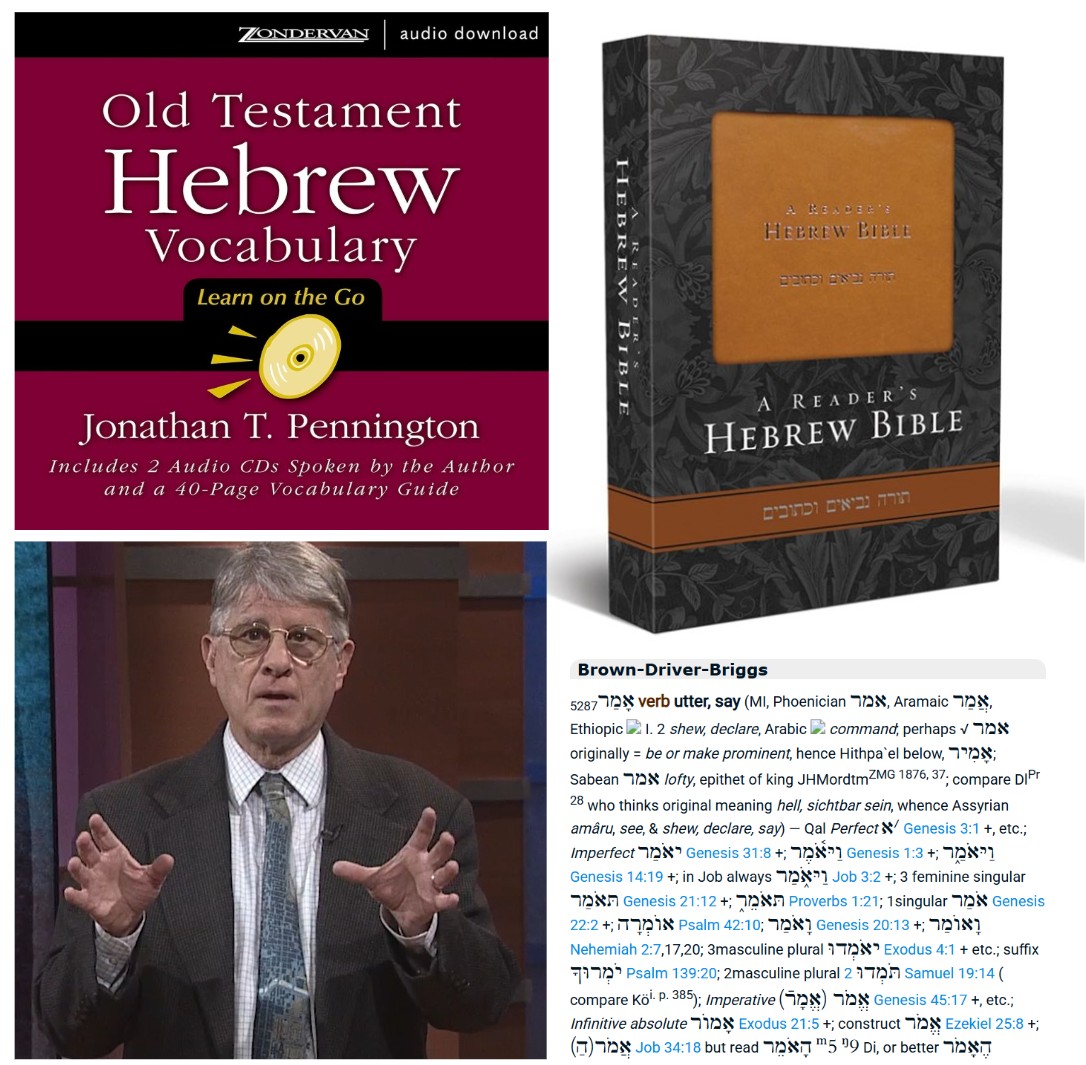
The second is an audiobook, Old Testament Hebrew Vocabulary by Jonathan T. Pennington. This is simply a vocabulary list in audiobook format. But that’s incredibly useful. It goes in order of word use frequency in the Bible. There’s no substitute to learning vocabulary, lots and lots of words! The full audiobook is two hours long. I recommend listening to it over and over again.
The third is the Biblehub Interlinear Bible. This is an online Hebrew Bible in both Hebrew and English. Each Hebrew word has an English gloss underneath it. A gloss, by the way, is not a comprehensive definition but just a short, inexact definition. Each word is also fully parsed out with its grammatical form. Each word also includes a hyperlink that includes the Brown–Driver–Briggs lexicon, which gives more than just a gloss, but a more comprehensive definition of each word. Brown–Driver–Briggs is an older but respectable lexicon. The best is probably the Hebrew and Aramaic Lexicon of the Old Testament (HALOT) but that one is definitely not free like Brown–Driver–Briggs is. Biblehub also includes entries from Strong’s concordance but it’s not as good as Brown–Driver–Briggs so I’d definitely go with that.
Last is A Reader’s Hebrew Bible published by Zondervan. If you want to go all in and get a Hebrew Bible in print this is a great one. The Reader’s Hebrew Bible gives the Hebrew text with footnotes providing glosses for words that occur less than 30 times. Words that occur 30 times or more are given gloss in the glossary but the best way to read it is to memorize all the words that occur 30 times or more. Then you can just read and look in the footnotes for the less common words. It’s really well done.
In the next two episodes we’ll look at the Hebrew alphabet and Hebrew vowel system respectively. Then get to the good stuff in the Hebrew Bible itself. And hopefully get back into conversations about science, Star Trek, Star Wars, philosophy, literature, and all that stuff.

