I love the Apostles’ Creed. If you ask me for a one-paragraph statement of what I believe, most fundamentally, this is it. Not just what I believe about religion, but what I believe most fundamentally about everything; about life, existence, and all of reality. The Apostles’ Creed gets right to the core of the most fundamental truths of all of it. It’s not scripture but a distillation of the truths of scripture that directs us toward the scriptures. Cyril of Alexandria (375 – 444) said that this “synthesis of faith” was made to accord with “what was of the greatest importance from all the Scriptures, to present the one teaching of the faith in its entirety. And just as the mustard seed contains a great number of branches in a tiny grain, so too this summary of faith encompassed in a few words the whole knowledge of the true religion contained in the Old and New Testaments.” (St. Cyril of Jerusalem, Catech. illum. 5, 12: PG 33, 521-524.) Here is the text of the Creed:
“I believe in God, the Father Almighty, Creator of Heaven and earth;
and in Jesus Christ, His only Son, Our Lord,
Who was conceived by the Holy Spirit, born of the Virgin Mary, suffered under Pontius Pilate, was crucified, died, and was buried.
He descended into Hell; the third day He rose again from the dead;
He ascended into Heaven, and sits at the right hand of God, the Father almighty; from thence He shall come to judge the living and the dead.
I believe in the Holy Spirit, the holy catholic [universal] church, the communion of saints, the forgiveness of sins, the resurrection of the body and life everlasting.
Amen.”
What’s fascinating to me about this is that it’s not only a set of propositions, though it is partially that. It’s also a story. The Gospel is a grand story and we find our stories by making it our own. On the Day of Pentecost when the Spirit filled the Apostles and gave them utterance Peter told this story:
“’Men of Israel, hear these words: Jesus of Nazareth, a Man attested by God to you by miracles, wonders, and signs which God did through Him in your midst, as you yourselves also know—Him, being delivered by the determined purpose and foreknowledge of God, you have taken by lawless hands, have crucified, and put to death; whom God raised up, having loosed the pains of death, because it was not possible that He should be held by it… His soul was not left in Hades, nor did His flesh see corruption. This Jesus God has raised up, of which we are all witnesses. Therefore being exalted to the right hand of God, and having received from the Father the promise of the Holy Spirit, He poured out this which you now see and hear… Therefore let all the house of Israel know assuredly that God has made this Jesus, whom you crucified, both Lord and Christ.’ Now when they heard this, they were cut to the heart, and said to Peter and the rest of the apostles, ‘Men and brethren, what shall we do?’ Then Peter said to them, ‘Repent, and let every one of you be baptized in the name of Jesus Christ for the remission of sins; and you shall receive the gift of the Holy Spirit.’” (Acts 2:22-24,31-32,36-38)
This is the Gospel. This is the grand story. I love Peter’s transformation here. The Spirit converted him into a confident and valiant preacher of the Gospel. When it grips you it’s exhilarating, like the “rushing mighty wind” (Acts 2:2). Paul had this same confidence and zeal for the Gospel. As he wrote to the Romans: “I am ready to preach the gospel to you who are in Rome also. For I am not ashamed of the gospel of Christ, for it is the power of God to salvation for everyone who believes, for the Jew first and also for the Greek.” (Romans 1:15-16)
Let’s look at the Apostles’ Creed in detail.
I believe in God, the Father almighty
Belief in God is foundational to Christian faith. The rest of the Gospel story depends on this foundation. But it also works in the other direction because the Gospel story is the way God is revealed to us. There are rational reasons to believe and good arguments for the existence of God. Those are valuable for apologetics. But in the Bible, in liturgy, and in worship it’s in the story of the Gospel that we come to know who God is.
Scripture is emphatic that God is one. There is only one God. One reason for the emphasis of this in the Hebrew Bible is because the Israelites, like all other surrounding nations, very often were polytheists, worshiping gods other than the Lord, something pointed out by modern historians of ancient Israel. And it should be no surprise. Idolatry was the great struggle that the prophets railed against incessantly over the centuries. But on this point the Torah was emphatic:
שְׁמַ֖ע יִשְׂרָאֵ֑ל יְהוָ֥ה אֱלֹהֵ֖ינוּ יְהוָ֥ה ׀ אֶחָֽד ׃
“Hear, O Israel: The Lord our God, the Lord is one!” (Deuteronomy 6:4)
The Shema was to pervade all life:
“You shall love the Lord your God with all your heart, with all your soul, and with all your strength. And these words which I command you today shall be in your heart. You shall teach them diligently to your children, and shall talk of them when you sit in your house, when you walk by the way, when you lie down, and when you rise up. You shall bind them as a sign on your hand, and they shall be as frontlets between your eyes. You shall write them on the doorposts of your house and on your gates.” (Deuteronomy 6:5-9)
This was especially stressed in Second Isaiah’s writings:
“Look to Me, and be saved, All you ends of the earth! For I am God, and there is no other.” (Isaiah 45:22)
When Jesus taught us how to pray he taught us to call God “Father”:
“In this manner, therefore, pray: Our Father who art in heaven, Hallowed be Thy name. Thy kingdom come. Thy will be done On earth as it is in heaven. Give us this day our daily bread. And forgive us our trespesses, As we forgive those who trespass against us. And lead us not into temptation, But deliver us from evil.” (Matthew 6:9-13)
Jesus further emphasizes God’s nature as Father in his parables. I also love the way Jesus portrays the Father in the Parable of the Prodigal Son:
“And he arose and came to his father. But when he was still a great way off, his father saw him and had compassion, and ran and fell on his neck and kissed him. And the son said to him, ‘Father, I have sinned against heaven and in your sight, and am no longer worthy to be called your son.’ “But the father said to his servants, ‘Bring out the best robe and put it on him, and put a ring on his hand and sandals on his feet. And bring the fatted calf here and kill it, and let us eat and be merry; for this my son was dead and is alive again; he was lost and is found.’ (Luke 15:20-24)
Paul taught that the Holy Spirit leads us to call God “Father”:
“For as many as are led by the Spirit of God, these are sons of God. For you did not receive the spirit of bondage again to fear, but you received the Spirit of adoption by whom we cry out, ‘Abba, Father.’ The Spirit Himself bears witness with our spirit that we are children of God, and if children, then heirs—heirs of God and joint heirs with Christ, if indeed we suffer with Him, that we may also be glorified together.” (Romans 8:14-17)
Thinking of God as Father makes a big difference. I think we are meant to understand this in a loving, nurturing way. It’s worth noting too that scripture also portrays God in maternal ways.
“Can a woman forget her nursing child, And not have compassion on the son of her womb? Surely they may forget, Yet I will not forget you. See, I have inscribed you on the palms of My hands” (Isaiah 49:15-16)
“As one whom his mother comforts, So I will comfort you; And you shall be comforted in Jerusalem.” (Isaiah 66:13)
We are encouraged in scripture to think of God in this way, as a parent who cares for us, teaches us, disciplines us, and loves us, as parents do to their children.
Creator of heaven and earth
The Bible begins with God’s act of creation:
“In the beginning God created the heavens and the earth.” (Genesis 1:1)
There is much that is significant about God and among these things his role as creator is especially salient. Consider all that is. He is before all things. Even though creation doesn’t define God exactly it’s certainly significant among the ways that we understand him and think about who he is.
“You who laid the foundations of the earth, So that it should not be moved forever… O Lord, how manifold are Your works! In wisdom You have made them all. The earth is full of Your possessions” (Psalm 104:5,24)
And in Jesus Christ, His only Son, Our Lord
We move now to distinctive Christian teaching. We believe not only in God the Father but also in His Son, Jesus Christ. Jesus Christ is God’s son:
“For God so loved the world that He gave His only begotten Son, that whoever believes in Him should not perish but have everlasting life.” (John 3:16)
The Father declared Jesus’s sonship at his baptism:
“When He had been baptized, Jesus came up immediately from the water; and behold, the heavens were opened to Him, and He saw the Spirit of God descending like a dove and alighting upon Him. And suddenly a voice came from heaven, saying, ‘This is My beloved Son, in whom I am well pleased.’” (Matthew 3:16-17)
Furthermore, the Son, Jesus Christ, is the manifestation of God to us.
“For in Him dwells all the fullness of the Godhead bodily” (Colossians 2:9)
“No one has seen God at any time. The only begotten Son, who is in the bosom of the Father, He has declared Him.” (John 1:18)
“He who has seen Me has seen the Father” (John 14:9)
Christian faith is distinctive for this focus on the man Jesus. In fact, our faith is exceedingly Christocentric, i.e. centered on Christ. And you really can’t go wrong with that. Phillip Cary has called it a Christian “obsession” with Christ and I think that’s right, in the best possible way (The History of Christian Theology).
Who was conceived by the Holy Spirit, born of the Virgin Mary
Speaking of Jesus, one of the things I find most fascinating about our faith is the Incarnation, that being Christ became physically embodied. The Son became an embodied human being like us. I don’t think we even begin to understand the Incarnation until we’ve reflected on it enough to be astounded by it. And essential to this process was a mortal woman, Mary.
“Now the birth of Jesus Christ was as follows: After His mother Mary was betrothed to Joseph, before they came together, she was found with child of the Holy Spirit. Then Joseph her husband, being a just man, and not wanting to make her a public example, was minded to put her away secretly. But while he thought about these things, behold, an angel of the Lord appeared to him in a dream, saying, ‘Joseph, son of David, do not be afraid to take to you Mary your wife, for that which is conceived in her is of the Holy Spirit.’” (Matthew 1:18-21)
“Then Mary said to the angel, ‘How can this be, since I do not know a man?’ And the angel answered and said to her, ‘The Holy Spirit will come upon you, and the power of the Highest will overshadow you; therefore, also, that Holy One who is to be born will be called the Son of God.’ Then Mary said, ‘Behold the maidservant of the Lord! Let it be to me according to your word.’” (Luke 1:34-35, 38)
The story of Mary is both miraculous and exemplary. Something I like to think about is how we can be like Mary in receiving and bearing Christ in ourselves, doing figuratively what she did literally. To say to God: “Behold the maidservant of the Lord! Let it be to me according to your word.”
Suffered under Pontius Pilate
This statement explicitly situates Jesus in history. The story of God is not abstracted from our world. It takes place in time and space. This is the God who covenanted with Abraham, who led the Israelites out of Egypt. And it’s the story of the Son becoming a man in a specific place at a specific time.
Furthermore, Jesus suffered. This is another crucial aspect of the wonder of Incarnation. Jesus lived and died in complete solidarity with us, suffering not only pain, but also abject humiliation.
“Then the soldiers of the governor took Jesus into the Praetorium and gathered the whole garrison around Him. And they stripped Him and put a scarlet robe on Him. When they had twisted a crown of thorns, they put it on His head, and a reed in His right hand. And they bowed the knee before Him and mocked Him, saying, ‘Hail, King of the Jews!’ Then they spat on Him, and took the reed and struck Him on the head. And when they had mocked Him, they took the robe off Him, put His own clothes on Him, and led Him away to be crucified.” (Matthew 27:27-31)
It’s certainly proper to reflect on this suffering and be moved by what Jesus was willing to suffer for our sakes.
Was crucified, died, and was buried
The crucifixion is undeniably a scandal. We worship a man who was crucified as a criminal. In crucifixion he was executed in the most humiliating and actually cursed way possible. The Torah says:
“If a man has committed a sin deserving of death, and he is put to death, and you hang him on a tree, his body shall not remain overnight on the tree, but you shall surely bury him that day, so that you do not defile the land which the Lord your God is giving you as an inheritance; for he who is hanged is accursed of God.” (Deuteronomy 21:22-23)
This is embarrassing for Christians, but Paul leaned right into this and emphasized this point:
“Christ has redeemed us from the curse of the law, having become a curse for us, for it is written, ‘Cursed is everyone who hangs on a tree.’” (Galatians 3:13)
Paul didn’t try to explain away Jesus’ cursed manner of execution. Instead he explained that this was precisely the point. Jesus became a curse for us. Regarding this article of the Creed Pope Benedict XVI said in his Introduction to Christianity:
“What position is really occupied by the Cross within faith in Jesus as the Christ? That is the question with which this article of the Creed confronts us once again… It is the expression of the radical nature of the love that gives itself completely, of the process in which one is what one does and does what one is; it is the expression of a life that is completely being for others… Almost all religions center around the problem of expiation; they arise out of mans’ knowledge of his guilt before God and signify the attempt to remove this feeling of guilt, to surmount the guilt through conciliatory actions offered up to God… In the New Testament the situation is almost completely reversed. It is not man who goes to God with a compensatory gift, but God who comes to man, in order to give to him… Here we stand before the twist that Christianity put into the history of religion. The New Testament does not say that men conciliate God, as we really ought to expect, since, after all, it is they who have failed, not God. It says, on the contrary, that ‘God was in Christ reconciling the world to himself’ (2 Cor 5:19). This is truly something new, something unheard of—the starting point of Christian existence and the center of New Testament theology of the Cross: God does not wait until the guilty come to be reconciled; he goes to meet them and reconciles them. Here we can see the true direction of the Incarnation, of the Cross. Accordingly, in the New Testament the Cross appears primarily as a movement from above to below. It stands there, not as the work of expiation that mankind offers to the wrathful God, but as the expression of that foolish love of God’s that gives itself away to the point of humiliation in order thus to save man; it is his approach to us, not the other way about. With this twist in the idea of expiation, and thus in the whole axis of religion, worship, too, man’s whole existence, acquires in Christianity a new direction. Worship follows in Christianity first of all in thankful acceptance of the divine deed of salvation. The essential form of Christian worship is therefore rightly called Eucharistia, thanksgiving.” (Introduction to Christianity, 161-162)
I think Benedict makes a very good point here about the radical inversion we see in the cross. This is truly something new. And how appropriate, since with Jesus “all things have become new” (2 Corinthians 5:17). No wonder people responded to Jesus with amazement and asked, “What is this? What new doctrine is this?” (Mark 1:27)
He descended into Hell
An Ancient Homily for Holy Saturday reads:
“Today a great silence reigns on earth, a great silence and a great stillness. A great silence because the King is asleep. the earth trembled and is still because God has fallen asleep in the flesh and he has raised up all who have slept ever since the world began. . . He has gone to search for Adam, our first father, as for a lost sheep. Greatly desiring to visit those who live in darkness and in the shadow of death, he has gone to free from sorrow Adam in his bonds and Eve, captive with him – He who is both their God and the son of Eve. . . ‘I am your God, who for your sake have become your son. . . I order you, O sleeper, to awake. I did not create you to be a prisoner in hell. Rise from the dead, for I am the life of the dead.’”
It is fundamental to Christ’s victory that he redeemed the dead from death. Christ descended into the realm of the dead but he didn’t stay there. He entered as conqueror and took the dead with him.
“’When He ascended on high, He led captivity captive, And gave gifts to men.’ Now this, ‘He ascended’—what does it mean but that He also first descended into the lower parts of the earth?” (Ephesians 8-9)
“For Christ also suffered once for sins, the just for the unjust, that He might bring us to God, being put to death in the flesh but made alive by the Spirit, by whom also He went and preached to the spirits in prison.” (1 Peter 3:18-19)
“For this reason the gospel was preached also to those who are dead, that they might be judged according to men in the flesh, but live according to God in the spirit.” (1 Peter 4:6)
“Most assuredly, I say to you, the hour is coming, and now is, when the dead will hear the voice of the Son of God; and those who hear will live.” (John 5:25)
Where are our dead? What is to become of us when we die? The state of unembodied death is not a place that we want to remain. And the announcement of the Gospel is that we won’t be left there, but that the dead will hear his voice and live.
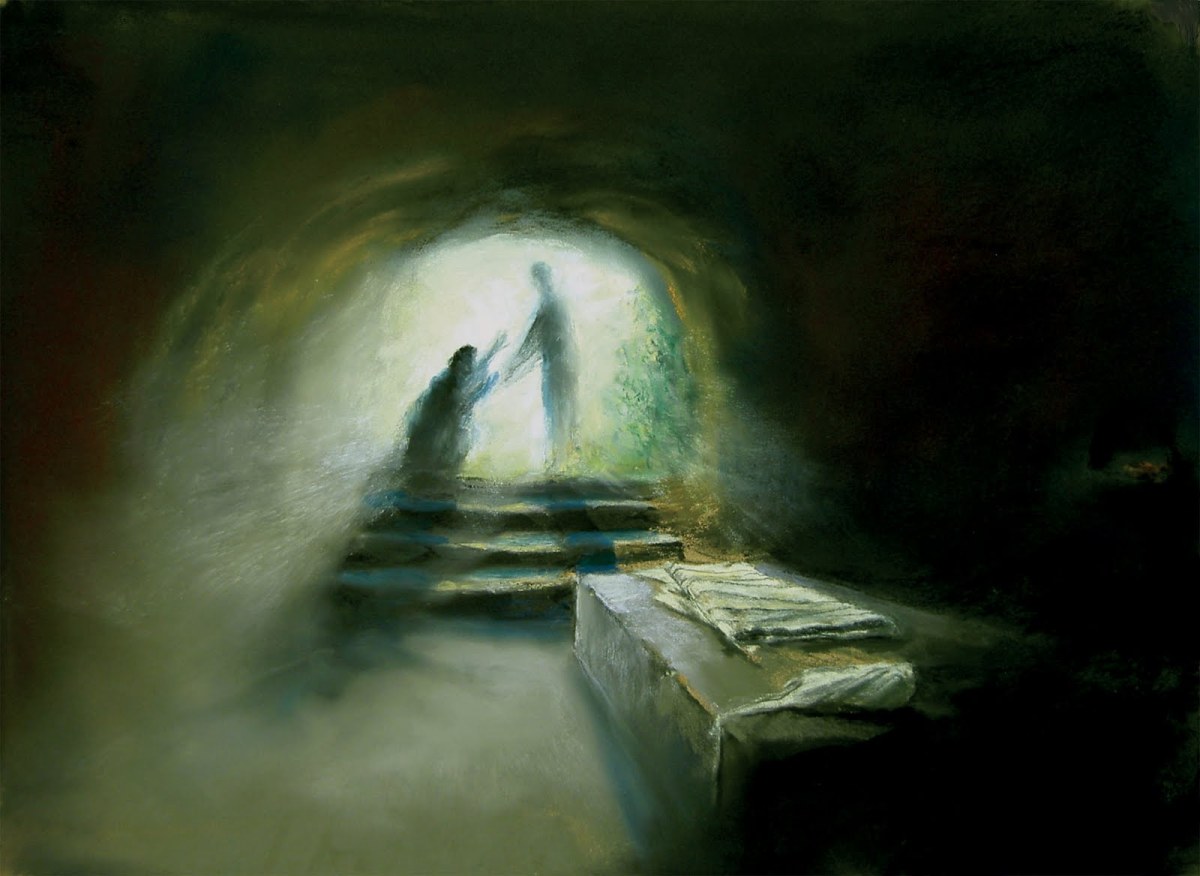
The third day he rose again from the dead
Easter morning was the event that started it all. Jesus had a following before but it was the empty tomb and his bodily appearance to his disciples that launched the revolution of Christianity throughout the world. This was what the apostles announced:
“Him God raised up on the third day, and showed Him openly, not to all the people, but to witnesses chosen before by God, even to us who ate and drank with Him after He arose from the dead. (Acts 10:40-41)
Here is one narration of that day:
“Now on the first day of the week, very early in the morning, they, and certain other women with them, came to the tomb bringing the spices which they had prepared. But they found the stone rolled away from the tomb. Then they went in and did not find the body of the Lord Jesus. And it happened, as they were greatly perplexed about this, that behold, two men stood by them in shining garments. Then, as they were afraid and bowed their faces to the earth, they said to them, ‘Why do you seek the living among the dead? He is not here, but is risen! Remember how He spoke to you when He was still in Galilee, saying, ‘The Son of Man must be delivered into the hands of sinful men, and be crucified, and the third day rise again.’ ‘He ascended into Heaven, and sits at the right hand of the Father almighty’” (Luke 24:1-7)
“Now as they said these things, Jesus Himself stood in the midst of them, and said to them, ‘Peace to you.’ But they were terrified and frightened, and supposed they had seen a spirit. And He said to them, ‘Why are you troubled? And why do doubts arise in your hearts? Behold My hands and My feet, that it is I Myself. Handle Me and see, for a spirit does not have flesh and bones as you see I have.’ When He had said this, He showed them His hands and His feet. But while they still did not believe for joy, and marveled, He said to them, ‘Have you any food here?’ So they gave Him a piece of a broiled fish and some honeycomb. And He took it and ate in their presence.” (Luke 24:36-43)
When Paul wrote of the significance of this event to the Corinthians he not only affirmed it with conviction but directed them to the many living witnesses who could affirm that they had seen the risen Lord.
“For I delivered to you first of all that which I also received: that Christ died for our sins according to the Scriptures, and that He was buried, and that He rose again the third day according to the Scriptures, and that He was seen by Cephas [i.e. Peter], then by the twelve. After that He was seen by over five hundred brethren at once, of whom the greater part remain to the present, but some have fallen asleep. After that He was seen by James, then by all the apostles. Then last of all He was seen by me also, as by one born out of due time. (1 Corinthians 15:3-8)
He ascended into Heaven, and sits at the right hand of God, the Father almighty
Christ’s ascension was another event witnessed and testified of by many.
“Now when He had spoken these things, while they watched, He was taken up, and a cloud received Him out of their sight.” (Acts 1:9)
His seat at the right hand of the Father is a place of honor affirmed by Stephan just before his martyrdom.
“But he, being full of the Holy Spirit, gazed into heaven and saw the glory of God, and Jesus standing at the right hand of God, and said, ‘Look! I see the heavens opened and the Son of Man standing at the right hand of God!’” (Acts 7:55-56)
From thence He shall come again to judge the living and the dead
Among the announcements of the apostles to the world was that Jesus would come again and that when he returns he will judge all who have ever lived.
“And while they looked steadfastly toward heaven as He went up, behold, two men stood by them in white apparel, who also said, ‘Men of Galilee, why do you stand gazing up into heaven? This same Jesus, who was taken up from you into heaven, will so come in like manner as you saw Him go into heaven.’” (Acts 1:10-11)
“Him God raised up on the third day, and showed Him openly, not to all the people, but to witnesses chosen before by God, even to us who ate and drank with Him after He arose from the dead. And He commanded us to preach to the people, and to testify that it is He who was ordained by God to be Judge of the living and the dead.” (Acts 10:40-42)
“And I saw the dead, small and great, standing before God, and books were opened. And another book was opened, which is the Book of Life. And the dead were judged according to their works, by the things which were written in the books.” (Revelation 20:12)
I believe in the Holy Spirit
Also unique to the Christian faith is our belief in the Holy Spirit alongside the Father and the Son. Scripture doesn’t give too many details but they leave no doubt about the Spirit’s existence and divinity. The Holy Spirit is invoked in the rite of baptism itself:
“Go therefore and make disciples of all the nations, baptizing them in the name of the Father and of the Son and of the Holy Spirit” (Matthew 28:19)
And the Spirit plays an active role throughout the history of the early Church:
“It came to pass that Jesus also was baptized; and while He prayed, the heaven was opened. And the Holy Spirit descended in bodily form like a dove upon Him (Luke 3:21-22)
“When the Day of Pentecost had fully come, they were all with one accord in one place. And suddenly there came a sound from heaven, as of a rushing mighty wind, and it filled the whole house where they were sitting. Then there appeared to them divided tongues, as of fire, and one sat upon each of them. And they were all filled with the Holy Spirit and began to speak with other tongues, as the Spirit gave them utterance.” (Acts 2:1-4)
“This Jesus God has raised up, of which we are all witnesses. Therefore being exalted to the right hand of God, and having received from the Father the promise of the Holy Spirit, He poured out this which you now see and hear.” (Acts 2:32-33)
Jesus also spoke of the Spirit’s mission directly, as recorded in the Gospel of John:
“And I will pray the Father, and He will give you another Helper, that He may abide with you forever— the Spirit of truth, whom the world cannot receive, because it neither sees Him nor knows Him; but you know Him, for He dwells with you and will be in you. I will not leave you orphans; I will come to you… These things I have spoken to you while being present with you. But the Helper, the Holy Spirit, whom the Father will send in My name, He will teach you all things, and bring to your remembrance all things that I said to you. Peace I leave with you, My peace I give to you; not as the world gives do I give to you. Let not your heart be troubled, neither let it be afraid. (John 14:16-18,25-27)
The Holy Spirit testifies of Christ and brings the words of Christ to our remembrance.
The holy catholic [universal] church, the communion of saints
Actually this is usually recited as, “The holy catholic church, the communion of saints”. Not only Roman Catholics profess the Creed or course. Christians of other denominations understand “catholic” here as small “c” catholic, in the sense of “universal”. For better or worse, there are multiple Christian denominations. But we still hold to one universal, catholic faith. Paul wrote in several instances about the importance of the unity of the Church.
“There is one body and one Spirit, just as you were called in one hope of your calling; one Lord, one faith, one baptism; one God and Father of all, who is above all, and through all, and in you all.” (Ephesians 4:4-6)
“Now I plead with you, brethren, by the name of our Lord Jesus Christ, that you all speak the same thing, and that there be no divisions among you, but that you be perfectly joined together in the same mind and in the same judgment. For it has been declared to me concerning you, my brethren, by those of Chloe’s household, that there are contentions among you. Now I say this, that each of you says, ‘I am of Paul,’ or ‘I am of Apollos,’ or ‘I am of Cephas,’ or ‘I am of Christ.’ Is Christ divided? Was Paul crucified for you? Or were you baptized in the name of Paul?” (1 Corinthians 1:10-13)
Unity is key for Paul. But he also values diversity in the service of unity. The Church is the Body of Christ. And as a body it is an organic system with mutually interacting parts:
“For as the body is one and has many members, but all the members of that one body, being many, are one body, so also is Christ. For by one Spirit we were all baptized into one body—whether Jews or Greeks, whether slaves or free—and have all been made to drink into one Spirit. For in fact the body is not one member but many… But now indeed there are many members, yet one body… But God composed the body, having given greater honor to that part which lacks it, that there should be no schism in the body, but that the members should have the same care for one another.” (1 Corinthians 12:12-14,20,24-25)
The forgiveness of sins
I think that one of the most important affirmations of the Gospel is that it is possible for people to change. I believe this but I actually find it more difficult to believe than many of the supernatural and miraculous aspects of Christianity. And that’s just because of the competing evidence of experience. We really seem to get set in our ways. Is it really possible to change? I think that believing this demands about as much faith as anything. But this is the message of the Gospel: that we can become new creatures.
“Therefore, if anyone is in Christ, he is a new creation; old things have passed away; behold, all things have become new.” (2 Corinthians 5:17)
Let’s look at some examples from the Gospels:
“When Jesus saw their faith, He said to the paralytic, ‘Son, your sins are forgiven you.’ And some of the scribes were sitting there and reasoning in their hearts, ‘Why does this Man speak blasphemies like this? Who can forgive sins but God alone?’ But immediately, when Jesus perceived in His spirit that they reasoned thus within themselves, He said to them, ‘Why do you reason about these things in your hearts? Which is easier, to say to the paralytic, ‘Your sins are forgiven you,’ or to say, ‘Arise, take up your bed and walk’? But that you may know that the Son of Man has power on earth to forgive sins’—He said to the paralytic, ‘I say to you, arise, take up your bed, and go to your house.’ Immediately he arose, took up the bed, and went out in the presence of them all, so that all were amazed and glorified God, saying, ‘We never saw anything like this!’” (Mark 2:5-12)
“Then one of the Pharisees asked Him to eat with him. And He went to the Pharisee’s house, and sat down to eat. And behold, a woman in the city who was a sinner, when she knew that Jesus sat at the table in the Pharisee’s house, brought an alabaster flask of fragrant oil, and stood at His feet behind Him weeping; and she began to wash His feet with her tears, and wiped them with the hair of her head; and she kissed His feet and anointed them with the fragrant oil. Now when the Pharisee who had invited Him saw this, he spoke to himself, saying, ‘This Man, if He were a prophet, would know who and what manner of woman this is who is touching Him, for she is a sinner.’ And Jesus answered and said to him, ‘Simon, I have something to say to you.’ So he said, ‘Teacher, say it.’ ‘There was a certain creditor who had two debtors. One owed five hundred denarii, and the other fifty. And when they had nothing with which to repay, he freely forgave them both. Tell Me, therefore, which of them will love him more?’ Simon answered and said, ‘I suppose the one whom he forgave more.’ And He said to him, ‘You have rightly judged.’ Then He turned to the woman and said to Simon, ‘Do you see this woman? I entered your house; you gave Me no water for My feet, but she has washed My feet with her tears and wiped them with the hair of her head. You gave Me no kiss, but this woman has not ceased to kiss My feet since the time I came in. You did not anoint My head with oil, but this woman has anointed My feet with fragrant oil. Therefore I say to you, her sins, which are many, are forgiven, for she loved much. But to whom little is forgiven, the same loves little.’ Then He said to her, ‘Your sins are forgiven.’ And those who sat at the table with Him began to say to themselves, ‘Who is this who even forgives sins?’ Then He said to the woman, ‘Your faith has saved you. Go in peace.’” (John 7:36-50)
This great transformation is expressed ritually in baptism:
“Our old man was crucified with Him, that the body of sin might be done away with, that we should no longer be slaves of sin. For he who has died has been freed from sin. Now if we died with Christ, we believe that we shall also live with Him, knowing that Christ, having been raised from the dead, dies no more. Death no longer has dominion over Him. For the death that He died, He died to sin once for all; but the life that He lives, He lives to God. Likewise you also, reckon yourselves to be dead indeed to sin, but alive to God in Christ Jesus our Lord.” (Romans 6:6-11)
Baptism not only symbolizes death of the old self and rebirth as a new creature. It should also orient us in the way that we think about ourselves, as being dead to sin and alive in Christ.
The resurrection of the body
When I affirm the resurrection of the body it leads me to reflect on our nature as human beings. What are we? Critically, we are embodied, physical beings. When we die and our bodies decay we are no longer completely ourselves. We understand the intermediate state between death and resurrection to be one of peace for the righteous, but this immaterial aspect that is left of us is not complete. We can be ourselves fully only by being physically embodied. This is why resurrection is simply indispensable. The resurrection of our bodies is not just a nice-to-have. It’s absolutely essential to the continuation of our identities as human beings. Paul explained this very clearly:
“And if Christ is not risen, your faith is futile; you are still in your sins! Then also those who have fallen asleep in Christ have perished. If in this life only we have hope in Christ, we are of all men the most pitiable. But now Christ is risen from the dead, and has become the firstfruits of those who have fallen asleep.” (1 Corinthians 15:17-20)
“So when this corruptible has put on incorruption, and this mortal has put on immortality, then shall be brought to pass the saying that is written: ‘Death is swallowed up in victory.’ ‘O Death, where is your sting? O Hades, where is your victory?’ The sting of death is sin, and the strength of sin is the law. But thanks be to God, who gives us the victory through our Lord Jesus Christ.” (1 Corinthians 15:54-57)
Resurrection changes everything. I think of history in terms of two major epochs: the fourteen billion years before Christ’s resurrection and the couple thousand years after it. The universe changed fundamentally with Christ’s resurrection. Death is no longer absolute. And that changes everything.
And the life everlasting
I can think of no greater affirmation of the goodness of personal existence than the hope for life everlasting. In this way we say, “Yes. Life is good. I want it to last forever.” Maybe this seems obvious but we might ask, would life get boring eventually and actually become unbearable? If you’ve seen the show The Good Place this is a problem they deal with. I think this doubt is quite astute and I actually don’t think it’s really possible for us to comprehend how everlasting life would be endlessly joyful and engaging. But I believe this is what we affirm with our faith in everlasting life. A few thoughts on this. Jesus talked about everlasting life as living water. He said to a Samaritan woman at Jacob’s Well:
“Whoever drinks of this water will thirst again, but whoever drinks of the water that I shall give him will never thirst. But the water that I shall give him will become in him a fountain of water springing up into everlasting life.” (John 4:13-14)
Working with this metaphor of the fountain of water, I think Gregory of Nyssa (335-395) had an important insight:
“The person who has drawn near to the fountain will marvel at that limitless supply of water that ever gushes out and flows from it, yet he would not say that he has seen all of the water. (For how can he see the water that is still concealed in earth’s bosom? The fact is that even if he remains for a long time at the gushing spring, he is always just beginning to contemplate the water, for the water never stops in its everlasting flow nor does it ever cease beginning to gush forth.) In the same way, the person who looks toward that divine and infinite Beauty glimpses something that is always being discovered as more novel and more surprising than what has already been grasped, and for that reason she marvels at that which is always being manifested, but she never comes to a halt in her desire to see, since what she looks forward to is in every possible way more splendid and more divine than what she has seen.” (Homilies on the Song of Songs, Homily 11)
I imagine here the wonder that a young child has at everything because everything is new. In Gregory of Nyssa’s metaphor this is what it’s like to look upon the divine and infinite Beauty. It’s always new, always surprising and novel.
The most important scripture pertaining to everlasting life is also the most well-known verse of the entire Bible:
“For God so loved the world that He gave His only begotten Son, that whoever believes in Him should not perish but have everlasting life.” (John 3:16)
This verse’s fame is well-deserved. This is the Gospel, that the gift of life, everlasting life, is possible through God’s only begotten Son, Jesus Christ.
Conclusion
Of course there is a lot more to Christian faith than what is in the Apostles’ Creed. But I like Cyril of Alexandria’s metaphor of the “great number of branches in a tiny grain”. The scriptures are interconnected in such a way that you can pick up at any point and quickly find yourself immersed in its vast network. Each of the scriptures here is part of a story and each story is part of a larger story. Reading these stories is the project of a lifetime of study. But the Apostles’ Creed distills the message so as to be able “to give a defense to everyone who asks you a reason for the hope that is in you” (1 Peter 3:15). It says what all of this is about and what God is about. And it’s what I believe most fundamentally about everything; about life, existence, and all of reality.


 Todd Decker