A video of this content is available on YouTube.
In the last post I went through the Hebrew alphabet. This post is an overview of Hebrew vowels. The letters of the Hebrew alphabet function mostly as consonants. For most of the history of the language it was just these consonants that were ever written. That’s still mostly the case in modern Hebrew. The nature of the language is such that the consonants alone do most of the needed work. I said they function mostly as consonants. The letters he, yud, and vav can also be used to hint at general types of vowel sounds. But eventually systems were developed to explicitly indicate specific kinds of vowel sounds. A little over a thousand years ago the Tiberian vowel system was developed and this is the system that is still used today. Ancient manuscripts of the Hebrew Bible and modern Torah scrolls have only the consonants but printed Hebrew Bibles use the Tiberian vowel system so that it’s very clear, at least once you learn it, exactly how to pronounce each word. In this vowel system, instead of using letters, vowel sounds are indicated with additional symbols written around the letters. These additional symbols or diacritics are called niqqud. Since the symbols are always written around letters and not by themselves I’ll show these here with the letter aleph.
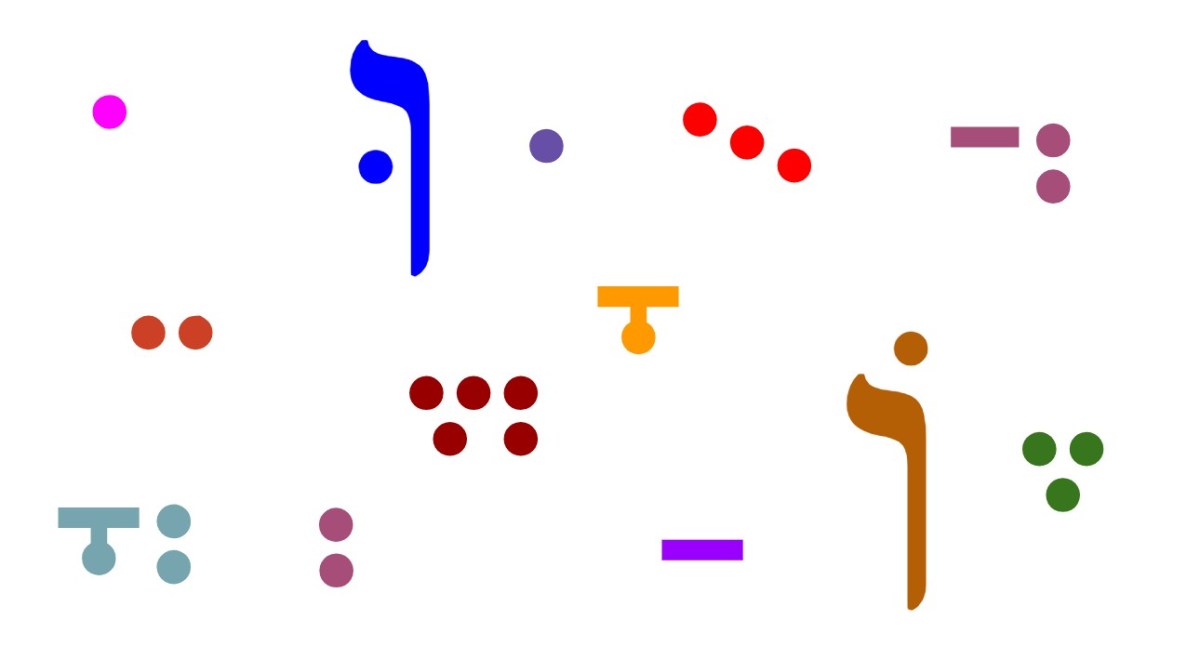
Qamatz – אָ. The qamatz looks like a little upper-case T that goes under the letter. The qamatz makes an “ah” sound as in “father”. That’s the sound it makes in most words. In some words it can also make an “oh” sound as in “go”.
Pataḥ – אַ . The pataḥ is a horizontal line written under the letter. It also makes an “ah” sound as in father. Qamatz and pataḥ have historically had distinct sounds but they are pronounced the same in modern Hebrew.
Tsere – אֵ . Tsere is written with two horizontally aligned dots under the letter. This makes an ‘ey’ sound as in “they”.
Seghol – אֶ. The seghol is written with three dots in the shape of a triangle, going under the letter. This makes an “eh” sound as in “bed”.
Ḥireq – אִ. The ḥireq is written as a single dot under the letter. It makes an“ee” sound as in “machine”. Letters with a ḥireq are sometimes followed by a yud as well, which is one of those helping letters.
Ḥolem – אֹ. The ḥolem is written as a single dot written to the upper left of the letter. It makes an “oh” sound as in “go”. It is also often written with a vav accompanying this single dot – אוֹֹ.
Shuruq – אוּ. The shuruq is written with a vav to the left of the letter with a single dot in the middle of the vav. It makes an ‘oo’ sound as in “food”.
Qubbutz – אֻ. The qubbutz is written with three dots arranged diagonally under the letter. It also makes an ‘oo’ sound.
Sheva – אְ. The sheva is written as two dots arranged vertically under the letter. It represents a very short vowel, pronounced like the first ‘a’ in “Maria” or the first ‘e’ in “Jerusalem”. Singers may be familiar with talking about a “schwa” sound, which comes from the Hebrew sheva. The sheva is also sometimes silent and is just there to mark the end of a syllable.
The sheva also combines with the qamatz, pataḥ, and seghol to form what are called “reduced” or “compound” versions of each of these.
Reduced Qamatz – אֳ. The reduced qamatz is written as a combination of a sheva and a qamatz, both written under the letter. It makes an “oh” sound as in “go”.
Reduced Pataḥ – אֲ. The reduced pataḥ is written as a combination of a sheva and a pataḥ, both written under the letter. It makes an “ah” sound as in “father”.
Reduced Seghol – אֱ. The reduced seghol is written as a combination of a sheva and a seghol, both written under the letter. It makes an “eh” sound as in “bed”.
Now let’s try spelling a few words using these vowels. With each of the following words I’ll just be giving a gloss, rather than a full definition. For a full definition consult something like the Brown-Driver-Briggs lexicon, which is freely available.
The first word is אֱלֹהִים, meaning “God” or “gods”. In אֱלֹהִים we have three of the vowel sounds. The first syllable has a reduced seghol under an aleph, pronounced – “eh”. The second syllable has a ḥolem to the left of the lamed, pronounced – “lo”. In the third syllable there’s a ḥireq under a he – “hee”. In this word there’s also a yud accompanying the ḥireq, which is quite common. This third syllable ends with the mem in its final form, so this last syllable becomes – “heem”. Eh-lo-heem. אֱלֹהִים.
The next word is יִשְׂרָאֵל, meaning “Israel”. In this word there are four niqqud but just three syllables. I’ll explain why. In the first syllable there is a ḥireq under a yud, pronounced – “yee”. This is followed by a sheva under a sin. In this case this sheva just indicates that it’s the end of the syllable so that syllable is pronounced – “yees”. So there are two niqqud in this one syllable. In the second syllable there’s a qamatz under a resh – “rah”. And in the third syllable there’s a tsere under an aleph followed by a lamed – “eyl”. Yees-rah-eyl. יִשְׂרָאֵל.
The next word is בָּבֶל, meaning “Babylon”. This word is interesting because we have two bets, one with a dagesh and one without a dagesh. So as a bonus I’ll also talk here about the dagesh. I mentioned in the recording on Hebrew letters that some letters are pronounced differently with or without a symbol called a dagesh. The dagesh is a dot in the middle of the letter. It can have a grammatical function but can also simply indicate pronunciation for those letters that change with or without a dagesh. The letters that change with a dagesh are bet, gimmel, dalet, kaf, pey, and tav. An acronym to remember these is “beged-kefet” and we can call these the beged-kefet letters, which change pronunciation with the dagesh. Or at least did change pronunciation in classical Biblical Hebrew. Some of them don’t really change any more. But some definitely still do and this includes the letter bet. In the word בָּבֶל we have two bets. The first one has a dagesh and is pronounced as a ‘b’. The second one doesn’t have a dagesh and is pronounced as a ‘v’. There’s a qammatz under the first bet, with a dagesh, so this is pronounced – “bah”. Then there’s a seghol under the second bet, without a dagesh, so this is pronounced – “veh”. Then this syllable ends with a lamed so the full second syllable is – “vel”. Bah-vel. בָּבֶל.
The next word is אֶרֶץ, meaning “land”, “earth”, or “ground”. אֶרֶץ has two seghols in it, the first under an aleph – “eh”, the second under a resh “reh”. Then the word ends with a tsade in its terminal form – “retz”. Eh-retz. אֶרֶץ.
The next word is שֻׁלְחָן, meaning table. The first syllable has a qubbutz under a shin – “shu”. Then there’s a sheva under the lamed, which ends the syllable, making this first syllable – “shul”. Next there’s qammatz under a chet, followed by a nun in its terminal form, making this second syllable – “chan”. Shul-chan. שֻׁלְחָן.
The next word is רוּחַ, meaning “spirit”, “wind”, or “breath”. The first syllable is a resh followed by a shuruq – “ru”. The second syllable is interesting and is an example of what is called a “furtive pataḥ”. Usually with the Hebrew vowels you pronounce the consonant that is given by the letter first and then the vowel that is written around it second. But when a pataḥ is under a chet, at the end of a word like this, in the last syllable, you actually pronounce the pataḥ vowel first and then the chet. So instead of “chah” this second syllable is pronounced “ach”. Ru-ach. רוּחַ.
The last word is שָׁלוֹם. This one I’m sure you’ve heard. שָׁלוֹם means “peace”, “welfare”, or “wholeness”. The first syllable has a qammatz under a shin – “Sha”. The second syllable has lamed followed by a ḥolem, this one written with a vav, followed by a mem in its final form – “lohm”. Sha-lohm. שָׁלוֹם.
And that’s my introduction to Hebrew vowels. After doing letters and vowels it’s advisable to go on and study things like pronouns, prepositions, verb forms, and so on. There are tons of good resources out there for that. My favorite is Michael Carasik’s Biblical Hebrew: Learning a Sacred Language, produced by The Great Courses. For now I’m not going to do any more posts dedicated to those topics myself, so I’ll just refer you to those resources. Instead I’m going to start looking at the Biblical text itself. And I’ll talk about various grammatical and vocabulary topics as they come up in that way. So that’s what we’ll do next time.

