“There went out a sower to sow.” In his parable of the sower Jesus gives various active and passive roles: sower, seed, good soil, soil among thorns, stony ground, and waysides. This meditation on Mark 4 considers the seed as the word and the Word Christ, our receptivity to Christ, how he can enter, germinate, grow, and transform us into new creatures.
One of the Church’s greatest theologians, Thomas Aquinas (1225 – 1274) was an astonishingly prolific writer. He’s especially known for his Summa Theologiae, which is one of my first go-to theology resources. His style was analytic and detailed. Each of the “Questions” in the Summa reads like a geometrical proof out of Euclid, each with some assertion, supporting points, counter-assertions, and detracting points, and a conclusion. It was a masterful intellectual achievement. Yet near the end of his life Aquinas had a mystical experience that seemed to lead him away from that stage of life and into another. He was no longer able to write, not out of physical incapacity but because of the greatness of his revelation. He felt his writings, great as they were, couldn’t possibly match the greatness of the revelation he had been given. The direct experience of his revelation transcended the rationality of this most rational of thinkers. That’s a sobering thought, still, I’m inclined to think of this overwhelming experience of his as a reward for all the work that he had done in a previous stage of life. His mystical stage, if we can call it that, only lasted a few months since he died shortly after. But it’s something I think about a lot. The analytical, rational stage of the adult in his younger and middle ages, succeeded by a later super-rational, mystical stage. Something about that seems quite appropriate. I approach religion and scripture in that very analytical, rational way. It’s just more natural for me right now. But I wouldn’t be surprised or at all disappointed if that changed at some point. As satisfying as the intellectual nature of theology is, the infusion of the Spirit is so much greater. I spoke in a previous episode about a life with the Holy Spirit. Those moments of spiritual elevation are invaluable.
On this subject I’d like to share a meditation Mark 4, a chapter in which we read of Jesus’s parable of the sower, a masterful parable. I’d like to focus on two aspects of it: (1) the seed and (2) the soil. When Jesus explained the parable of the sower to his disciples he said that the seed was “the word”; “The sower soweth the word.” (Mark 4:14). For readers familiar with John’s gospel this can have at least a double meaning: (1) the word of the Gospel, the words that people speak to preach the message, and (2) the Word, Logos, is also Christ himself (John 1:1-3).
Another story about Thomas Aquinas. One day while Aquinas was in prayer before the crucifix the voice of Christ called out to him and said, “You have written well of me, Thomas. What reward will you receive from me for your labor?” And Aquinas answered, “Lord, nothing except you.”
I love the Christmas hymn “O Little Town of Bethlehem”, especially this verse:
“O holy Child of Bethlehem, descend to us, we pray, cast out our sin and enter in, be born in us today.”
I thought about this a lot this past Christmas. I tried to put myself in Mary’s state of mind as one who receives and carries the Lord himself within her body. She declared so much with that statement, “Behold the handmaid of the Lord” (Luke 1:38). I think it’s powerful – also for men, who probably aren’t used to thinking in this way – to think of being the mother Mary, bearing God in her body. It’s one vivid image of something that the scriptures and the ritual practices of the Church communicate in various ways, the Eucharist for example: that we are to take Christ into ourselves and allow him to transform us into new creatures.
This is how I think about the seeds in Jesus’s parables. The seed is “the word”, the message of the Gospel, as well as “the Word”, Christ himself.
In the parable of the sower, the sower plays the active role. “Behold, there went out a sower to sow” (Mark 4:3). He is the one sowing the seeds. By the time the sower passes by the soil is either ready or it isn’t. The soil is passive but its condition makes all the difference.
“And it came to pass, as he sowed, some fell by the way side, and the fowls of the air came and devoured it up. And some fell on stony ground, where it had not much earth; and immediately it sprang up, because it had no depth of earth: But when the sun was up, it was scorched; and because it had no root, it withered away. And some fell among thorns, and the thorns grew up, and choked it, and it yielded no fruit. And other fell on good ground, and did yield fruit that sprang up and increased; and brought forth, some thirty, and some sixty, and some an hundred. And he said unto them, He that hath ears to hear, let him hear.” (Mark 4:4-9)
Let’s talk first about the active role of the sower. One of the things that strikes me about moments of spiritual revelation is that they don’t happen whenever we want them to. They come as a gift of grace. That’s because they’re not manufactured. And they’re not the product of an individual. Rather, they are special encounters between us and Spirit. The Spirit, as the other person in these encounters, has to decide to participate. The philosopher Martin Buber (1878 – 1965) called this an “I-You” encounter. He contrasted this with the “I-It” experience in which a person can individually and unilaterally perceive and consider objects, ideas, and people in a way that doesn’t require another’s free participation. Basically, how we live most of the time. But our lives are sometimes interrupted by encounters of a different kind. And he says these come by “grace”:
“The You encounters me by grace–it cannot be found by seeking. But that I speak the basic word to it is a deed of my whole being, is my essential deed. The You encounters me. But I enter into a direct relationship to it. Thus the relationship is election and electing, passive and active at once: An action of the whole being must approach passivity, for it does away with all partial actions and thus with any sense of action, which always depends on limited exertions. The basic word I-You can be spoken only with one’s whole being. The concentration and fusion into a whole being can never be accomplished by me, can never be accomplished without me. I require a You to become; becoming I, I say You. All actual life is encounter.” (Martin Buter, I and Thou, 61)
What’s crucial to understand is that the Father, Son, and Holy Ghost are persons. We can’t manufacture encounters with persons on our own. It requires the full cooperation of the other person. The Holy Ghost needs to act. And that happens when he chooses. But we can act to be receptive and prepare ourselves. We are the soil and we can condition ourselves as soil to receive Christ.
Jesus interpreted the parable for his disciples in this way:
“The sower soweth the word. And these are they by the way side, where the word is sown; but when they have heard, Satan cometh immediately, and taketh away the word that was sown in their hearts. And these are they likewise which are sown on stony ground; who, when they have heard the word, immediately receive it with gladness; And have no root in themselves, and so endure but for a time: afterward, when affliction or persecution ariseth for the word’s sake, immediately they are offended. And these are they which are sown among thorns; such as hear the word, And the cares of this world, and the deceitfulness of riches, and the lusts of other things entering in, choke the word, and it becometh unfruitful. And these are they which are sown on good ground; such as hear the word, and receive it, and bring forth fruit, some thirtyfold, some sixty, and some an hundred.” (Mark 4:14-20)
A lot here to think about. One part that stands out to me at the moment is the case of the seeds sown among thorns. The thorns are “the cares of this world, and the deceitfulness of riches, and the lusts of other things”. These create unfruitful conditions. To be fruitful it is necessary to be set apart from these things. Some Christians throughout history have applied this kind of setting apart in a physical sense, actually taking up a monastic life. But I think what’s most important is to apply this existentially, to be set apart from the world in the way we live and in our way of being. Especially in the things we care about.
Following Christ is not a light matter and Jesus made this clear.
“And it came to pass, that, as they went in the way, a certain man said unto him, Lord, I will follow thee whithersoever thou goest. And Jesus said unto him, Foxes have holes, and birds of the air have nests; but the Son of man hath not where to lay his head. And he said unto another, Follow me. But he said, Lord, suffer me first to go and bury my father. Jesus said unto him, Let the dead bury their dead: but go thou and preach the kingdom of God. And another also said, Lord, I will follow thee; but let me first go bid them farewell, which are at home at my house. And Jesus said unto him, No man, having put his hand to the plough, and looking back, is fit for the kingdom of God.” (Luke 9:57-62)
Wow! Clearly the kind of life Jesus requires is quite different from the way normal people live. In thinking about these verses it makes me reflect on the things I care about and whether they enable or impede my receptivity to the Holy Spirit. Jesus warns about the cares of the world. The Greek for “care” is μέριμνα (mérimna). The corresponding verb is μεριμνάω (merimnao): to be anxious or worried about something. It’s used several times in the following passage from the Sermon on the Mount:
“Therefore I say unto you, Take no thought [μὴ μεριμνᾶτε, me merimnate] for your life, what ye shall eat, or what ye shall drink; nor yet for your body, what ye shall put on. Is not the life more than meat, and the body than raiment? Behold the fowls of the air: for they sow not, neither do they reap, nor gather into barns; yet your heavenly Father feedeth them. Are ye not much better than they? Which of you by taking thought [μεριμνῶν, merimnon] can add one cubit unto his stature? And why take ye thought [μεριμνᾶτε, merimnate] for raiment? Consider the lilies of the field, how they grow; they toil not, neither do they spin: And yet I say unto you, That even Solomon in all his glory was not arrayed like one of these. Wherefore, if God so clothe the grass of the field, which to day is, and to morrow is cast into the oven, shall he not much more clothe you, O ye of little faith? Therefore take no thought [μὴ οὖν μεριμνήσητε, me oun merimnesete], saying, What shall we eat? or, What shall we drink? or, Wherewithal shall we be clothed? (For after all these things do the Gentiles seek:) for your heavenly Father knoweth that ye have need of all these things. But seek ye first the kingdom of God, and his righteousness; and all these things shall be added unto you. Take therefore no thought [μὴ οὖν μεριμνήσητε, me oun merimnesete] for the morrow: for the morrow shall take thought [μεριμνήσει, merimnese] for the things of itself. Sufficient unto the day is the evil thereof.” (Matthew 6:25-34)
Do we need food, drink, and clothing? Yes, Jesus said as much. “Your heavenly Father knoweth that ye have need of all these things.” But he said not to seek after them. And this interesting, he says that seeking after food, drink, or clothing is what the Gentiles do. Gentiles are those who have not entered into the covenant. The Gentile way of life is a completely different way of life, and really the normal way of life. But it’s not the way of Jesus. Jesus said these cares “choke the word, and it becometh unfruitful”.
Jesus explained the good soil represents people who “hear the word, and receive it”. And again, I like to consider the double meaning in which the Word here is also Christ himself. The good soil receives Christ. Christ enters into it, germinates, and grows. Like with Mary, the God-Bearer, the Spirit can enter into us and Christ can abide in us. This reception is also mutual abiding. We abide in Christ and he abides in us. In the Trinity this kind of relation is sometimes called interpenetration and a similar kind of mutual abiding and interpenetration is happening here:
“Abide in me, and I in you. As the branch cannot bear fruit of itself, except it abide in the vine; no more can ye, except ye abide in me. I am the vine, ye are the branches: He that abideth in me, and I in him, the same bringeth forth much fruit: for without me ye can do nothing.” (John 14:4-5)
I believe this is ultimately what Christian holiness looks like. Understanding, yes. By all means. Learn the doctrine, study the principles, develop a sophisticated philosophical and theological understanding. I think that’s appropriate and good, especially for certain periods of life. But beyond that is this direct receptivity to the Spirit and this planting of Christ into the core of our being to be transformed into new creatures.
An introduction to eight of the Early Church Fathers: Clement, Ignatius of Antioch, Polycarp, Justin Martyr, Irenaeus, Tertullian, Clement of Alexandria, and Origen of Alexandria. Important witnesses to the Christian faith in its earliest days who everyone should know about.
Introduction
With this episode I’d like to give a brief introduction to eight of the Early Church Fathers. This is a subject that interests me immensely and one that occupies much of my personal study. I’m fascinated by the lives and writings of these men. But I don’t find that they are especially well known. So I’d like to introduce them here. It’s an introduction in two ways. First, I won’t be going into much depth this time around. And second, I’m just focusing on some the earliest of the Church Fathers from the second century. Maybe later I’ll go into more depth on these eight and also introduce later Church Fathers.
One of the things I focus on in my study of these men is how they faithfully transmitted and carried on the teachings that had been handed down to them by Jesus and his Apostles. They were immersed in the scriptures: the Hebrew Bible, the epistles of the Apostles, and the Gospels. They maintained continuity of the faith. And their writings were fresh and vibrant. They didn’t always have the systematic rigor of later Church Fathers, but they were steeped in the life of the faith and you can see it in their lives and in their writings.
The eight Church Fathers who I want to introduce today are:
Clement of Rome (c. 35 – c. 99) Ignatius of Antioch (c. 35 – c. 110) Polycarp of Smyrna (c. 69 – c. 155) Justin Martyr (c. 100 – c. 165) Irenaeus of Lyons (c. 130 – c. 202) Tertullian of Carthage (c. 155 – c. 222) Clement of Alexandria (c. 150 – c. 215) Origen of Alexandria (c. 185 – c. 254)
All or most of their dates are “circa” or approximate.
First, let’s situate them in the history and timeline of early Christianity. Jesus’s ministry was in the 30s. And our earliest Christian writings are Paul’s letters; to the Galatians, Thessalonians, Corinthians, Romans, Philippians, etc. These date around the 50s and 60s. The four Gospels were written in the 70s, 80s, and 90s. At that point we start to transition and overlap with the period of these Early Church Fathers of the next generation.
Those of the generation immediately following the Apostles are known as the “Apostolic Fathers” because of their contact with the Apostles of Jesus. These include Clement of Rome, Ignatius of Antioch, and Polycarp of Smyrna. According to tradition, Clement was consecrated by Peter and Ignatius and Polycarp were disciples of John. These three left important epistles to the churches of their day and were active at the end of the first century and beginning of the second century.
The generations just after these Apostolic Fathers included Justin Martyr, Irenaeus of Lyons, Tertullian of Carthage, Clement of Alexandria, and Origen of Alexandria. These men were active in the later second century. And their writings tend to be works of apologetics, reasoned defenses of the Christian faith.
Clement of Rome (c. 35 – c. 99)
The Epistle of Clement to the Corinthians is the earliest of the writings we have from one of the Church Fathers. Clement is also known as Pope Clement I since he was bishop of Rome from 88 to 99 AD. His most important contribution to Church history is his Epistle to the Corinthians, sometimes called 1 Clement. It was probably written sometime in the 90s.
Funny enough, the situation that called for the letter to be written was quite similar to the situations that called for Paul to write 1st and 2nd Corinthians: community strife. In the case of 1 Clement the specific issue was that members of the Corinthian congregation were trying to depose their bishop. The letter is quite long and before even addressing the issue of the attempted deposition of these Corinthian bishops Clement recounts a history of Israel in which he creatively highlights examples of humility and envy, attributes he later uses as examples for the case he is addressing.
“Our Apostles knew through our Lord Jesus Christ that there would be strife for the office of bishop. For this reason, therefore, having received perfect foreknowledge, they appointed those who have already been mentioned, and afterwards added the further provision that, if they should die, other approved men should succeed to their ministry. As for these, then, who were appointed by them, or who were afterwards appointed by other illustrious men with the consent of the whole Church, and who have ministered to the flock of Christ without blame, humbly, peaceably and with dignity, and who have for many years received the commendations of all, we consider it unjust that they be removed from the ministry.” (1 Clement 44:1-3)
Clement traces the authority to appoint bishops back to the Apostles and to Jesus. It’s not a matter of popularity or something that can be arbitrarily changed. These offices are managed through the church hierarchy established with Jesus and the Apostles.
In addition to that specific issue, the letter is also valuable for its doctrine and Gospel teaching. A few highlights:
“Let us fix our gaze on the blood of Christ and know how precious it is to His Father, because it was poured out for our salvation and brought the grace of repentance to the whole world. Let us look back over all the generations, and let us learn that in generation after generation the Master has given a place of repentance to all those who have the will to turn to Him.” (1 Clement 7:4-5)
“Let us consider, beloved, how the Master is continually proving to us that there will be a future resurrection, of which He has made the Lord Jesus Christ the firstling, by raising Him from the dead. Let us look, beloved, at the resurrection which is taking place seasonally. Day and night make known the resurrection to us. The night sleeps, the day arises. Consider the plants that grow. How and in what manner does the sowing take place? The sower went forth and cast each of the seeds onto the ground; and they fall to the ground, parched and bare, where they decay. Then from their decay the greatness of the Master’s providence raises them up, and from the one grain more grow, and bring forth fruit.” (1 Clement 24:1-5)
“We, therefore, who have been called by His will in Christ Jesus, are not justified by ourselves, neither by our wisdom or understanding or piety, nor by the works we have wrought in holiness of heart, but by the faith by which almighty God has justified all men from the beginning: To whom be glory forever and ever. Amen. What, then, shall we do, brethren? Shall we cease from good works, and shall we put an end to love? May the Master forbid that such should ever happen among us; rather, let us be eager to perform every good work earnestly and willingly.” (1 Clement 32:4 – 33:1)
Good stuff. Good Christian teaching. And definitely worth reading.
Ignatius of Antioch (c. 35 – c. 110)
Ignatius is a personal hero of mine and an inspiration, as he was to the Christians of his day. Ignatius was so prominent because died. He died a martyr’s death and he knew he was going to be martyred when he wrote the letters that we have from him. We have seven of these letters:
The Epistle to the Ephesians The Epistle to the Magnesians The Epistle to the Trallians The Epistle to the Romans The Epistle to the Philadelphians The Epistle to the Smyrnaeans The Epistle to Polycarp, a bishop of Smyrna
Ignatius addressed many issues with the communities he wrote to. And again, because he wrote these letters while traveling, being taken with his full knowledge, to Rome to be fed to the wild beasts, his counsels and teachings carried a lot of weight. They still do as I see it.
One of the issues he addressed was, like Clement, dissension and opposition to church leaders. It’s important to note that in these days being a church leader was not a cushy job. And Ignatius was the perfect example of this. As a bishop he was on the front lines during persecution and a prime target for execution. Church leaders sacrificed for their faith in Christ, often with their very lives.
His Epistle to the Romans is famous for his anticipation of his death by wild beasts. It seems quite morbid and I suppose it is. But nonetheless remarkable and heroic.
“I write to the Churches, and impress on them all, that I shall willingly die for God, unless you hinder me. I beseech of you not to show an unseasonable good-will towards me. Allow me to become food for the wild beasts, through whose instrumentality it will be granted me to attain to God. I am the wheat of God, and let me be ground by the teeth of the wild beasts, that I may be found the pure bread of Christ. Rather entice the wild beasts, that they may become my tomb, and may leave nothing of my body; so that when I have fallen asleep, I may be no trouble to any one. Then shall I truly be a disciple of Christ, when the world shall not see so much as my body.” (Epistle to the Romans, Chapter 4)
“From Syria even unto Rome I fight with beasts, both by land and sea, both by night and day, being bound to ten leopards, I mean a band of soldiers, who, even when they receive benefits, show themselves all the worse. But I am the more instructed by their injuries [to act as a disciple of Christ]; yet am I not thereby justified. 1 Corinthians 4:4 May I enjoy the wild beasts that are prepared for me; and I pray they may be found eager to rush upon me, which also I will entice to devour me speedily, and not deal with me as with some, whom, out of fear, they have not touched. But if they be unwilling to assail me, I will compel them to do so. Pardon me [in this]: I know what is for my benefit. Now I begin to be a disciple. And let no one, of things visible or invisible, envy me that I should attain to Jesus Christ. Let fire and the cross; let the crowds of wild beasts; let tearings, breakings, and dislocations of bones; let cutting off of members; let shatterings of the whole body; and let all the dreadful torments of the devil come upon me: only let me attain to Jesus Christ.” (Epistle to the Romans, Chapter 5)
He considered this martyrdom the ultimate witness of his life for Christ.
In addition to his counsel to submit to the authority of the bishop and his anticipated martyrdom, Ignatius taught important doctrines regarding the nature and person of Jesus Christ. Some examples:
“There is one Physician, who is both flesh and spirit, born and not born, who is God in man, true life in death, both from Mary and from God, first able to suffer and then unable to suffer, Jesus Christ our Lord.” (Letter to the Ephesians 7:2)
“He underwent all these sufferings for us, so that we might be saved; and He truly suffered, just as He truly raised Himself, not as some unbelievers contend, when they say that His passion was merely in appearance. It is they who exist only in appearance; and as their notion, so shall it happen to them: they will be bodiless and ghost-like shapes. I know and believe that He was in the flesh even after the resurrection. And when He came to those with Peter He said to them: ‘Here, now, touch Me, and see that I am not a bodiless ghost.’ Immediately they touched Him and, because of the merging of His flesh and spirit, they believed. For the same reason they despised death and in fact were proven superior to death. After His resurrection He ate and drank with them as a being of flesh, although He was united in spirit to the Father.” (Epistle to the Smyrnaeans 2:1-3)
Here Ignatius is speaking against the heresy of docetism, which was the teaching that Christ’s body was not human but either a phantasm or of real but celestial substance, and that therefore his sufferings were only apparent.
One more I’ll share from the Epistle to Polycarp:
“Become more diligent than you are. Observe well the times. Look for Him that is above seasons, timeless; invisible, yet, for our sakes, becoming visible; who cannot be touched; who cannot suffer, yet, for our sakes, accepted suffering, and who on our account endured everything.” (Letter to Polycarp 3:2)
Polycarp of Smyrna (c. 69 – c. 155)
Polycarp was also a great martyr for the Church. We have some of his writing in his Epistle to the Philippians. And he is also known through a document about his death called the Martyrdom of Polycarp. The account is quite miraculous and dramatic. I’ll share part of it:
“And he, placing his hands behind him, and being bound like a distinguished ram [taken] out of a great flock for sacrifice, and prepared to be an acceptable burnt-offering unto God, looked up to heaven, and said,”
“‘O Lord God Almighty, the Father of your beloved and blessed Son Jesus Christ, by whom we have received the knowledge of You, the God of angels and powers, and of every creature, and of the whole race of the righteous who live before you, I give You thanks that You have counted me, worthy of this day and this hour, that I should have a part in the number of Your martyrs, in the cup of your Christ, to the resurrection of eternal life, both of soul and body, through the incorruption [imparted] by the Holy Ghost. Among whom may I be accepted this day before You as a fat and acceptable sacrifice, according as You, the ever-truthful God, have foreordained, have revealed beforehand to me, and now have fulfilled. Wherefore also I praise You for all things, I bless You, I glorify You, along with the everlasting and heavenly Jesus Christ, Your beloved Son, with whom, to You, and the Holy Ghost, be glory both now and to all coming ages. Amen.’”
“When he had pronounced this amen, and so finished his prayer, those who were appointed for the purpose kindled the fire. And as the flame blazed forth in great fury, we, to whom it was given to witness it, beheld a great miracle, and have been preserved that we might report to others what then took place. For the fire, shaping itself into the form of an arch, like the sail of a ship when filled with the wind, encompassed as by a circle the body of the martyr. And he appeared within not like flesh which is burnt, but as bread that is baked, or as gold and silver glowing in a furnace. Moreover, we perceived such a sweet odour [coming from the pile], as if frankincense or some such precious spices had been smoking there.”
“At length, when those wicked men perceived that his body could not be consumed by the fire, they commanded an executioner to go near and pierce him through with a dagger. And on his doing this, there came forth a dove, and a great quantity of blood, so that the fire was extinguished; and all the people wondered that there should be such a difference between the unbelievers and the elect, of whom this most admirable Polycarp was one, having in our own times been an apostolic and prophetic teacher, and bishop of the Catholic Church which is in Smyrna. For every word that went out of his mouth either has been or shall yet be accomplished.”
Justin Martyr (c. 100 – c. 165)
Justin Martyr is one of this next generation of Church Fathers with whom we see a great focus on apologetics. Two of his most significant works are First Apology and Dialogue with Trypho. Both are works of apologetics.
Justin was trained as a philosopher prior to his conversion to Christianity and he brought a philosopher’s way of thinking to Christian apologetics. For example, he bridged the philosophical concept of logos, reason and intelligibility, with the Christian doctrine of Logos as the person of Jesus Christ. For example, he said in his First Apology:
“We have been taught that Christ is the first-born of God, and we have declared above that He is the Word of whom every race of men were partakers; and those who lived reasonably are Christians, even though they have been thought atheists; as, among the Greeks, Socrates and Heraclitus, and men like them” (Apol. I, 46)
The Apology also has some interesting and important information about the Eucharist and moral standards of the Christians of the second century. One highlight:
“We who formerly delighted in fornication now cleave only to chastity. We who exercised the magic arts now consecrate ourselves to the good and unbegotten God. We who valued above all else the acquisition of wealth and property now direct all that we have to a common fund, which is shared with every needy person. We who hated and killed one another, and who, because of differing customs, would not share a fireside with those of another race, now, after the appearance of Christ, live together with them. We pray for our enemies, and try to persuade those who unjustly hate us that, if they live according to the excellent precepts of Christ, they will have a good hope of receiving the same reward as ourselves, from the God who governs all.” (Apol. I, 14)
Justin’s Dialogue with Trypho is a dialogue, through the persons of Justin and Trypho, between Christianity and Judaism. The Dialogue includes in its first few chapters an account of Justin’s early philosophical education and his conversion to Christianity. He had searched for truth among Stoics, Peripatetics, Pythagoreans, Platonists. His conversion came with a chance meeting on the sea-shore with an elderly man, a Christian, who told him that the truth he sought could be obtained only by divine revelation. Here’s a part of the Dialogue:
“Old Man: There existed, long before this time, certain men more ancient than all those who are esteemed philosophers, both righteous and beloved by God, who spoke by the Divine Spirit, and foretold events which would take place, and which are now taking place. They are called prophets. These alone both saw and announced the truth to men, neither reverencing nor fearing any man, not influenced by a desire for glory, but speaking those things alone which they saw and which they heard, being filled with the Holy Spirit. Their writings are still extant, and he who has read them is very much helped in his knowledge of the beginning and end of things, and of those matters which the philosopher ought to know, provided he has believed them. For they did not use demonstration in their treatises, seeing that they were witnesses to the truth above all demonstration, and worthy of belief; and those events which have happened, and those which are happening, compel you to assent to the utterances made by them, although, indeed, they were entitled to credit on account of the miracles which they performed, since they both glorified the Creator, the God and Father of all things, and proclaimed His Son, the Christ [sent] by Him: which, indeed, the false prophets, who are filled with the lying unclean spirit, neither have done nor do, but venture to work certain wonderful deeds for the purpose of astonishing men, and glorify the spirits and demons of error. But pray that, above all things, the gates of light may be opened to you; for these things cannot be perceived or understood by all, but only by the man to whom God and His Christ have imparted wisdom.”
“Justin: When he had spoken these and many other things, which there is no time for mentioning at present, he went away, bidding me attend to them; and I have not seen him since. But straightway a flame was kindled in my soul; and a love of the prophets, and of those men who are friends of Christ, possessed me; and while revolving his words in my mind, I found this philosophy alone to be safe and profitable. Thus, and for this reason, I am a philosopher. Moreover, I would wish that all, making a resolution similar to my own, do not keep themselves away from the words of the Saviour. For they possess a terrible power in themselves, and are sufficient to inspire those who turn aside from the path of rectitude with awe; while the sweetest rest is afforded those who make a diligent practice of them. If, then, you have any concern for yourself, and if you are eagerly looking for salvation, and if you believe in God, you may— since you are not indifferent to the matter — become acquainted with the Christ of God, and, after being initiated, live a happy life.” (Dialogue with Trypho, 7-8)
I love Justin’s account and find in him a kindred spirit. He is a philosopher because he is a seeker. And I admire his humility in recognizing that a person cannot obtain knowledge independently, without it being imparted by God. And I very much relate to that experience when he says, “But straightway a flame was kindled in my soul; and a love of the prophets, and of those men who are friends of Christ, possessed me.” Yes. That fire of Spirit being kindled in the soul. That’s where it’s at.
Irenaeus of Lyons (c. 130 – c. 202)
Irenaeus has actually been in the news recently because Pope Francis just this year officially made him a Doctor of the Church. On January 21, 2022. I think everyone had assumed he already was one before that. But now it’s official. Irenaeus was also a kind of apologist but more specifically against Christian heresies. In particular he wrote against Gnostic Christian heresies. His great work was Against Heresies.
What stands out to me about Irenaeus is his continuity with the other Church Fathers, the Apostles, and the earliest Christian texts that we now have in the New Testament. There’s a narrative about early Christianity that what we now call “orthodox” Christian doctrine should, in the context of the first and second centuries, only be called “proto-orthodox”, because it was one of several competing Christianities. This is the view of New Testament scholar Bart Ehrman. I have nothing but high regard for Ehrman’s scholarship and I’ve learned a lot from reading his work on the New Testament. But I don’t find that particular idea very convincing. For one thing, as a believing Christian I have an understanding of orthodoxy as something objectively true, regardless of whatever competing views may have been around. But even beyond that, I think Irenaeus himself made a good case that the Gnostics were the ones coming out of left field, whereas the teachers of orthodoxy had a continuous line of authority and tradition going back to Jesus and his Apostles. The oldest documents by the people closest to Jesus are orthodox in their doctrine. All the Gnostic documents come later. And this, I think, is Irenaeus’s strongest point:
“For all these [heretics] are of much later date than are the bishops to whom the Apostles handed over the Churches; and this fact I pointed out most carefully in the third book. It is of necessity, then, that these aforementioned heretics, because they are blind to the truth, walk in various and devious paths; and on this account the vestiges of their doctrine are scattered about without agreement or connection. The path of those, however, who belong to the Church, goes around the whole world; for it has the firm tradition of the Apostles, enabling us to see that the faith of all is one and the same.” (Against Heresies, 5,20,1)
Gnosticism was highly varied and Irenaeus documented much of that diversity. The 20th century discoveries of the Nag Hammadi documents, which included Gnostics texts, corroborated many of Irenaeus’s accounts of Gnostic ideas which, though he disagreed with them, he actually portrayed fairly and accurately. Some common Gnostic ideas include that the material world was created by an incompetent deity, who was lower in status than the higher deities. Gnosticism disparaged Judaism and the God of the Hebrew Bible. They understood Jesus to be one who imparted secret knowledge, gnosis, that would enable the elect to escape from materiality. Irenaeus would have none of this.
“It is possible, then, for everyone in every Church, who may wish to know the truth, to contemplate the tradition of the Apostles which has been made known throughout the whole world. And we are in a position to enumerate those who were instituted bishops by the Apostles, and their successors to our own times: men who neither knew nor taught anything like these heretics rave about. For if the Apostles had known hidden mysteries which they taught to the elite secretly and apart from the rest, they would have handed them down especially to those very ones to whom they were committing the self-same Churches. For surely they wished all those and their successors to be perfect and without reproach, to whom they handed on their authority.” (Against Heresies, 3,1,1)
“The true gnosis is the doctrine of the Apostles, and the ancient organization of the Church throughout the whole world, and the manifestation of the body of Christ according to the successions of bishops, by which successions the bishops have handed down the Church which is found everywhere; and the very complete tradition of the Scriptures, which have come down to us by being guarded against falsification, and which are received without addition or deletion; and reading without falsification, and a legitimate and diligent exposition according to the Scriptures, without danger and without blasphemy; and the pre-eminent gift of love, which is more precious than knowledge, more glorious than prophecy, and more honored than all the other charismatic gifts.” (Against Heresies, 4,33,8)
One of the ideas I especially like from Irenaeus is that the Christian Gospel is not elitist. There is not a superior, secret version that is taught only to the most intelligent and superior people. It is taught openly. It’s not about trying to get some secret knowledge. Along with Paul in 1 Corinthians 13, Irenaeus affirms that “the pre-eminent gift of love” is a “more excellent way” (1 Corinthians 12:31) “more precious than knowledge, more glorious than prophecy, and more honored than all the other charismatic gifts”.
Tertullian of Carthage (c. 155 – c. 222)
I wondered whether I should include Tertullian in this introduction because in one respect he was the complete opposite of Irenaeus: by the end of his life Tertullian was a heretic. But I include him for two reasons. The first is that his contributions to Christian theology when he was orthodox were substantial and significant. The second is that the way he became a heretic is quite interesting and instructive.
Tertullian was highly intelligent, prolific, eloquent, and feisty. He was the kind of person you’d want on your side in a debate. His Latin style was superb. And he was highly adept in Roman legal styles of argumentation. Some of his major works include: The Apology, Ad Nationes, On Prayer, On Patience, On Repentance, and On Baptism. His writing is often entertaining but also very edifying. Some famous passages from The Apology:
“If the Tiber rises to the city walls, if the Nile does not rise to the fields, if the weather continues without change, if there is an earthquake, if famine, if pestilence, immediately, “Christians to the lion!” So many for one beast?” (The Apology 40,1)
“Crucify us, torture us, condemn us, destroy us! Your wickedness is the proof of our innocence, for which reason does God suffer us to suffer this.. Nor does your cruelty, however exquisite, accomplish anything: rather, it is an enticement to our religion. The more we are hewn down by you, the more numerous do we become. The blood of martyrs is the seed of Christians!” (The Apology, 50,12)
Some of Tertullian’s feisty side. There’s also this passage on Christian character, which is quite moving:
“Now I myself will explain the practices of the Christian society.…We are a body joined together by religious conviction, unity of discipline, and by hope. We assemble in a meeting and comprise a congregation, so that we might surround God with our prayers, as if by force of arms. Such violence is pleasing to God. We pray even for the emperors, for their ministers and those in power, for the condition of the world, that peace may prevail, and that the end may be stayed. We assemble to recall the divine Scriptures, if any condition of the present times makes it needful to be forewarned or to reflect. And in any case, with holy words we nourish our faith, uplift our hope, strengthen our trust, and confirm the discipline by the inculcating of precepts. In the same place there are exhortations, corrections and divine censure. Judgment is passed with the greatest of gravity, as among men who are certain of the presence of God; and it is the greatest foretaste of the future judgment, when anyone has sinned so grievously that he is cut off from communication in prayer and assembly and from every holy transaction. Certain approved elders preside, who have received that honor not for a price but by the witness of character; for nothing that pertains to God is to be had for a price. Even if there is some kind of a treasury, it is not made up of huge grants, as if they were the price of religion. Each one puts in a small amount on the monthly day, or when he wishes, accordingly as he wishes and is able. No one is compelled, and it is given freely. These are, as it were, the deposits of piety. For they are not expended therefrom on feasts and drinking parties and in thankless houses of gluttony, but for the support and burial of the poor, for boys and girls without parents and destitute of means, for the aged quietly confined to their homes, for the shipwrecked; and if there are any in the mines or in the islands or in the prisons, if it be for the reason that they are worshippers of God, then they become the foster-sons of their confession. But it is mainly the practice of such a love which leads some to put a brand upon us. ‘See,’ they say, ‘how they love one another’; for they themselves hate each other. ‘And how ready they are to die for one another,’ they themselves being more inclined to kill each other. (The Apology, 38,1-7)
Some comments on Tertullian’s heresy. He eventually followed a movement known as the Montanists, named after its charismatic founder Montanus. Won’t get into the details of Montanism at the moment but what’s interesting about Tertullian’s trajectory is that you can track his slide into heresy by the increasing rigor and extremism of his ideas. Scholars divide his work into three periods:
Catholic period (197 – 206) Semi-Montanist period (206 – 212) Montanist period (213 – 220)
William Jurgens describes his Semi-Montanist period as one “marked by rigorist tendencies and a developing attitude of anticlericalism” and the Montanist period in which “his rigorism has become extreme, his anti-clericalism has reached the point of invective”. (The Faith of the Early Fathers, Vol. 1, pp. 111-112) Works from his full Montanist period include On Monogamy, in which he condemned re-marriage even after the death of a spouse, Flight in Time of Persecution, in which he condemns those who flee persecution, and On Modesty, in which he declared that there is no forgiveness for the gravest sins. It’s interesting to me that Tertullian’s heresy was marked by increasing rigor and extremism. These days we usually think of heresy as compromising and softening of the hard doctrines. And it can certainly take that form and often does. But extremism and ratcheting rigor is an especially dangerous path to heresy because it can seem like ever-increasing enlightenment and religiosity, even as it is actually leading away from God.
All that being said, the earlier Tertullian was a remarkable man and a devoted Christian whose writings are inspiring, instructive, and edifying. Well worth reading.
Clement of Alexandria (c. 150 – c. 215)
Clement is regarded as one of the most intellectual of the Early Church Fathers. He was well educated in and knowledgeable of the philosophy of his day. Residing in Alexandria, he confronted numerous heresies that were rampant in that city. But he also had to confront an overreaction among orthodox Christians under his influence who, wary of philosophically-influenced heresies, had retreated into anti-intellectualism. Critics of Christianity were already accusing Christians of being simplistic and anti-intellectual. So it was up to Clement to confront heresy but also defend the use of the intellect and philosophy to Christians. He was adept at this. But what I also admire about Clement is that for all his familiarity with contemporary philosophy he was still grounded primarily in the scriptures. In his four major extant works he quotes the New Testament 3000 times and the Hebrew Bible 1500 times. Historian Robert Louis Wilken, in his book The Spirit of Early Christian Thought commented on this heavy use of scripture among the Church Fathers generally:
“I have tried to give a sense of how fresh, even astonishing, the Bible appeared to thinkers schooled in ancient literature. The Scriptures disclosed a world unlike anything they had known before, and reading and expounding the Bible left a lasting imprint on their vocabulary and altered their patterns of thought.”
“As intellectuals formed by the classical tradition, the first Christian thinkers belonged to a learned and contented club, secure in the confidence they knew whatever was useful to know… Yet when they took the Bible in hand they were overwhelmed. It came upon them like a torrent leaping down the side of a mountain. Once they got beyond its plain style they sensed they had entered a new and mysterious world more alluring than anything they had known before.”
For Wilken this was especially true of Clement:
“How fresh the water of the Bible seeped drop by drop into the mind of the early church can be observed best in the writings of Clement of Alexandria… In Clement’s writings the Bible emerges for the first time as the foundation of a Christian culture. His writings are suffused with its language, its forms of expressions, its images and metaphors, its stories.”
“Clement cites Greek literature to illustrate a point, to give flourish to an argument, to delight and amuse his readers. When he cites the Scriptures there is a sense of discovery, that something extraordinary is to be learned in its pages, that it is not one book among many.”
William Jurgens summarized the thrust of Clement’s thought as a deep concern with “the educative function of the Logos, the Divine Word, throughout the history of mankind”. In this he was very similar to Justin Martyr. A few characteristic quotes:
“The Word, then, the Christ, is the cause both of our ancient beginning—for He was in God—and of our well-being. And now this same Word has appeared as man. He alone is both God and man, and the source of all our good things. It is by Him that we are taught to live well and then are sent along to life eternal.… He is the New Song, the manifestation which has now been made among us, of the Word which existed in the beginning and before the beginning. The Savior, who existed before, has only lately appeared. He that has appeared is in Him that is; for the Word that was with God, the Word by whom all things were made, has appeared as our Teacher; and He, who bestowed life upon us in the beginning, when, as our Creator, He formed us, now that He has appeared as our Teacher, has taught us to live well so that, afterwards, as God, He might furnish us abundantly with eternal life.” (Exhortation to the Greeks, 1,7,1-3)
“When the loving and benevolent Father had rained down the Word, that Word then became the spiritual nourishment of those who have good sense. O mystic wonder! The Father of all is indeed one, one also is the universal Word, and the Holy Spirit is one and the same everywhere.… The Word is everything to a child: both Father and Mother, both Instructor and Nurse. ‘Eat My Flesh,’ He says, ‘and drink My Blood.’ The Lord supplies us with these intimate nutriments. He delivers over His Flesh, and pours out His Blood; and nothing is lacking for the growth of His children. O incredible mystery!” (The Instructor of Children, 1,6,41,3)
“But that man in whom reason (λόγος) dwells is not shifty, not pretentious, but has the form dictated by reason (λόγος) and is like God. He is beautiful, and does not feign beauty. That which is true is beautiful; for it, too, is God. Such a man becomes God because God wills it. [2, 1] Rightly, indeed, did Heraclitus say: ‘Men are gods, and gods are men; for the same reason (λόγος) is in both.’ That this is a mystery is clear: God is in a man, and a man is God, the Mediator fulfilling the will of the Father. The Mediator is the Word (Λόγος) who is common to both, being the Son of God and the Savior of men.” (The Instructor of Children, 3,1,1,5)
And then a couple more quotes just to get a feel for his writing and thought:
“For into all men in general, and indeed, most particularly into those who are engaged in intellectual pursuits, a certain divine emanation has been instilled, by reason of which they confess, if somewhat reluctantly, that God is one, indestructible and unbegotten, and that somewhere above in the heavenly regions, in His proper and familiar vantage point, He truly and eternally exists.” (Exhortation to the Greeks, 6,68,2-3)
“When we are baptized, we are enlightened. Being enlightened, we are adopted as sons. Adopted as sons, we are made perfect. Made perfect, we are become immortal. ‘I say,’ he declares, ‘you are gods and sons all of the Most High.’ This work is variously called grace, illumination, perfection, and washing. It is a washing by which we are cleansed of sins; a gift of grace by which the punishments due our sins are remitted; an illumination by which we behold that holy light of salvation—that is, by which we see God clearly; and we call that perfection which leaves nothing lacking. Indeed, if a man know God, what more does he need? Certainly it were out of place to call that which is not complete a true gift of God’s grace. Because God is perfect, the gifts He bestows are perfect.” (The Instructor of Children, 1,6,21,1-2)
Origen of Alexandria (c. 185 – c. 254)
Origen is the last of the Church Fathers for this introduction. Origen was also a diligent scholar and extremely prolific. His largest work, the Hexapla, is no longer extant in its entirety but we know what it was and it must have been massive. The Hexapla was a critical edition of the Hebrew Bible with six versions of the text lined up in columns. The six versions were:
1. the Hebrew consonantal text 2. the Hebrew text transliterated into Greek 3. the translation of Aquila of Sinope into Greek (2nd century) 4. the translation of Symmachus the Ebionite into Greek (late 2nd century) 5. a critical edition of the Greek Septuagint showing differences between the Septuagint and the Hebrew text 6. the translation of Theodotion into Greek (mid 2nd century)
Clearly, this was a massive scholarly undertaking. Especially considering that this would all have been done by hand.
Two other important works by Origen that we do have are Against Celsus and On the First Principles.
Against Celsus was a work of apologetics responding to criticism from the philosopher Celsus. Celsus’s criticisms were challenging and, to many, intimidating. As a man of learning and eloquence Celsus’s challenge that no self-respecting philosopher of the Platonic tradition would ever be so stupid as to become a Christian required a response from someone of Origen’s intellectual stature. And Origen proved himself up to the challenge and well in the same league as Christianity’s sophisticated critics. After Origen it was no longer possible to so easily dismiss Christian thought.
On the First Principles was arguably the most comprehensive work of systematic theology written up to that time. It’s a marvelous text and one that, even in our day of digital texts – ebooks and pdfs – I have selected to have in print on my bookshelf.
Some selections. First, here’s an example of Origen’s overview of the basic Christian teachings:
“The specific points which are clearly handed down through the apostolic preaching are these: First, that there is one God who created and arranged all things, and who, when nothing existed, called all things into existence; … and that in the final period this God, just as He had promised beforehand through the Prophets, sent the Lord Jesus Christ.… Secondly, that Jesus Christ Himself, who came, was born of the Father before all creatures; and after He had ministered to the Father in the creation of all things,—for through Him were all things made,—in the final period he emptied Himself and was made man. Although He was God, He took flesh; and having been made man, He remained what He was, God. He took a body like our body, differing only in this, that it was born of a Virgin and the Holy Spirit. Moreover, this Jesus Christ was truly born and truly suffered; and He endured this ordinary death, not in mere appearance, but did truly die; for He truly rose again from the dead, and after His resurrection He conversed with His disciples, and was taken up. Third, they handed it down that the Holy Spirit is associated in honor and dignity with the Father and the Son.” (On the First Principles, 1, Preface, 4)
In his systematic theology he touched on many significant philosophical points. For example, free will and choice:
“After these points, it is taught also that the soul, having a substance and life proper to itself, shall, after its departure from this world, be rewarded according to its merits. It is destined to obtain either an inheritance of eternal life and blessedness, if its deeds shall have procured this for it, or to be delivered up to eternal fire and punishments, if the guilt of its crimes shall have brought it down to this. And it is also taught that there will be a time for the resurrection of the dead, when this body which is now sown in corruption will rise in incorruption, and that which is sown in dishonor will rise in glory. This also is clearly defined in ecclesiastical teaching, that every rational soul has free will and choice; also, that it has a struggle against the devil and his angels and opposing powers, in which they strive to burden it with sins, while we, if we live rightly and properly, should endeavor to shake ourselves free of any such disgrace. Whence it follows also that we do not understand ourselves as being subject to necessity, so as to be entirely compelled, even against our will, to do either evil or good. For while we make our own decisions, some powers may perhaps impel us to sin, and others help us to salvation. We are not, however, forced by necessity to act either rightly or wrongly, as is maintained by those who say that the course and movement of the stars is the cause of human actions, and not only of those events which take place apart from the freedom of choice, but of those also which are placed within our power.” (On the First Principles, 1, Preface, 5)
He also developed ideas and explanations of the nature of God:
“Since our mind is in itself unable to behold God Himself as He is, it knows the Father of the universe from the beauty of His works and from the elegance of His creatures. God, therefore, is not to be thought of as being either a body or as existing in a body, but as a simple intellectual Being, admitting within Himself no addition of any kind. Thus, He cannot be believed to have within Himself something greater and something lesser. Rather, He is in every part μονἀς [alone] and, so to speak, ἑνάς [the One]. He is the mind and source from which every intellectual being or mind takes its beginning.” (On the First Principles, 1,1,6)
“John says in the Gospel, ‘No one has at any time seen God,’ clearly declaring to all who are able to understand, that there is no nature to which God is visible: not as if He were indeed visible by nature, and merely escaped or baffled the view of a frailer creature, but because He is by nature impossible to be seen. And if you should ask of me what I think even of the Only-begotten Himself, whether I could say that the nature of God, which is naturally invisible, is not visible even to Him, let not such a question seem to you to be at once either impious or absurd: for we will give you a logical answer. For it is just as unsuitable to say that the Son is able to see the Father, as it is unbecoming to suppose that the Holy Spirit is able to see the Son. It is one thing to see, another to know. To see and to be seen belongs to bodies. To know and to be known belongs to an intellectual being. That, therefore, which is proper to bodies, is not to be attributed to either the Father or to the Son; but that which pertains to deity is common to the Father and the Son. Finally, even He Himself did not say in the Gospel that no one has seen the Father except the Son, nor anyone the Son except the Father. But He did say, ‘No one knows the Son except the Father, nor does anyone know the Father except the Son.’ By this it is clearly indicated that whatever among corporal natures is called seeing and being seen, is termed, between the Father and the Son, knowing and being known—by means of the power of knowledge, and not by the frail sense of sight. Inasmuch, then, as neither seeing nor being seen can be properly predicated of an incorporeal and invisible being, neither is the Father, in the Gospel, said to be seen by the Son, nor the Son by the Father; rather, They are said to be known.” (One the First Principles, 1,1,8)
Origin, unlike Tertullian, never fell into heresy and was always in communion and good standing with the Church. Some of his ideas were later deemed unorthodox but they had not been so determined during his lifetime. After his death there were groups of people called “Origenists” who persisted in holding to unorthodox ideas not upheld by the Church. But this was not something that Origen himself ever did. He always strove to follow and teach correct doctrine and be in conformity with the Church.
Conclusion
When it comes to ancient history we never have as much documentation and information as we would like. But with early Church history we are actually quite fortunate to have a fair amount. It certainly helped that the documents were treasured and revered with literally religious devotion by people who preserved, copied, and distributed these documents throughout the Christian world. So we know a fair amount. There’s plenty there for any one person to devote an entire lifetime of study toward and never exhaust. Even after reading a text that’s merely the beginning of a process of digging into its profundities.
I think these ancient texts can be as instructive or even more instructive than many modern ideas. It’s interesting to me how the Second Vatican Council of the 1960s combined both aggiornamento, “updating”, with ressourcement, a return to the sources in scripture and these Church Fathers. Theology develops but, paradoxically, inspiration for the future often comes from the past. In the case of the Church Fathers their ability to inspire and guide us is rich indeed.
The primacy of Logos entails that all things are intellectually structured, that the order of reality is rationally intelligible. All things come to pass in accordance with the Logos (Heraclitus) and all things were made through the Logos (John 1:3). This episode looks at Logos through the thought of Benedict XVI, who calls Logos the intellectual structure of being. The implications are significant to our general understanding of reality. Even more significant is the identification of the Logos with the person Jesus Christ.
My deep dive, theological and philosophical topic of study lately has been the Logos, a term that in Christian scripture is used to describe Jesus Christ. The Gospel of John opens, speaking of Christ, saying:
“In the beginning was the Word, and the Word was with God, and the Word was God. He was in the beginning with God. All things were made through Him, and without Him nothing was made that was made.” (John 1:1-3)
The word translated here as “Word” is Logos (Λόγος) and it’s often referred to in theology by just using the Greek term, which I’ll do in this episode. As I did with the episode on Hell, I’ve been reading the scriptures, early Church Fathers, and theologians throughout history to learn what they’ve had to say on the subject. There’s a lot there and I’d love to share it all at some point. But I eventually decided to break it down into more manageable parts.
Part of the reason for this, beyond just deciding to make it easier on myself, is that I came across a fantastic treatment of the Logos by Joseph Ratzinger, later Pope Benedict XVI, in his 1968 book Introduction to Christianity. Calling it an “introduction” may be a stretch, but regardless the book is excellent and I found that he put into words pretty much exactly what I wanted to say and understand about Logos. So with this episode I’d like to focus on Benedict’s theology of Logos in that book. And maybe, hopefully, go into more of a historical study later in another episode.
What is Logos? My own definition is that the Logos is the rational order of all things. Benedict refers to Logos as “intellectual structure”; and I love that. I’ve been trying to work out my own philosophy of structure so that description definitely gets my attention.
Logos has been a term of philosophical significance going back to at least Heraclitus (535 – 475 BC). Heraclitus said all things come to pass in accordance with the Logos (γινομένων γὰρ πάντων κατὰ τὸν λόγον, ginomenon gar panton kata ton logon). Or put another way, the Logos is what makes all things come to pass in the way that they come to pass. This is quite similar to the statement in the Prologue to the Gospel of John:
“All things were made (egeneto) through Him, and without Him nothing was made that was made.” (John 1:3)
Both Heraclitus and the Gospel writer used the word γίνομαι (ginomai): to become, to happen. All becoming, all happening, proceeds only in accordance with and not without the Logos.
As someone who is always trying to understand things I find this concept very interesting and important. And it’s a subject in which my scientific, philosophical, and theological interests converge. Every “why” and “how” question ultimately falls under the umbrella of the Logos. If you ever think about why something is the way it is or works the way it does you are pursuing the Logos. To one degree or another, everyone is pursuing the Logos. But what I find especially useful about it is that as a concept it serves as a way to unify and systematize our thinking about all these things.
Another way of describing Logos that I read recently and quite liked is as “an interlocking system of ideas”. I read that one from Edward Feser (Five Proofs of the Existence of God, 104-105, 110). That is not by any means an exhaustive description of what the Logos is. But it’s one description. An interlocking system of ideas. If you think about everything that happens what is it that makes it all happen the way it does? Just thinking of it from a purely scientific, physicalist, closed-system perspective. Laws of physics? Constraints of logic? I think that’s right. We often predict the evolution of a system over time with some set of starting and boundary conditions. Such a system is governed by an interlocking system of ideas.
So now let’s look at Benedict. First quote, he says:
“Christian faith in God means first the decision in favor of the primacy of the logos as against mere matter. Saying “I believe that God exists” also implies opting for the view that the logos—that is, the idea, freedom, love—stands not merely at the end but also at the beginning, that it is the originating and encompassing power of all being.”
Let’s break this down. Benedict is starting with the philosophical idea that Christianity holds in common with Hellenistic philosophies like Platonism, Stoicism, and Neo-Platonism. It’s a metaphysical stance. What is the nature of reality? Is it strictly material? Does reality consist only of “atoms and the void”, in the words of Democritus (c. 460 – c. 370 BC)? This would be what Benedict calls “mere matter”. The alternative is “the primacy of the logos”. Matter exists and it’s important. But it’s secondary, not primary. Logos is primary. Matter is derivative of and secondary to Logos.
Benedict calls Logos “intellectual structure”. So this means that prior to all matter there is an intellectual structure undergirding it. Why should we think this?
Let’s look at three quotes on this:
“In the old Pythagorean saying about the God who practices geometry there is expressed that insight into the mathematical structure of being which learns to understand being as having been thought, as intellectually structured; there is also expressed the perception that even matter is not simply non-sense that eludes understanding, that it too bears in itself truth and comprehensibility that make intellectual comprehension possible.”
“The intellectual structure that being possesses and that we can re-think is the expression of a creative premeditation, to which they owe their existence.”
“All our thinking is, indeed, only a rethinking of what in reality has already been thought out beforehand.”
Put briefly we ought to consider reality as intellectually structured because we can intellectually understand it. Not entirely of course. But everywhere we look, the more we look at the universe we find intelligible structure. It’s not just utter chaos but reality is actually something that we’re able to make sense of.
So the order of reality is rational and intelligibile to us. But is it more than that? Is there some kind of rational intelligibility per se. Say that there were no intelligent beings in the universe at all. Would it still make sense to call it a rational order or rational and intelligible? Maybe. Consider three possibilities:
1. The rationality of reality is a conditional property, conditional on there being intelligent beings in reality. 2. The rationality of reality is independent of any intelligent beings. 3. The rationality of reality is the rationality of a mind that grounds reality.
In the first option the rationality of reality is a conditional feature, a feature that reality would have if certain conditions are met, even if they are not otherwise actualized. Something of the form:
1. IF there are intelligent beings in reality. 2. AND IF any existing intelligent beings obtain some degree of accurate understanding of reality. 3. THEN such intelligent beings will find reality to be intelligible and rational.
This is probably the option that seems most immediately plausible and straightforward.
The second option moves away from a subjective understanding of rationality to an objective understanding. This gets a little tricky because just by talking about rationality, or anything, we’re using language and terms that are human constructions. How can you talk about something independent of thought and first-person experience when the very terms we are using to talk about it are creations of thought and first-person experience? There’s a passage from Richard Rorty that I find helpful here:
“We need to make a distinction between the claim that the world is out there and the claim that truth is out there. To say that the world is out there, that it is not our creation, is to say, with common sense, that most things in space and time are the effects of causes which do not include human mental states. To say that truth is not out there is simply to say that where there are no sentences there is no truth, that sentences are elements of human languages, and that human languages are human creations. Truth cannot be out there – cannot exist independently of the human mind – because sentences cannot so exist, or be out there. The world is out there, but descriptions of the world are not. Only descriptions of the world can be true or false. The world on its own – unaided by the describing activities of human beings – cannot.” (Rorty, Contingency, Irony, and Solidarity)
This is a very fine distinction and it can be easily confused. But it’s about the best explanation I’ve found of the problem at hand: how to talk about reality as it is independent of language, how to think about reality as it is independent of thought. Immanuel Kant’s concepts of noumena and phenomena are also useful for those familiar with them, otherwise they require some significant introduction.
So how would reality be rational per se, independent of any intelligent beings? One way of understanding rationality is consistency. For intelligent beings instrumental rationality is consistency between actions and intentions. But apart from intelligent beings we could think of consistency between states of affairs. At a most basic level, noncontradiction. For some state of affairs, S, it won’t be the case that both S and not-S.
That can get a little complicated and require different levels of states of affairs. For example, in quantum mechanics we see superpositions of states in which it might seem that both S and not-S could indeed be the case. But I think that’s resolvable by understanding any such superpositions of states as merely part of a higher-level state. In the case of a quantum superposition the relevant level of consistency would not be the superposed states, or eigenstates, but the probability amplitude of the quantum system. For more on that see my earlier episode on quantum properties (Quantum Properties, 5 Oct 2020). That might actually give reason to think that the rationality of reality is intrinsically independent of the thought and first-hand experience of intelligent beings. Because intelligent beings might mistakenly see inconsistency where there is actually unseen consistency and rational order.
The third option is that the rationality of the rational order is actually the rationality of a rational mind. Such a mind would be very unique, absolutely unique actually. This would be a mind grounding all reality. This is the view taken by Pope Benedict and many Christian theologians, that the rational order, the Logos, is the intellectual activity of God.
Benedict proposes a crucial parallelism between God’s thought and our own. All thinking is rethinking, “a rethinking of what in reality has already been thought out beforehand”. What people re-think is “the expression of a creative premeditation, to which they owe their existence”. The Creation was an act of intellect and speech, something attested in scripture, both in Genesis and in John. How did God create?
וַיֹּ֥אמֶר אֱלֹהִ֖ים יְהִ֣י אֹ֑ור וַֽיְהִי־אֹֽור׃
καὶ εἶπεν ὁ Θεός· γενηθήτω φῶς· καὶ ἐγένετο φῶς.
“Then God said, ‘Let there be light’; and there was light.” (Genesis 1:3)
God said (vayomer elohim). God’s creative activity was an act of speech. That creation was an act of intellect was a view also held by the second century Jewish philosopher Philo of Alexandria (25 B.C. – 50 A.D.) Philo was very educated in both Jewish and Greek learning. Notably in his writings he makes frequent use of a Platonic idea of the image (εἰκών, eikon), which in Platonic thought is a form after which all things are patterned. Philo understood the God of Israel to have had these kinds of images in His intellect. For example, in his commentary On the Creation:
“Now we must form a somewhat similar opinion of God, who, having determined to found a mighty state, first of all conceived its form in his mind, according to which form he made a world perceptible only by the intellect, and then completed one visible to the external senses, using the first one as a model (ἐκείνῳ, ekeino). As therefore the city, when previously shadowed out in the mind of the man of architectural skill had no external place, but was stamped solely in the mind of the workman, so in the same manner neither can the world which existed in ideas (τῶν ἰδεῶν κόσμος, ton ideon kosmos) have had any other local position except the divine reason (τὸν θεῖον λόγον, ton theion logon) which made them.” (De Opificio, 19-20)
Philo imagines the process of Creation as an act of planning things out and that the “location”, so to speak, of this planning out was in the divine reason (τὸν θεῖον λόγον, ton theion logon). It is this “creative premeditation” that Benedict understands us to retrace whenever we come to understand the workings of reality in the universe in our own minds. We can retrace the divine thought in our own minds because there is divine thought there to retrace.
Let’s look again at the three possible understandings of the rational order of reality:
1. The rationality of reality is a conditional property, conditional on there being intelligent beings in reality. 2. The rationality of reality is independent of any intelligent beings. 3. The rationality of reality is the rationality of a mind that grounds reality.
All three can be interpreted theistically, i.e. in terms of God. We can think of the first two options, especially the second, as describing a kind of “God of the philosophers”. A God who is not especially personal or much like God as we read about Him in the Bible. More like an abstract principle.
The third view is Philo’s and also that of Judaism and Christianity. Philo shared many ideas about God, or the Logos, as held by the Hellenistic philosophies of his day, like Stoicism, Platonism, and Neo-Platonism. But he also affirmed more than this. Philo held the third view, that the rationality of reality is the rationality of a mind that grounds reality. The God of Israel is more than the God of the philosophers.
Pope Benedict stresses this point:
“It becomes easy to see the barrier to equating the ‘God of faith’ and the ‘God of the philosophers’ constituted by a narrow and insufficiently pondered concept of person.”
“The mathematician discovers the mathematics of the cosmos, the being-thought-ness of things; but no more. He discovers only the God of the philosophers.”
“Because in its investigations it [physics] abstracts, in accordance with its nature, from the aesthetic feeling and from the moral attitude, questions nature from a purely mathematical point of view, and consequently can also catch sight only of the mathematical side of nature.”
I think it’s quite remarkable and significant that “the mathematician discovers the mathematics of the cosmos, the being-thought-ness of things”. Let’s not downplay that. That’s a big deal. That kind of intellectual vision of transcendent, immaterial realities is an important breakthrough. It was something along these lines that helped Augustine of Hippo (354 – 430) in his intellectual development and eventual conversion to Christianity, when he read “certain books of the Platonists” and “having read then those books of the Platonists, and thence been taught to search for incorporeal truth” he saw the “invisible things, understood by those things which are made.”
That’s important. But it doesn’t get us all the way to the personal Father, Son, and Holy Spirit. Disciplines do what they are intended to do. You find what you’re looking for. Many phenomena lend themselves to mathematical description and modeling. Models don’t intend or claim to capture everything. They’re maps not replications. As Benedict says, aesthetic feelings and moral attitudes don’t factor into the investigations of physics because they don’t have to. We all know that they are there. But for some tasks we don’t have to consider them. But for other tasks we do. For other tasks aesthetic feelings and moral attitudes are central. And so thinking about them requires different techniques that don’t abstract away from them. Mathematics and the sciences do bring us to God. It’s a kind of communion. But there is further communion to be had, to recognize the personal God we find in scripture and in Jesus Christ.
Benedict makes an important connection between intellectual structure and the act of intellect that can be understood to underlie it:
“The world is objective mind; it meets us in an intellectual structure, that is, it offers itself to our mind as something that can be reflected upon and understood. From this follows the next step. To say ‘Credo in Deum—I believe in God’ expresses the conviction that objective mind is the product of subjective mind and can only exist at all as the declension of it, that, in other words, being-thought (as we find it present in the structure of the world) is not possible without thinking.”
This is an interesting idea. I don’t think it’s exhaustively proven here but it makes a lot of sense in my opinion. Benedict connects three ideas:
1. Intellectual structure 2. Objective mind 3. Subjective mind
Intellectual structure is the intelligibility of reality. We can think about it and make sense of it in our intellect. There is at least an “as-if” quality to the intelligibility of reality. It is structured “as if” rationally constructed. Let’s call this objective mind. But is it just that? Or is there actually a subjective mind behind the objective mind that is actually doing the thinking, so that it is not merely thinking “as if” but thinking “in-fact”? That’s the move Benedict makes.
Benedict then takes this idea and places it in the context of three major metaphysical systems. Metaphysics concerns the ultimate nature of reality; the question of all questions:
“The question to which everything finally leads could be formulated like this: In all the variety of individual things, what is, so to speak, the common stuff of being—what is the one being behind the many ‘things’, which nevertheless all ‘exist’?”
Benedict then looks at three possible answers to this question; three metaphysical systems:
1. Materialism 2. Idealism 3. Christianity
“The many answers produced by history can finally be reduced to two basic possibilities. The first and most obvious would run something like this: Everything we encounter is in the last analysis stuff, matter; this is the only thing that always remains as demonstrable reality and, consequently, represents the real being of all that exists—the materialistic solution. The other possibility points in the opposite direction. It says: Whoever looks thoroughly at matter will discover that it is being-thought, objectivized thought. So it cannot be the ultimate. On the contrary, before it comes thinking, the idea; all being is ultimately being-thought and can be traced back to mind as the original reality; this is the ‘idealistic’ solution.”
What Benedict has been saying up to this point, making the case for the intellectual structure and mind behind all reality fits quite well with idealism. But he will argue that idealism is not the final stop. There is more to reality than just idea:
“The Christian belief in God is not completely identical with either of these two solutions. To be sure, it, too, will say, being is being-thought. Matter itself points beyond itself to thinking as the earlier and more original factor. But in opposition to idealism, which makes all being into moments of an all-embracing consciousness, the Christian belief in God will say: Being is being-thought—yet not in such a way that it remains only thought and that the appearance of independence proves to be mere appearance to anyone who looks more closely. On the contrary, Christian belief in God means that things are the being-thought of a creative consciousness, of a creative freedom, and that the creative consciousness that bears up all things has released what has been thought into the freedom of its own, independent existence. In this it goes beyond any mere idealism.”
This is a fascinating idea. This is what moves Christianity beyond Platonism. In a sense, it brings us back to the material world, but with a renewed and richer understanding of it; no longer “mere matter”. The material world and, what is especially important, our physical bodies are not just illusions or mental projections. They are real. Logos, the divine intellect, is generative not only of all things but also of more intellects with powers to think on their own. And Benedict actually makes this kind of freedom foundational:
“In the Christian view what supports it all is a creative freedom that sets what has been thought in the freedom of its own being.”
“At the beginning of all being it puts not just some kind of consciousness but a creative freedom that creates further freedoms. To this extent one could very well describe Christianity as a philosophy of freedom. For Christianity, the explanation of reality as a whole is not an all-embracing consciousness or one single materiality; on the contrary, at the summit stands a freedom that thinks and, by thinking, creates freedoms, thus making freedom the structural form of all being.”
What I see as one of the essential features of Christian thought is an insistence on the reality, importance, and goodness of matter and physical bodies. This is especially evident in the doctrines of Incarnation and resurrection. In the Incarnation Christ became human with a material body. Not only that, but after he died he was resurrected and became embodied again. And that is our ultimate destiny as well. We humans are physically embodied beings. Our bodies are not meant to be escaped and transcended. Our bodies are essential to who we are. And so our salvation necessarily consists in our eventual resurrection as individual, embodied beings. We have our own personal identities and freedom. Benedict places this kind of individuality and freedom, along with Logos, into a primary position:
“If Christian belief in God is first of all an option in favor of the primacy of the logos, faith in the preexisting, world-supporting reality of the creative meaning, it is at the same time, a belief in the personal nature of that meaning, the belief that the original thought, whose being-thought is represented by the world, is not an anonymous, neutral consciousness but rather freedom, creative love, a person.”
“Accordingly, if the Christian option for the logos means an option for a personal, creative meaning, then it is at the same time an option for the primacy of the particular as against the universal. The highest is not the most universal but, precisely, the particular, and the Christian faith is thus above all also the option for man as the irreducible, infinity-oriented being. And here once again it is the option for the primacy of freedom as against the primacy of some cosmic necessity or natural law.”
There are three things here that Benedict gives primacy:
1. Logos 2. The Particular 3. Freedom
This brings together some concepts that at first glance seem contrary: order and freedom. On the one hand reality is rationally ordered. Things happen according to laws and patterns in ways that are intelligible. On the other hand reality is replete with animate life, both at its foundation in God and in its products in intelligent created beings. Benedict proposes that these ideas in apparent tension are not only compatible but mutually necessary:
“Moreover, it can be shown that the first option—for the primacy of the logos as opposed to mere matter—is not possible without the second and third, or, to be more accurate, the first, taken on its own, would remain mere idealism; it is only the addition of the second and third options—primacy of the particular, primacy of freedom—that marks the watershed between idealism and Christian belief, which now denotes something different from mere idealism.”
The implications from this are far-reaching and recur back to the foundations and redefine it. The Logos of Christianity, because it is coupled with the particular and with freedom, is radically distinct from the logos of Stoicism and other Hellenistic philosophies.
“But if the logos of all being, the being that upholds and encompasses everything, is consciousness, freedom, and love, then it follows automatically that the supreme factor in the world is not cosmic necessity but freedom. The implications of this are very extensive. For this leads to the conclusion that freedom is evidently the necessary structure of the world.”
Again this paradox. Freedom and necessity would seem not to fit well together. But Benedict calls freedom “the necessary structure of the world”, working freedom into necessity. Freedom is not only possible but absolutely necessary.
“The Christian sees in man, not an individual, but a person; and it seems to me that this passage from individual to person contains the whole span of the transition from antiquity to Christianity, from Platonism to faith.”
Let’s review some of the transitions Benedict outlines in all this. I see three transitions, each with three parts.
First, there’s the transition of:
Intellectual structure → Objective mind → Subjective mind
Second, there’s the transition of:
Materialism → Idealism → Christianity
And third, there’s the transition, or mutual primacy of:
Logos → The Particular → Freedom
These are all related and follow a transition, as Benedict describes it, from Platonism to faith.
Conversion to Christianity is a work of the Holy Spirit, something that’s not simple to characterize. Jesus said it’s like the wind, that “blows where it wishes” where you “cannot tell where it comes from and where it goes” (John 3:8). But as best we can discern, it can manifest in both emotional and intellectual forms. Or sometimes even as silence (hesychia, ἡσυχία). But the intellectual form is one manifestation of the Spirit. And it’s one that I focus on a lot.
As far as I know there aren’t too many people calling themselves Platonists these days but I think many technically and intellectually inclined people hold Platonist ideas, even if they don’t think of them in that way. And I’m interested in working with that. I see Platonism as a kind of “gateway drug” to Christianity. At least for the intellectually inclined. So as a ministry let’s see if we can convince people of Platonism first, appealing to the intellect, and then move from there to Christianity, through these transitions Benedict lays out.
In a way these concepts kind of work in a cycle, getting us back where we all start off. Before we ever get too sophisticated it’s natural to think of a world filled with free, thinking individuals whose decisions have meaning and value. Later we come to notice, or are taught about, the regularity of nature. And that regularity is extremely useful. We can do a lot of stuff with science and technology using our understanding of the order and regularity of things. That’s the value of empirical methods: experiments and data. All important parts of a material perspective. But there’s more to be gained and appreciated by still further abstraction, abstracting away the material components of systems to the patterns and structures themselves. Mathematical structures and algorithms have even more generalized utility and power. And their immaterial, substrate-neutral natures are especially amenable to the mental. It’s a perspective at the level of ideas. This is, in a sense, the goal of all education, to get us to be able to comprehend the intelligible structure of things. And I think that’s right, as far as it goes. It’s basically Plato’s model for education outlined in the Republic. But from an existential perspective there’s still more. And that is to consider, not just the ideas themselves but also the thinkers thinking and producing these ideas. Both the one great mind, the Logos, thinking all of reality into being and the multiple created beings living in the created order. And that brings us back to a world filled with free, thinking individuals whose decisions have meaning and value, as measured by the standards of the transcendent Logos. It ends up in much the same spot but picks up a great deal of insight through the process. More of an ascending helix than a circle.
Like Pope Benedict I take this all the way out to Christianity. But in my intellectual activity and conversations I tend to occupy the idealist space, being interested in both the transition into it and through it. I think a lot of intellectuals find materialism convincing. And I’m interested in the move from materialism to idealism, how to make a case for it, and to understand the difficulties and problems with making that move. I think that’s very interesting and challenging. The realm of intellectual structure is where a lot of exciting and interesting stuff is happening. More difficult but even more important is the move from idealism to faith. To understand Logos not only as order and intellectual structure but also as the person Jesus Christ.
What is the Christian doctrine of Hell? How many people will be in Hell? Will they be there forever? Is it possible to repent once in Hell? Do you have to be Christian to be saved from Hell? Does it matter if you die as an infant before being baptized? Does it matter if you never hear the Gospel? Does it matter if your exposure to the Gospel is only cursory? Do you have to have a detailed understanding of the metaphysical nature of God? This episode surveys scripture and the history of Christian tradition on the subject.
Introduction
My experience of the Christian Gospel is primarily joyful. My favorite of the psalms, one that reflects my own feelings, is the final psalm, number 150:
“Let everything that has breath praise the Lord.” (Psalm 150:6)
I also find the Gospel inexhaustibly rich and fascinating to contemplate. The best metaphor I’ve found for this is from Gregory of Nyssa (335-395), who compared contemplation of God to a looking at a fountain:
“The person who has drawn near to the fountain will marvel at that limitless supply of water that ever gushes out and flows from it, yet he would not say that he has seen all of the water. (For how can he see the water that is still concealed in earth’s bosom? The fact is that even if he remains for a long time at the gushing spring, he is always just beginning to contemplate the water, for the water never stops in its everlasting flow nor does it ever cease beginning to gush forth.) In the same way, the person who looks toward that divine and infinite Beauty glimpses something that is always being discovered as more novel and more surprising than what has already been grasped, and for that reason she marvels at that which is always being manifested, but she never comes to a halt in her desire to see, since what she looks forward to is in every possible way more splendid and more divine than what she has seen.” (Homilies on the Song of Songs, Homily 11)
It’s the joy and the awe that motivates my worship and contemplation of God. But I’ve recently come to appreciate another aspect of Christian experience: the seriousness of sin. I’ve come to appreciate this in the process of preparing for this episode. The motivation behind this episode was the problem of Hell. Or rather, one of the problems of Hell. There are at least two problems of Hell. The first is the possibility of actually going there. The second is the problem of believing in such an objectionable doctrine. The idea of Hell quite offensive. There are many reasons to object to the idea and reject it. Of course, if Hell is real, rejecting the idea of Hell won’t do much good. But there’s a bit of a catch-22: Hell is horrible so it is important to believe in it and respond to it, but because the idea of Hell is so horrible it keeps people from believing in it.
Is there a way to get over that hurdle? To use a kind of oxymoron, is there anything redemptive about Hell? In the process of preparing for this episode I’ve come more to think that there is; that Hell need not be just a source of embarrassment for Christians in the twenty-first century. And this goes back to the seriousness of sin. Sin is not pleasant to think about but it is very real and very serious. Sin is destructive of everything we are as living souls. The process of moving toward God and becoming more holy is a process of moving away from sin. So that in a very real way the joy and awe of Christian experience is consistent with rejection of sin. It reminds me of the lyrics to Paul Phillip Bliss’s hymn “More Holiness Give Me”:
“More holiness give me, … More sorrow for sin, … More joy in his service, More purpose in prayer.”
Both joy and sorrow are consistent with ways of holiness.
What then is the Christian doctrine of Hell? This isn’t simple to answer because both scripture and Christian tradition have ideas that can lead in some different directions. How many people will be in Hell? Will they be there forever? Is it possible to repent once in Hell? Do you have to be Christian to be saved from Hell? Does it matter if you die as an infant before being baptized? Does it matter if you never hear the Gospel? Does it matter if your exposure to the Gospel is only cursory? Do you have to have a detailed understanding of the metaphysical nature of God? Different passages of scriptures can be understood to answer these questions in different ways. And different theologians have said different things in the course of Christian history.
The process of preparing for this episode was mostly exploratory, or at least it became more so as I got further into it. I had to abandon starting with any kind of conclusion for which I might have tried to gather supporting evidence. That just wouldn’t work. There was too much evidence to contradict any one conclusion. Instead I had to cast a pretty wide net and gather up from a broad range of perspectives. At least I tried as best I could. In what follows I don’t want so much to give answers to these questions as to provide resources to answer them. Some of the theologians I’ll quote here are well known. Others are pretty obscure. And I think there’s value in gathering all their ideas into one spot to consider together.
Even if I don’t have some final answer to the questions pertaining to the doctrine of Hell I can at least talk about the ways I’ve responded to this study, to the effect it’s had on me. Like I said, I’ve come to appreciate more the seriousness of sin and the importance of repentance. At the same time as I was studying the scriptures and theologians on this topic I also read Dante’s Divine Comedy, which I’ll also quote in what follows. I really appreciated the middle section of the poem; the Purgatorio. In Dante’s poem both Hell and Purgatory are populated by sinners, even people who have committed the same sins. In both Hell and in Purgatory sinners are subjected to suffering. But while the sinners in Hell remain self-justifying, self-centered, and unrepentant, the sinners in Purgatory are repentant. For the sinners in Purgatory their suffering is purgative; it’s cleansing, reforming, and healing. It’s painful but it’s also transformative. And isn’t that true to experience? Transformation is painful, even if it’s a satisfying pain, a joyful pain.
I don’t know the answers to all the questions about Hell. But I know that sin is serious and that I want to forsake it. I know that’s a difficult and long process. But the hunger and thirst for holiness and the joy that comes with it also motivates me to forsake sin.
So now I’ll turn to the sources, starting with scripture.
Scripture
I’ll focus here on New Testament writings, mostly because there’s not much about Hell, as we’re talking about it here, in the Old Testament. The Old Testament Sheol doesn’t really overlap too much with it and is more of an underworld where the dead reside. The oldest New Testament writings are Paul’s letters but we actually read the most about Hell in sayings of Jesus in the Gospels. As we go through these passages look for the things that Jesus picks as being worthy of torment in Hell.
Matthew 5:21-22
“You have heard that it was said to those of old, You shall not murder, and whoever murders will be in danger of the judgment. But I say to you that whoever is angry with his brother without a cause shall be in danger of the judgment. And whoever says to his brother, Raca! shall be in danger of the council. But whoever says, You fool! shall be in danger of hell fire.”
The word used here is Gehenna, which is an actual place but also used to refer to a place of burning and torment.
Matthew 5:27-30
“You have heard that it was said to those of old, ‘You shall not commit adultery.’ But I say to you that whoever looks at a woman to lust for her has already committed adultery with her in his heart. If your right eye causes you to sin, pluck it out and cast it from you; for it is more profitable for you that one of your members perish, than for your whole body to be cast into hell. And if your right hand causes you to sin, cut it off and cast it from you; for it is more profitable for you that one of your members perish, than for your whole body to be cast into hell.”
Matthew 7:13-14
“Enter by the narrow gate; for wide is the gate and broad is the way that leads to destruction, and there are many who go in by it. Because narrow is the gate and difficult is the way which leads to life, and there are few who find it.”
Luke 16:19-31
“There was a certain rich man who was clothed in purple and fine linen and fared sumptuously every day. But there was a certain beggar named Lazarus, full of sores, who was laid at his gate, desiring to be fed with the crumbs which fell from the rich man’s table. Moreover the dogs came and licked his sores. So it was that the beggar died, and was carried by the angels to Abraham’s bosom. The rich man also died and was buried. And being in torments in Hades, he lifted up his eyes and saw Abraham afar off, and Lazarus in his bosom. Then he cried and said, ‘Father Abraham, have mercy on me, and send Lazarus that he may dip the tip of his finger in water and cool my tongue; for I am tormented in this flame.’ But Abraham said, ‘Son, remember that in your lifetime you received your good things, and likewise Lazarus evil things; but now he is comforted and you are tormented. And besides all this, between us and you there is a great gulf fixed, so that those who want to pass from here to you cannot, nor can those from there pass to us.’ Then he said, ‘I beg you therefore, father, that you would send him to my father’s house, for I have five brothers, that he may testify to them, lest they also come to this place of torment.’ Abraham said to him, ‘They have Moses and the prophets; let them hear them.’ And he said, ‘No, father Abraham; but if one goes to them from the dead, they will repent.’ But he said to him, ‘If they do not hear Moses and the prophets, neither will they be persuaded though one rise from the dead.’”
One thing to note about the passages read so far is that in each case the thing that merits Hell has something to do with sinful actions: giving insult, lust, wealth, sumptuous living. Nothing yet about choosing the wrong religion. This next passage even undermines the value of professing the right religion.
Matthew 5:21-23
“Not everyone who says to Me, ‘Lord, Lord,’ shall enter the kingdom of heaven, but he who does the will of My Father in heaven. Many will say to Me in that day, ‘Lord, Lord, have we not prophesied in Your name, cast out demons in Your name, and done many wonders in Your name?’ And then I will declare to them, ‘I never knew you; depart from Me, you who practice lawlessness!’”
Invoking the Lord and doing things in his name is not sufficient. Just actions are what matter. We see the other side of this in another passage in which workers of justice do not even realize that they are serving Christ.
Matthew 25:31-46
“When the Son of Man comes in His glory, and all the holy angels with Him, then He will sit on the throne of His glory. All the nations will be gathered before Him, and He will separate them one from another, as a shepherd divides his sheep from the goats. And He will set the sheep on His right hand, but the goats on the left. Then the King will say to those on His right hand, ‘Come, you blessed of My Father, inherit the kingdom prepared for you from the foundation of the world: for I was hungry and you gave Me food; I was thirsty and you gave Me drink; I was a stranger and you took Me in; I was naked and you clothed Me; I was sick and you visited Me; I was in prison and you came to Me.’ Then the righteous will answer Him, saying, ‘Lord, when did we see You hungry and feed You, or thirsty and give You drink? When did we see You a stranger and take You in, or naked and clothe You? Or when did we see You sick, or in prison, and come to You?’ And the King will answer and say to them, ‘Assuredly, I say to you, inasmuch as you did it to one of the least of these My brethren, you did it to Me.’ Then He will also say to those on the left hand, ‘Depart from Me, you cursed, into the everlasting fire prepared for the devil and his angels: for I was hungry and you gave Me no food; I was thirsty and you gave Me no drink; I was a stranger and you did not take Me in, naked and you did not clothe Me, sick and in prison and you did not visit Me.’ Then they also will answer Him, saying, ‘Lord, when did we see You hungry or thirsty or a stranger or naked or sick or in prison, and did not minister to You?’ Then He will answer them, saying, ‘Assuredly, I say to you, inasmuch as you did not do it to one of the least of these, you did not do it to Me.’ And these will go away into everlasting punishment, but the righteous into eternal life.”
What’s interesting about this passage is that those righteous people who feed the hungry, give drink to the thirsty, take in strangers, clothe the naked, visit the sick, and come to those in prison don’t even know that they are serving Christ. Maybe they’re Christians. Maybe they aren’t. But regardless Christ considers them his own because of their ways of holiness.
The passages quoted so far don’t speak much to the importance of believing the right things or belonging to the right religion. So let’s look at some of those.
Mark 16:15-16
“And He said to them, “Go into all the world and preach the gospel to every creature. He who believes and is baptized will be saved; but he who does not believe will be condemned.”
This is one version of what is called the Great Commission. We find this in Matthew chapter 28 as well, though the Matthew version doesn’t say anything about condemnation. I consider this verse canonical but it’s worth noting that it is not found in the oldest manuscripts so may have been added later. For what it’s worth.
Here are a few passages from John on believing in the Son and his words:
John 12:48
“He who rejects Me, and does not receive My words, has that which judges him—the word that I have spoken will judge him in the last day.”
John 3:18
“He who believes in Him is not condemned; but he who does not believe is condemned already, because he has not believed in the name of the only begotten Son of God.”
John 3:36
“He who believes in the Son has everlasting life; and he who does not believe the Son shall not see life, but the wrath of God abides on him.”
Those are quite straightforward and don’t require much comment. But it’s worth remarking that the idea that believing in Christ is required for salvation and that not believing in Christ leads to damnation isn’t coming out of nowhere. These passages certainly lend support to it.
I’ll also quote some passages from Paul. One significant passage is in Romans 9, about Jacob and Esau:
Romans 9:10-24
“When Rebecca also had conceived by one man, even by our father Isaac (for the children not yet being born, nor having done any good or evil, that the purpose of God according to election might stand, not of works but of Him who calls), it was said to her, ‘The older shall serve the younger.’ As it is written, ‘Jacob I have loved, but Esau I have hated.’ What shall we say then? Is there unrighteousness with God? Certainly not! For He says to Moses, ‘I will have mercy on whomever I will have mercy, and I will have compassion on whomever I will have compassion.’ So then it is not of him who wills, nor of him who runs, but of God who shows mercy. For the Scripture says to the Pharaoh, ‘For this very purpose I have raised you up, that I may show My power in you, and that My name may be declared in all the earth.’ Therefore He has mercy on whom He wills, and whom He wills He hardens. You will say to me then, ‘Why does He still find fault? For who has resisted His will?’ But indeed, O man, who are you to reply against God? Will the thing formed say to him who formed it, ‘Why have you made me like this?’ Does not the potter have power over the clay, from the same lump to make one vessel for honor and another for dishonor? What if God, wanting to show His wrath and to make His power known, endured with much longsuffering the vessels of wrath prepared for destruction, and that He might make known the riches of His glory on the vessels of mercy, which He had prepared beforehand for glory, even us whom He called, not of the Jews only, but also of the Gentiles?”
This may be one of the most historically contended passages in the Bible. I don’t want to wade too far into all of that at the moment. But I at least want to introduce the subject. It may be the case that we just aren’t able to understand the justifications for God’s actions that seem unjust to us, because of our limited understanding. And there seems to be something of that idea here: “O man, who are you to reply against God?” We are just the vessels that God has created. It’s not our place to question the maker of the vessels. Still, I’m not sure that that’s the extent of it. Paul seems to speculate about reasons, even after saying that we aren’t authorized to make judgment of God. He speculates: “What if God, wanting to show His wrath and to make His power known… that He might make known the riches of His glory on the vessels of mercy… not of the Jews only, but also of the Gentiles?” Paul seems to be avoiding definitive affirmations here. But he speculates that there’s a grand plan at work.
Romans 11:28-33
“Concerning the gospel they are enemies for your sake, but concerning the election they are beloved for the sake of the fathers. For the gifts and the calling of God are irrevocable. For as you were once disobedient to God, yet have now obtained mercy through their disobedience, even so these also have now been disobedient, that through the mercy shown you they also may obtain mercy. For God has committed them all to disobedience, that He might have mercy on all. Oh, the depth of the riches both of the wisdom and knowledge of God! How unsearchable are His judgments and His ways past finding out!”
Paul sees God using people in different ways for a grand plan of mercy, even “mercy on all”. God commits people to disobedience that he might later have mercy, even, again, “on all”. Everything is ultimately directed toward mercy, even if there’s disobedience and wrath along the way. Or at least that’s one way of reading it.
Paul, as apostle to the Gentiles, had some interesting ways of correlating the religion of the Jews and the Gospel of Christ to things that Gentiles already believed. In his letter the Romans he said:
“For the wrath of God is revealed from heaven against all ungodliness and unrighteousness of men, who suppress the truth in unrighteousness, because what may be known of God is manifest in them, for God has shown it to them. For since the creation of the world His invisible attributes are clearly seen, being understood by the things that are made, even His eternal power and Godhead, so that they are without excuse.” (Romans 1:18-20)
Even without the revealed Law, given through Moses, people still know many of the basic moral truths. Murderers aren’t without responsibility just because no one ever said to them explicitly that murder is immoral. There are things that are evident, as Paul says, “by the things that are made”. The world around us, in both the natural and human aspects of it, has order and regularity from which people understand basic moral principles. One theological term that has been used for this is “general revelation”, things that God has revealed by just creating the world.
Paul said something similar to the Athenians in a quite creative way, even appropriating Greek literature in the process. On the Areopagus he said to them:
“Men of Athens, I perceive that in all things you are very religious; for as I was passing through and considering the objects of your worship, I even found an altar with this inscription:
TO THE UNKNOWN GOD.
Therefore, the One whom you worship without knowing, Him I proclaim to you: God, who made the world and everything in it, since He is Lord of heaven and earth, does not dwell in temples made with hands. Nor is He worshiped with men’s hands, as though He needed anything, since He gives to all life, breath, and all things. And He has made from one blood every nation of men to dwell on all the face of the earth, and has determined their preappointed times and the boundaries of their dwellings, so that they should seek the Lord, in the hope that they might grope for Him and find Him, though He is not far from each one of us; for in Him we live and move and have our being, as also some of your own poets have said, ‘For we are also His offspring.’” (Acts 17:22-28)
This is quite similar to something that Justin Martyr said later; that many people are practically Christians without even knowing it. They follow the Logos, the order that governs all things. The Stoics, for example, even called it Logos. Daoists call it dao. Hindus call in Brahman. John the Evangelist declared that this Logos is Christ, even if to others he is “The Unknown God”.
A few scriptures that lend themselves to very expansive and optimistic expectations about salvation and its reach:
John 12:32
“And I, if I am lifted up from the earth, will draw all peoples to Myself.”
Ephesians 1:9-10
“having made known to us the mystery of His will, according to His good pleasure which He purposed in Himself, that in the dispensation of the fullness of the times He might gather together in one all things in Christ, both which are in heaven and which are on earth—in Him.”
1 Timothy 2:3-4
“For this is good and acceptable in the sight of God our Savior, who desires all men to be saved and to come to the knowledge of the truth.”
There are certainly other scriptures that are relevant to the topic but I’ll leave it at that for now and move onto writings that come after scripture in the history of the Christian Tradition.
Christian Tradition
The other important source to look to for understanding Christian doctrine is Christian tradition. The benefit of tradition is that we don’t have to start from scratch as it were with each generation. Christians have been thinking, writing, and praying about the Gospel for many centuries. They’ve been corresponding and often debating with each other about the doctrines and through the process have worked through many of the questions that arise in scripture and Christian practice.
In what follows I’d like to share several quotations, starting with the early church fathers, through the middle ages, early modernity, and ending with the present day. Although I prefer tightly-crafted analysis to an encyclopedic catalogue I think there’s value in just collecting these quotations in one place to be able to hear their words directly. The idea here is to give a survey and a sense for the kinds of things Christians have been saying about Hell and damnation over the centuries. There are many common themes they all share but there are also some important differences of opinion between these writers. Rather than try to harmonize everything I’d like to just put it all out there. This is necessarily only a selection but I’ve tried to make it representative. And I’ve made an effort to share quotes that I even disagree with, or especially quotes that I disagree with, because I think it’s important to start with an accurate understanding of the tradition before deciding how to respond to it.
I’ll start with the second century A.D., the generation just after the age of the Apostles.
Ignatius of Antioch died c. 108/140 AD
Ignatius of Antioch was especially influential in the early Church because he was so prolific. He was imprisoned and ultimately martyred. As he was led to his martyrdom, knowing of his forthcoming fate, he wrote to multiple church communities along the way. One of the issues he addressed in his letters was schism. In touching on this topic we see his understanding of the importance of the Church for salvation.
“Be not deceived, my brethren: If anyone follows a maker of schism, he does not inherit the kingdom of God; if anyone walks in strange doctrine, he has no part in the passion. Take care, then, to use one Eucharist, so that whatever you do, you do according to God: For there is one flesh of our Lord Jesus Christ, and one cup in the union of his blood; one altar, as there is one bishop, with the presbytery and my fellow servants, the deacons” (Letter to the Philadelphians 3:3–4:1).
Of note here is that Ignatius makes a point about correct teaching and belief. It is important not to walk in strange doctrine, i.e. heresy. Such do not inherit the kingdom of God and have no part in the passion of Christ.
The Martyrdom of Polycarp 155/157
The Martyrdom of Polycarp is the earliest work in a genre of “martyr acts”. Martyrdom was an extremely important part of Christian religion in the first few centuries prior to Constantine. Christians viewed the martyrs, like Ignatius and Polycarp, as the consummate exemplars of Christian life, following in the pattern of Jesus Christ himself. This is important to bear in mind as we see in these documents what to our sensibilities seems like an unhealthy focus on extreme violence, particularly in their images of Hell. But it’s important to remember that this kind of violence was part of their world. Being a Christian meant being open to suffering extreme violence in the form of torture, degradation, public humiliation, and death.
“Fixing their minds on the grace of Christ, [the martyrs] despised worldly tortues, and purchased eternal life with but a single hour. To them, the fire of their cruel torturers was cold. They kept before their eyes their escape from the eternal and unquenchable fire. With the eyes of their heart they look up to the good things which are reserved for those who persevere, things which neither has ear heard nor eye seen nor has the heart of man conceived: but to them, no longer men but already angles, a glimpse of these things was granted by the Lord.” (2, 3)
Thinking about the eternal and unquenchable fires of Hell has not only moved people, through fear, to repent of their sins. It has also motivated martyrs and confessors to find the strength and resolve to accomplish superhuman acts of bravery and suffering for the sake of their faith. They could bear the fires of torture and martyrdom because they would be received into eternal life and joy instead of eternal hell and fire.
Justin Martyr 100-165
Justin Martyr is interesting because he was a Hellenistic philosopher prior to becoming a Christian. Because of that he brought a philosophical perspective to his theology that also made him something of a bridge between Hellenisitc philosophy and Christianity. One important concept common to both philosophies like neoplatonism and stoicism and Christianity is the logos. For philosophers the logos is the ultimate rational order underlying all things. For Christians the Logos is Christ himself.
“We have been taught that Christ is the first-begotten of God, and we have declared him to be the Logos of which all mankind partakes [John 1:9]. Those, therefore, who lived according to reason [logos] were really Christians, even though they were thought to be atheists, such as, among the Greeks, Socrates, Heraclitus, and others like them. . . . Those who lived before Christ but did not live according to reason [logos] were wicked men, and enemies of Christ, and murderers of those who did live according to reason [logos], whereas those who lived then or who live now according to reason [logos] are Christians. Such as these can be confident and unafraid” (First Apology 46).
This is an interesting view to see written in the second century A.D. It seems quite modern and even sounds like some of the things we’ll see later in the Second Vatican Council in the twentieth century. It’s this idea that some of the truths found in their fullness in Christianity are also available in other traditions, which is a rather ecumenical idea. Still, something that we will see with even many of these theologians who seem more “open” and “inclusive” in their outlook –the kinds that more liberal Christians would like to quote– is that they are still just as firm in their hatred of sin and their passionate calls to repentance from it.
“More than all other men, we are your helpers and allies in maintaining peace; for it is our position that it is no more possible for the evil-doer, the avaricious and the treacherous, to hide from God, than it is for the virtuous; and that every man will receive the eternal punishment or reward which his actions deserve. Indeed, if all men recognized this, no one would choose evil even for a short time, knowing that he would incur the eternal sentence of fire. On the contrary, he would take every means to control himself and to adorn himself in virtue, so that he might obtain the good gifts of God and escape the punishments.” (First Apology, 12)
Irenaeus 130-202
Irenaeus of Lyon is most well-known for his monumental work, Against Heresies. He’s actually an important source for information about various forms of Christianity in the early church, because he wrote about them. Before the discovery of many Gnostic texts in Nag Hammadi he was the only source for many of these forms of Christianity. We can certainly expect for Irenaeus, as one who dedicated so much of his life to the refutation of heresy, to believe that orthodoxy, right belief was quite important. The following quotations are taken from his work, Against Heresies:
“In the Church God has placed apostles, prophets, teachers, and every other working of the Spirit, of whom none of those are sharers who do not conform to the Church, but who defraud themselves of life by an evil mind and even worse way of acting. Where the Church is, there is the Spirit of God; where the Spirit of God is, there is the Church and all grace” (Against Heresies 3:24:1).
“[The spiritual man] shall also judge those who give rise to schisms, who are destitute of the love of God, and who look to their own special advantage rather than to the unity of the Church; and who for trifling reasons, or any kind of reason which occurs to them, cut in pieces and divide the great and glorious body of Christ, and so far as in them lies, destroy it—men who prate of peace while they give rise to war, and do in truth strain out a gnat, but swallow a camel. For they can bring about no ‘reformation’ of enough importance to compensate for the evil arising from their schism” (Against Heresies 4:33:7–8).
Tertullian 155 – 220
“But the godless and those who have not turned wholly to God will be punished in fire equally unending; and they shall have from the very nature of this fire, divine as it were, a supply of incorruptibility. Even the philosophers knew the difference between ordinary and secret fire. There is a great difference between that which serves man’s needs and that which is seen in the judgment of God, whether it casts thunderbolts from heaven or belches from the earth through mountain peaks; for it does not consume what it burns, but while it destroys it also repairs.” (Apology 48, 12)
This is a common idea I find in the Church Fathers. There’s a detailed interest in the nature of Hell fire and its regenerative power. Very much like the Myth of Prometheus, whose liver was devoured daily by an eagle, only to be regenerated overnight and consumed again the next day.
The interest in the nature of fire and its pains takes a few forms. For many of these theologians it’s only punitive and not redemptive. But for others it is both punitive and redemptive.
“Crucify us, torture us, condemn us, destroy us! Your wickedness is the proof of our innocence, for which reason does God suffer us to suffer this… Nor does your cruelty, however exquisite, accomplish anything: rather, it is an enticement to our religion. The more we are hewn down by you, the more numerous do we become. The blood of the martyrs is the seed of Christians!” (Apology 50, 12)
“If your are inclined to draw back from confession, consider in your heart the hell which confession extinguishes from you, and imagine first the magnitude of the penalty, so that you will not hesitate about making use of the remedy… Therefore, when you know that after the initial support of the Lord’s Baptism there is still in confession a second reserve against hell, why do you desert your salvation? Why do you hesitate to approach what you know will heal you?” (Repentance, 12, 1)
Origen of Alexandria (184 – 253)
“Let no one, then be persuaded otherwise, nor let anyone deceive himself: outside this house, that is outside the Church, no one is saved. For if anyone go outside he shall be guilty of his own death.” (Homilies on Josue, 3, 5)
Origen was one of the most insightful and ambitious of the early Church Fathers. Exceedingly prolific and knowledgeable of scripture, Hebrew, and philosophy. He was orthodox relative to his contemporaries but since he proceeded many of the councils that worked out orthodox positions on many topics he sometimes proposed ideas that were later rejected. One idea Origen is quite known for is apocatastasis, restitution, the belief that everyone – including the damned in hell and the devil – will ultimately be saved.
“The last enemy, moreover, who is called death, is said on this account to be destroyed, that there may not be anything left of a mournful kind when death does not exist, nor anything that is adverse when there is no enemy. The destruction of the last enemy, indeed, is to be understood, not as if its substance, which was formed by God, is to perish, but because its mind and hostile will, which came not from God, but from itself, are to be destroyed. Its destruction, therefore, will not be its non-existence, but its ceasing to be an enemy, and (to be) death. For nothing is impossible to the Omnipotent, nor is anything incapable of restoration to its Creator: for He made all things that they might exist, and those things which were made for existence cannot cease to be.” (On First Principles III, 6, 6)
Like Justin Martyr, Origen also believed that Christian truths were also available in other forms outside of Christianity itself.
“I do not know how it is, that after the foolish remarks which he has made upon the subject which we have just been discussing, he should add the following, that ‘God does not desire to make himself known for his own sake, but because he wishes to bestow upon us the knowledge of himself for the sake of our salvation, in order that those who accept it may become virtuous and be saved, while those who do not accept may be shown to be wicked and be punished.’ And yet, after making such a statement, he raises a new objection, saying: ‘After so long a period of time, then, did God now bethink himself of making men live righteous lives, but neglect to do so before?’ To which we answer, that there never was a time when God did not wish to make men live righteous lives; but He continually evinced His care for the improvement of the rational animal, by affording him occasions for the exercise of virtue. For in every generation the wisdom of God, passing into those souls which it ascertains to be holy, converts them into friends and prophets of God. And there may be found in the sacred book (the names of) those who in each generation were holy, and were recipients of the Divine Spirit, and who strove to convert their contemporaries so far as in their power.” (Against Celsus 4:7)
Clement of Alexandria 150-215
“Before the coming of the Lord, philosophy was necessary for justification to the Greeks; now it is useful for piety . . . for it brought the Greeks to Christ as the law did the Hebrews” (Miscellanies 1:5).
Another example of the idea that philosophy has also served as an avenue to piety toward God.
Cyprian of Carthage 210-258
Cyprian of Carthage is especially relevant to this topic because he coined the phrase “extra ecclesiam nulla salus”, “outside the Church there is no salvation”. It’s interesting that what became such a historically significant phrase was first written as a parenthetical:
“But if not even the baptism of a public confession and blood can profit a heretic to salvation, because there is no salvation out of the Church, how much less shall it be of advantage to him, if in a hiding-place and a cave of robbers, stained with the contagion of adulterous water, he has not only not put off his old sins, but rather heaped up still newer and greater ones!” (Letters, 72, 21)
Some theologians, including Joseph Ratzinger later Pope Benedict XVI, have even proposed that Cyprian’s comments here were very specific to the case of heretics and that he was not expressing a theory on the eternal fate of all baptized and unbaptized persons. Nevertheless, the idea is quite influential in the history of the Christian tradition.
Cyprian also had a strong view of the eternity of Hell and, like others of his day, contrasted the torments of Hell with the suffering of the martyrs and of persecution.
“An ever-burning Gehenna and the punishment of being devoured by living flames will consume the condemned; nor will there by any way in which the torments can ever have respite or be at an end. Souls along with their bodies will be preserved for suffering in infinite agonies… The grief at punishment will then be without the fruit of repentance; weeping will be useless, and prayer ineffectual. Too late will they believe in eternal punishment, who would not believe in eternal life.” (To Demetrian, 24)
“Oh, what a day that will be, and how great when it comes, dearest brethren! When the Lord begins to survey His people and to recognize by examining with divine knowledge the merits of each individual! To cast into hell evildoers, and to condemn our persecutors to the eternal fire and punishing flame! And indeed, to present to us the reward of faith and devotion!” (Letter of Cyprian to the People of Thibar, 58, 10)
Lactantius 250 – 325
“The Holy Writings teach us, however, that the impious are to be given punishments. Because they committed sins in their bodies, they will again be clothed with flesh, so that in their bodies they can make expiation. Yet, it will not be that flesh which God put upon man. It will be similar to the earthly flesh, but indestructible and lasting forever, so that it will be able to hold together under tortue and under eternal fire, the nature of which is different from the common fire we use for the necessities of life, and which is extinguished unless it is nourished by fuel of some material kind. That divine fire, however, lives forever of its own accord and keeps strong without any nutriment. Neither does it have any smoke mixed in it. It is pure and liquid, and fluid like water. Neither is it driven upward by some force, as our fire is, which, because of the taint of the earthly body by which it is held, is compelled to leap forth along with the intermingled smoke and to fly up into the sky with a tremulous movement. The same divine fire, then by one and the same force and power, will both consume the wicked and re-create them; and as much as it takes away from their bodies, that much also will it replace, while it will be for itself its own supply of eternal food. This fact the poets carried over to the vulture of Tityus. Thus, without any wasting of bodies, which constantly regain their substance, it will only burn and inflict with a sense of pain.” (The Divine Institutions, 7, 21, 1)
Here’s another example of this interest in the nature of hellfire and its regenerative power. Lactantius even makes reference to Greek myth with Tityus who, like Prometheus, was punished by having his liver eaten daily and having it regenerate overnight.
Basil the Great 330 – 379
“It is one of the artifices of the devil, that many men, as if forgetting these and other such statements and utterances of the Lord, ascribe an end to punishment, so that they can sin the more boldly. If, however, there were going to be an end of eternal punishment, there would likewise be an end to eternal life. If we cannot conceive of an end to that life, how are we to suppose that there will be an end to eternal punishment? The qualification of ‘eternal’ is ascribed equally to both of them. ‘For these are going,’ He says, ‘into eternal punishment; the just, however, into eternal life.’” (Rules Briefly Treated, 267)
This is a common idea in the early church, that the word “eternal” should be applied consistently to both punishment and to life.
Gregory of Nyssa 335 – 395
Gregory of Nyssa is another theologian who, like Origen, is understood by many to have taught universal salvation. There is some dispute about the exact nature of his beliefs on that subject. But there are certainly writings that point in that direction or something like it.
“His end is one, and one only; it is this: when the complete whole of our race shall have been perfected from the first man to the last — some having at once in this life been cleansed from evil, others having afterwards in the necessary periods been healed by the Fire, others having in their life here been unconscious equally of good and of evil — to offer to every one of us participation in the blessings which are in Him, which, the Scripture tells us, eye has not seen, nor ear heard, nor thought ever reached.” (On the Soul and the Resurrection)
“If a man distinguished in himself what is peculiarly human from that which is irrational, and if he be on the watch for a life of greater urbanity for himself, in this present life he will purify himself of any evil contracted, overcoming the irrational by reason. And if he have inclined to the irrational pressure of the passion, using for the passions the cooperating hide of things irrational, he may afterwards in a quite different manner be very much interested in what is better, when, after his departure out of the body, he gains knowledge of the difference between virtue and vice, and finds that he is not able to partake of divinity until he has been purged of the filthy contagion in his soul by the purifying fire.” (Sermon on the Dead)
“The Adversary himself will not doubt that what took place [in the Incarnation] was both just and salutary, if it be that he is to attain to the enjoyment of its benefit. Those who are cut and cauterized for the sake of a cure are angry with those who are curing them, and they wince in pain at the incision. But if a cure is effected by these means, and the pain of the cauterizing pass away, they are grateful to those who have worked this cure in them. In this same matter, when, after periods of time, the evil in our nature, which now is mixed with it and has coalesced with it, is expelled from it, and when those now lying prostrate in wickedness have been restored to their primordial condition, all creation will give thanks in one voice, those who have been punished in purgation as well as those who from the beginning had no need of purgation.” (The Great Catechism, 26)
What’s interesting about Gregory’s view, whether or not it is universalist, is that however many do end up being saved it is not without cost and trial. Sin needs to be purged. He calls it healing by fiery. A fascinating idea that we’ll also see in our day with Pope Benedict XVI.
And as with many of the other early theologians Gregoy was quite interested in the nature of this fire.
“The life of torment allotted to sinners is in no way equivalent to anything that torments the sense here. If one or the other of those torments is named in terms of something well known here, there is still no small difference. When you hear the word fire, you have been taught to understand something else than the fire that we know of, because of that fire’s having a quality which our fire has not; for that fire is never quenched, whereas experience has discovered many ways of quenching our fire. There is a great difference between fire that can be quenched and fire that is unquenchable.” (The Great Catechism, 40)
“The doorkeepers of the [heavenly] kingdom are careful and they do not play games. They see the soul bearing the marks of her banishment… Then the miserable soul, accusing herself severely of her own thoughtlessness, and howling and wailing and lamenting, remains in that sullen place, cast away as if in a corner, while the incessant and inconsolable wailing takes vengeance forever.” (Against Those Who Resent Corrections)
John Chrysostom 347 – 407
“That we are required only to know that God exists, and not to meddle needlessly into His essence, hear what Paul has to say: ‘He that is coming to God must believe that God exists.’ (Hebrew 11:6) And again the Prophet, accusing someone of impiety, does not accuse him of not knowing what God is but of not knowing that God is. ‘For,’ he states, ‘the fool says in his heart, ‘There is no God!’” (Psalm 13:1) (Against the Anomoians, 5, 5)
This quote from Chrysostom stood out to me because one issue that’s come up in discussions about Hell is how detailed a person’s understanding of doctrine needs to be, especially of highly technical philosophical matters like the metaphysics of God’s nature. God’s nature is something I find fascinating to study and I find topics like transcendence, atemporality, aseity, and ontology quite interesting. But is this kind of understanding essential in mortality?
Chrysostom says it’s more important to know that God is than to know what God is. One issue with that though is whether an affirmation that God is without any detail about what God is lacks content and meaning. I think that’s an important point. However, I think what Chrysostom is getting at is less about propositional knowledge than about relational knowledge. It’s not just knowing about God but knowing God. And how does a person know God? In Christianity a person knows God through the Church community (the “body of Christ”), by loving other human beings (1 John 4:20-21), through prayer, and through other religious practices.
Jerome 342/347 – 420
“If all rational creatures are equal, and by their own free will are, in view of their virtues or of their vices, either raised up to the heights or plunged down to the depths, and after the lengthy passage of infinite ages there will be a restitution of all things and but a single dignity for all the soldiers, how far apart will a virgin be from a whore? What difference between the Mother of the Lord and–it is impious even to say it–the victims of public licentiousness? Will Gabriel and the devil be the same? The Apostles and the demons the same? The Prophets and pseudo-prophets the same? Martyrs and their persecutors the same?”
Augustine 354 – 430
Augustine of Hippo took a very sharp stance on this topic. I’m kind of an Augustine apologist. I really like Augustine and I want to defend him from his detractors, especially when they evaluate him unfairly. So even though I don’t assent to everything he said in what follows I try to read it with an open mind and with charity, critiquing out of nothing but respect.
“Whoever is separated from this Catholic Church, by this single sin of being separated from the unity of Christ, no matter how estimable a life he may imagine he is living, shall not have life, but the wrath of God rests upon him.” (Letters 141:5)
“A man cannot have salvation, except in the Catholic Church.” (To The People of Caesarea, 6)
“How can eternal punishment be taken to mean a fire of long duration, and eternal life be believed to be without end, when in the very same place and in one and the same sentence Christ spoke of both together: ‘Those shall go into eternal punishment, but the righteous into life eternal?’ If both are eternal, certainly it must be understood either that both are of long duration but with an end, or both are perpetual and without end. For they are related as being equal: on the one hand, eternal punishment, and on the other eternal life. But to say in this one and the same sense, eternal life will be without end and eternal punishment will have an end, is quite absurd.” (The City of God, 21, 23)
Another example where, as with Basil the Great, there’s this insistence that the word “eternal” be used in the same way for punishment and for life.
“The soul is so connected to this body that it submits to the greatest pains and departs; for the very structure of our members and vital parts is so infirm that it is unable to sustain the force which is brought to bear by great and extreme pain. But in the life to come the soul will be connected in such a way to the body that the bond between them will be dissolved by no length of time nor broken by any pain… Death will be eternal when the soul will not be able to possess God and live, nor to die and escape the pains of the body. The first death drives the soul from the body against her will; the second death holds the soul in the body against her will.” (The City of God, 21, 3, 1)
A few important ideas from Augustine that were later very influential on this topic. One is the damnation of unbaptized infants:
“‘An infant,’ [the Pelagians] say, ‘even if he be not baptized, by merit of innocence, since he has no sin at all, neither his own nor original sin, contracted neither on his own nor from Adam, –it is necessary,’ they say, ‘that he have salvation and eternal life, even if he be not baptized; but for this reason he is to be baptized, so that he may also enter into the kingdom of God, that is, into the kingdom of heaven.’… Is there eternal life, then, outside the kingdom of heaven? First, turn your ears away from this error, eradicate it from your minds. This is something new in the Church, previously unheard of: that there is eternal life outside the kingdom of heaven, that there is eternal salvation outside the kingdom of God. First, brother, see whether you ought not perhaps agree with us, that whoever does not belong to the kingdom of God, undoubtedly belongs to damnation.” (Sermons, 294, 2)
Another influential idea from Augustine is his highly developed theology of predestination, which would later be very influential in Protestant theology, especially Calvinism. Augustine understood the entire human race to be a condemned mass, a massa damnata. As such we would be entirely worthy of damnation. Anyone who is saved would be saved only by sheer grace undeserved. And those not saved would receive exactly what they deserve in their damnation.
“Therefore all men are . . . one condemned mass [massa damnata] of sin, that owes a debt of punishment to the divine and supreme justice. Whether it [the debt] be exacted, or whether it be condoned, there is no injustice.” (Ad Simplicianum 1, 2, 16)
“Faith, then, as well in its beginning as in its completion, is God’s gift; and let no one have any doubt whatever, unless he desires to resist the plainest sacred writings, that this gift is given to some, while to some it is not given. But why it is not given to all ought not to disturb the believer, who believes that from one all have gone into a condemnation, which undoubtedly is most righteous; so that even if none were delivered therefrom, there would be no just cause for finding fault with God. Whence it is plain that it is a great grace for many to be delivered, and to acknowledge in those that are not delivered what would be due to themselves; so that he that glories may glory not in his own merits, which he sees to be equalled in those that are condemned, but in the Lord. But why He delivers one rather than another —His judgments are unsearchable, and His ways past finding out. (Romans 11:33) For it is better in this case for us to hear or to say, O man, who are you that repliest against God? (Romans 9:20) than to dare to speak as if we could know what He has chosen to be kept secret. Since, moreover, He could not will anything unrighteous.” (On the Predestination of the Saints, 1, 16)
And finally, Augustine also shared this idea that we’ve seen before that Christians truths are made available to other peoples in other forms:
“Yet, from the beginning of the human race, sometimes obscurely and sometimes openly, –whatever, as it seemed to His providence, was suited to the time, –He never ceased to prophesy. Before He appeared in the flesh there were men who believed in Him, from Adam to Moses, among the people of Israel, by divine ordinance the prophetic race, and among other peoples also. In the sacred books of the Hebrews there is mention of many from the time of Abraham who were not of Abraham’s stock nor of the Israelite nation who were not joined by any kind of alliance to the people of Israel but who were participants in His worship. Why, then, would we not believe that betimes there were other men, here and there among other peoples, who worshipped Him, even if we find no mention of them in those same sacred books? The salvation which belongs to this religion, the only true religion through which alone true salvation is truthfully promised, was never wanting to anyone who was worthy of it; and anyone to whom it was wanting was not worthy of it. From the beginning of human propagation to the end He is preached to the reward of some and to the judgment of others.” (Letter of Augustine to Deogratias, 102, 15)
Fulgentius of Ruspe 465 – 527/533
Fulgentius had a very strong view of the extra ecclesiam nulla salus doctrine.
“Anyone who is outside this Church, which received the keys of the kingdom of heaven, is walking a path not to heaven but to hell. He is not approaching the home of eternal life; rather he is hastening to the torment of eternal death.” (The Forgiveness of Sins, 1,19,2)
“Hold most firmly and never doubt in the least that no person baptized outside the Catholic Church can become a participant of eternal life if, before the end of this life he has not returned and been incorporated in the Catholic Church. Hold most firmly and never doubt in the least that not only all pagans but also all Jews and all heretics and schismatics who end this present life outside the Catholic Church are about to go into the eternal fire that was prepared for the Devil and his angels.” (The Rule of Faith, 80-81)
“The wicked therefore will have a resurrection of the flesh in common with the just but they will not have the gratuitous gift of the change that will be given the just; because from the bodies of the impious, the corruption, shame and weakness in which they were sown will not be taken away; and for this reason they will not be extinguished even by death, so that the never-ending torment to body and soul will be a punishment of eternal death.” (The Rule of Faith, 37)
Pope Gregory I 540 – 604
“‘But,’ some may say, ‘a fault that has a termination ought not be punished unendingly. Almighty God is undoubtedly just; and if what was committed was not an eternal sin, it ought not be punished by eternal torment.’ We hasten to answer that they would be correct, if the severe and just Judge were coming to weigh men’s deeds and not their hearts. For the sinning of the wicked does have a termination, because their lives have a termination. They would have wished to live without end so that they might be able to continue in their iniquities without end. For they seek more to sin than to live. And they desire to live here always, because if they could continue to live they would never have to stop sinning. It pertains, therefore, to the justice of the strict judge that those who were of such a mind in this life, that they willed never to be without sin, shall never be without torment; and no end of punishment is given the wicked man, because, so long as it was possible, he did not want there to be any end to his crime.” (Moral Teachings From Job, 34, 19, 36)
“Certainly the fire of hell is one; but it does not torment all sinners in the same way. For there each sinner feels its punishment according to his own degree of guilt… But it remains unquestionably true that just as there is no end of joy for the good, so too there will be no end of torment for the wicked.” (Dialogues, 4, 45)
Thomas Aquinas 1225 – 1274
I’ll just give a plug here for Thomas Aquinas as one of my favorite theologians. His monumental Summa Theologiae, from which all the following quotations are taken, is a superlative example of the integration of faith and reason. The Christian tradition is complex because there’s just a lot of it. And naturally there are many opinions on all the different topics. Aquinas is the best example of someone who draws from resources of scripture and Christian tradition in all its varieties. On every topic he quotes scripture and things that different theologians have said on the subject throughout history. Both for and against some position. Then he weighs the different sides and gives his own opinion. It is an excellent example of how rich and complex theology can be.
Whether sacraments are necessary for man’s salvation?
“Sacraments are necessary unto man’s salvation for three reasons. The first is taken from the condition of human nature which is such that it has to be led by things corporeal and sensible to things spiritual and intelligible. Now it belongs to Divine providence to provide for each one according as its condition requires. Divine wisdom, therefore, fittingly provides man with means of salvation, in the shape of corporeal and sensible signs that are called sacraments.
The second reason is taken from the state of man who in sinning subjected himself by his affections to corporeal things. Now the healing remedy should be given to a man so as to reach the part affected by disease. Consequently it was fitting that God should provide man with a spiritual medicine by means of certain corporeal signs; for if man were offered spiritual things without a veil, his mind being taken up with the material world would be unable to apply itself to them.
The third reason is taken from the fact that man is prone to direct his activity chiefly towards material things. Lest, therefore, it should be too hard for man to be drawn away entirely from bodily actions, bodily exercise was offered to him in the sacraments, by which he might be trained to avoid superstitious practices, consisting in the worship of demons, and all manner of harmful action, consisting in sinful deeds.
It follows, therefore, that through the institution of the sacraments man, consistently with his nature, is instructed through sensible things; he is humbled, through confessing that he is subject to corporeal things, seeing that he receives assistance through them: and he is even preserved from bodily hurt, by the healthy exercise of the sacraments.” (Summa Theologiae, Third Part, Question 61, Article 1)
Whether unbelief is a sin?
“Unbelief may be taken in two ways: first, by way of pure negation, so that a man be called an unbeliever, merely because he has not the faith. Secondly, unbelief may be taken by way of opposition to the faith; in which sense a man refuses to hear the faith, or despises it, according to Isaiah 53:1: ‘Who hath believed our report?’ It is this that completes the notion of unbelief, and it is in this sense that unbelief is a sin.
If, however, we take it by way of pure negation, as we find it in those who have heard nothing about the faith, it bears the character, not of sin, but of punishment, because such like ignorance of Divine things is a result of the sin of our first parent. If such like unbelievers are damned, it is on account of other sins, which cannot be taken away without faith, but not on account of their sin of unbelief. Hence Our Lord said (John 15:22) ‘If I had not come, and spoken to them, they would not have sin’; which Augustine expounds (Tract. lxxxix in Joan.) as ‘referring to the sin whereby they believed not in Christ.’” (Summa Theologiae, Second Part of the Second Part, Question 10, Article 1)
Whether unbelief is the greatest of sin?
“Every sin consists formally in aversion from God, as stated above (I-II:71:6; I-II:73:3). Hence the more a sin severs man from God, the graver it is. Now man is more than ever separated from God by unbelief, because he has not even true knowledge of God: and by false knowledge of God, man does not approach Him, but is severed from Him.
Nor is it possible for one who has a false opinion of God, to know Him in any way at all, because the object of his opinion is not God. Therefore it is clear that the sin of unbelief is greater than any sin that occurs in the perversion of morals. This does not apply to the sins that are opposed to the theological virtues, as we shall stated further on (II-II:20:3; II-II:34:2 ad 2; II-II:39:2 ad 3).” (Summa Theologiae, Second Part of the Second Part, Question 10, Article 3)
Whether the unbelief of pagans or heathens is graver than other kinds?
“As stated above (Article 5), two things may be considered in unbelief. One of these is its relation to faith: and from this point of view, he who resists the faith after accepting it, sins more grievously against faith, than he who resists it without having accepted it, even as he who fails to fulfil what he has promised, sins more grievously than if he had never promised it. On this way the unbelief of heretics, who confess their belief in the Gospel, and resist that faith by corrupting it, is a more grievous sin than that of the Jews, who have never accepted the Gospel faith. Since, however, they accepted the figure of that faith in the Old Law, which they corrupt by their false interpretations, their unbelief is a more grievous sin than that of the heathens, because the latter have not accepted the Gospel faith in any way at all.
The second thing to be considered in unbelief is the corruption of matters of faith. On this respect, since heathens err on more points than Jews, and these in more points than heretics, the unbelief of heathens is more grievous than the unbelief of the Jews, and that of the Jews than that of the heretics, except in such cases as that of the Manichees, who, in matters of faith, err even more than heathens do.
Of these two gravities the first surpasses the second from the point of view of guilt; since, as stated above (Article 1) unbelief has the character of guilt, from its resisting faith rather than from the mere absence of faith, for the latter as was stated (Article 1) seems rather to bear the character of punishment. Hence, speaking absolutely, the unbelief of heretics is the worst.” (Summa Theologiae, Second Part of the Second Part, Question 10, Article 6)
Whether the blessed in heaven will see the sufferings of the damned?
“Nothing should be denied the blessed that belongs to the perfection of their beatitude. Now everything is known the more for being compared with its contrary, because when contraries are placed beside one another they become more conspicuous. Wherefore in order that the happiness of the saints may be more delightful to them and that they may render more copious thanks to God for it, they are allowed to see perfectly the sufferings of the damned.” (Summa Theologiae, Supplement to the Third Part, Question 94, Article 1)
Dante Alighieri 1265 – 1321
I recently read Dante’s Divine Comedy for the first time. I was already planning to read it before starting to prepare for this episode but the timing worked out perfectly since Hell plays an important part in the poem. The Divine Comedy is a work of fiction and is not scripture or doctrinally authoritative. But I find it interesting and useful for a few reasons. For one thing, it gives an idea of what sorts of things a medieval Christian could believe. For another, the Divine Comedy is just a remarkable literary achievement with some profound theological insights. It is tremendously personal, written, as he says in the opening lines, midway upon the journey of life, finding himself in a dark wood. It’s sort of an account of redemption from a spiritual midlife crisis. Of the three parts the Inferno is the most famous. So it’s relevant to the subject matter of Hell and damnation. But I think it’s crucial to keep in mind the way the Inferno works instrumentally in the context of the whole poem, which is one reason I don’t think it should be read in isolation, as it often is. Everything in the Inferno has parallels in the Purgatorio and Paradiso. Dante uses examples of the ways that the unrepentant sinners in Hell speak and think to contrast them with the ways that repentant sinners, many having the same sins as those in Hell, speak and think as they are going through the process of purgation or have completed it. Dante is trying to map out a journey of redemption from sin, not indulge our voyeurism over the suffering of the damned. When we see the suffering of the damned we should always be thinking about how we as readers are similarly suffering because of our own sins and find hope in being redeemed from our sins like the people in the Purgatorio and Paradiso.
One of the things that’s troubling in The Divine Comedy is that many virtuous pagans are left in Hell. Not tortured but still in limbo, literally. This includes one of the main characters, Virgil, who is Dante’s guide and an extremely admirable character, one of the most admirable in all literature. Yet Virgil is not able to enter Paradise. Here’s a passage from Inferno:
“Here, for as much as hearing could discover, there was no outcry louder than the sighs that caused the everlasting air to tremble.
The sighs arose from sorrow without torments, out of the crowds—the many multitudes— of infants and of women and of men.”
Note the presence of infants, though it’s hard to miss.
“The kindly master said: ‘Do you not ask who are these spirits whom you see before you? I’d have you know, before you go ahead,
they did not sin; and yet, though they have merits, that’s not enough, because they lacked baptism, the portal of the faith that you embrace.
And if they lived before Christianity, they did not worship God in fitting ways; and of such spirits I myself am one.
For these defects, and for no other evil, we now are lost and punished just with this: we have no hope and yet we live in longing.’
Great sorrow seized my heart on hearing him, for I had seen some estimable men among the souls suspended in that limbo.” (Inferno, Canto IV)
Dante’s expectations for non-Christians is very restricted here. And I think it’s much more restricted than the bulk and consensus of Christian tradition. Still, this is something that a medieval Christian found natural to believe and it’s an important part of the Western literary Canon. So it’s worth mentioning.
It’s also important to know that there’s more to the fate of pagans in The Divine Comedy than just Inferno, Canto IV. The topic is revisited in the Paradiso. And even though it doesn’t resolve the problem it opens up more possibilities. Here’s a passage from Paradiso, Canto XIX:
“Now is the hiding place of living Justice laid open to you—where it had been hidden while you addressed it with insistent questions.
For you would say: ‘A man is born along the shoreline of the Indus River; none is there to speak or teach or write of Christ.
And he, as far as human reason sees, in all he seeks and all he does is good: there is no sin within his life or speech.
And that man dies unbaptized, without faith. Where is this justice then that would condemn him? Where is his sin if he does not believe?’…
No one without belief in Christ has ever risen to this kingdom—either before or after He was crucified.
But there are many who now cry ‘Christ! Christ!’ who at the Final Judgment shall be far less close to Him than one who knows not Christ;
the Ethiopian will shame such Christians when the two companies are separated, the one forever rich, the other poor.” (Paradiso, Canto XIX)
So this sets out the problem. The man born on the shoreline of the Indus with no knowledge of Christianity who lives a just life. And he is not saved. Where is the justice in that? We could find consolation in the fact that at least some Christians will have it worse; they will be “less close to Him than one who knows not Christ”. But what good does that do for the Ethiopian or the man on the Indus?
In the next canto, Canto XX, I think we find something at least a little more satisfying and probably closer to the scriptures I quoted earlier. Dante sees two pagans in Heaven: Trajan, the Roman emperor, and Ripheus, a very minor character in Virgil’s Aeneid. So why are they there and not Virgil and other virtuous pagans? The explanation given for Trajan is kind of unusual and related to a strange medieval legend about him being brought back to life by the Pope. I’ll skip over that. I find the Ripheus story more interesting.
From Canto XX:
“When these souls left their bodies, they were not Gentiles—as you believe—but Christians…
The other [Ripheus], through the grace that surges from a well so deep that no created one has ever thrust his eye to its first source,
below, set all his love on righteousness, so that, through grace on grace, God granted him the sight of our redemption in the future;
thus he, believing that, no longer suffered the stench of paganism and rebuked those who persisted in that perverse way.
More than a thousand years before baptizing, to baptize him there were the same three women you saw along the chariot’s right-hand side.
How distant, o predestination, is your root from those whose vision does not see the Primal Cause in Its entirety!
And, mortals, do take care—judge prudently: for we, though we see God, do not yet know all those whom He has chosen; but within
the incompleteness of our knowledge is a sweetness, for our good is then refined in this good, since what God wills, we too will.”
So, from the image God Himself had drawn, what I received was gentle medicine; and I saw my shortsightedness plainly.” (Paradiso, Canto XX)
This reminds me of Paul’s comments in Romans chapter 11 regarding the great mystery of predestination: “Oh, the depth of the riches both of the wisdom and knowledge of God! How unsearchable are His judgments and His ways past finding out!”
I find Dante’s choice to use Ripheus here quite fascinating, mostly for literary reasons but maybe theological as well. First, as a character in the Aeneid there’s the connection to Virgil, which highlights the mysterious difference between Ripheus being saved and not Virgil. There’s also the fact that Ripheus is such a minor character so there’s not really anything about him in the Aeneid that can give us clues. It’s sort of a clean slate like Esau, not having done any good or evil before birth (Romans 9:11). Finally, there’s a fascinating detail about Ripheus in the Aeneid at the scene of his death:
“Ripheus also fell, uniquely the most just of all the Trojans, the most faithful preserver of equity; but the gods decided otherwise” (Virgil, Aeneid II, 426–8)
In Virgil’s Aeneid the gods of the Greek pantheon do not agree that Ripheus is most just and the most most faithful preserver of equity. How interesting then that the God of Israel, the one true God, elects this man for salvation, in refutation of the pagan gods.
Dante doesn’t give details about how many other non-Christians might be saved in Heaven. We just know that many virtuous pagans aren’t. Dante was very conservative in his numbers but the underlying theology, about the mystery of God’s election and purposes, is sound, even if we think, as I do, that he was way too conservative on his numerical estimates.
John Calvin 1509 – 1564
John Calvin had a rich and complex theology that unfortunately often gets reduced just to his ideas about predestination. I’m not going to do anything to remedy that here because the following quote is about exactly that. But I’ll just mention that Marilynne Robinson has made me realize that Calvin deserves a more considered evaluation. It’s important to note that Calvin did not come up with the doctrine of predestination. It’s arguably in Paul of course and we saw earlier that Augustine had a very developed theology of predestination. One difference is that Calvin took a stronger stance in saying that God not only elects some people to be saved but he also said that God elects people to be damned, an idea known as “double predestination”.
“The covenant of life is not preached equally to all, and among those to whom it is preached, does not always meet with the same reception. This diversity displays the unsearchable depth of the divine judgment, and is without doubt subordinate to God’s purpose of eternal election. But if it is plainly owing to the mere pleasure of God that salvation is spontaneously offered to some, while others have no access to it, great and difficult questions immediately arise, questions which are inexplicable, when just views are not entertained concerning election and predestination. To many this seems a perplexing subject, because they deem it most incongruous that of the great body of mankind some should be predestinated to salvation, and others to destruction. How ceaselessly they entangle themselves will appear as we proceed. We may add, that in the very obscurity which deters them, we may see not only the utility of this doctrine, but also its most pleasant fruits. We shall never feel persuaded as we ought that our salvation flows from the free mercy of God as its fountain, until we are made acquainted with his eternal election, the grace of God being illustrated by the contrast—viz. that he does not adopt all promiscuously to the hope of salvation, but gives to some what he denies to others.” (Institutes of the Christian Religion, 3.21.1)
John Henry Newman 1801 – 1890
“Conscience is not a long-sighted selfishness, nor a desire to be consistent with oneself; but it is a messenger from Him, who, both in nature and in grace, speaks to us behind a veil, and teaches and rules us by His representatives. Conscience is the aboriginal Vicar of Christ, a prophet in its informations, a monarch in its peremptoriness, a priest in its blessings and anathemas, and, even though the eternal priesthood throughout the Church could cease to be, in it the sacerdotal principle would remain and would have a sway.” (Letter to the Duke of Norfolk)
The idea of the “aboriginal Vicar of Christ” is quite fascinating and coheres nicely with some of the ideas from the early Church Fathers about Christian truths being present in other forms to people outside the Church itself.
Karl Barth 1886 – 1968
The Swiss Calvinist theologian Karl Barth had a very interesting theology of election, which was quite influential even on important Catholic theologians like Hans Urs von Balthasar and Pope John Paul II. All of Barth’s theology was profoundly Christocentric, or centered in Christ. And this includes his theology of election. For Barth God’s election is first and foremost the election of Jesus Christ. All of history –creation, fall, and so forth– is centered on the Incarnation of Christ. Barth reworked the Calvinist idea of “double predestination”: predestination either to salvation or to damnation. For Barth this is a “No” and a “Yes”. In Christ, God says no to humanity but also yes, and the no serves the yes. Christ himself is doubly predestined. He is predestined to suffer from the wrath of God on the cross. Christ is rejected by God. But, the rejection serves the affirmation; the no always serves the yes. The crucifixion leads to the resurrection. God says no to Jesus on the cross in order to say yes to him in the resurrection. The yes is addressed to Christ and in Christ to all human beings. Barth proposed that God’s affirmation through Christ might indeed be unlimited and extend to all humanity.
“It is the concern of God that there should be these frontier-crossings… It is His concern what is to be the final extent of the circle. If we are to respect the freedom of divine grace, we cannot venture the statement that it must and will finally be coincident with the world of man as such (as in the doctrine of the so-called apokatastasis). No such right or necessity can legitimately be deduced. Just as the gracious God does not need to elect or call any single man, so He does not need to elect or call all mankind… But, again, in grateful recognition of the grace of the divine freedom we cannot venture the opposite statement that there cannot and will not be this final opening up and enlargement of the circle of election and calling.” (Church Dogmatics, II/2, 417-418)
“This much is certain, that we have no theological right to set any sort of limits to the loving-kindness of God which has appeared in Jesus Christ. Our theological duty is to see and understand it as being still greater than we had seen before.” (The Humanity of God)
Here we see an interesting insistence on consistency that mirrors an insistence on consistency we saw in the early Church Fathers. Recall that the early Church Fathers, like Augustine (The City of God, 21, 23), had said that if eternal life really is eternal then eternal punishment also really has to be eternal. Here Barth’s logic has a similar structure but he is saying that if we cannot claim to know for certain that all people will be saved neither can we claim to know for certain that they won’t be. We’ll see this again in Hans Urs von Balthasar. It’s not a firm statement that all will be saved but a claim that we cannot place limits on God’s decision on who to save.
C.S. Lewis 1898 – 1963
“I willingly believe that the damned are, in one sense, successful, rebels to the end; that the doors of hell are locked on the inside. I do not mean that the ghosts may not wish to come out of hell, in the vague fashion wherein an envious man ‘wishes’ to be happy: but they certainly do not will even the first preliminary stages of that self-abandonment through which alone the soul can reach any good. They enjoy forever the horrible freedom they have demanded, and are therefore self-enslaved: just as the blessed, forever submitting to obedience, become through all eternity more and more free.” (The Problem of Pain)
This is a view that is at once hopeful and at the same time uncompromising. If the doors of hell are locked on the inside there is hope for sinners to unlock those doors. That’s hopeful. But will we? Lewis, while hopeful, is also uncompromising in his conviction that sin is sin and that sin is a serious thing, that this fact is even foundational to the Christian message.
“A recovery of the old sense of sin is essential to Christianity. Christ takes it for granted that men are bad. Until we really feel this assumption of His to be true, though we are part of the world He came to save, we are not part of the audience to whom His words are addressed. We lack the first condition for understanding what He is talking about.” (The Problem of Pain)
“There is no doctrine which I would more willingly remove from Christianity than this [the doctrine of Hell], if it lay in my power. But it has the full support of Scripture and, specially, of Our Lord’s own words; it has always been held by Christendom; and it has the support of reason. If a game is played, it must be possible to lose it. If the happiness of a creature lies in self-surrender, no one can make that surrender but himself (though many can help him to make it) and he may refuse. I would pay any price to be able to say truthfully ‘All will be saved.’ But my reason retorts ‘Without their will, or with it?’ If I say ‘Without their will’ I at once perceive a contradiction; how can the supreme voluntary act of self-surrender be involuntary? If I say ‘With their will,’ my reason replies ‘How if they will not give in?’” (The Problem of Pain)
“In all discussions of Hell we should keep steadily before our eyes the possible damnation, not of our enemies nor our friends (since both these disturb the reason) but of ourselves.” (The Problem of Pain)
The Second Vatican Council 1962 – 1965
The Second Vatican Council was one of the most important events in Christian history. Attendees included not only Catholics but also Protestant and Orthodox representatives. Among the councils of Church history I think it is among the most significant. Among its documents are some remarkable and important statements about the various Christian denominations as well as non-Christian religions.
“Even in the beginnings of this one and only Church of God there arose certain rifts, which the Apostle strongly condemned. But in subsequent centuries much more serious dissensions made their appearance and quite large communities came to be separated from full communion with the Catholic Church – for which, often enough, men of both sides were to blame. The children who are born into these Communities and who grow up believing in Christ cannot be accused of the sin involved in the separation, and the Catholic Church embraces upon them as brothers, with respect and affection. For men who believe in Christ and have been truly baptized are in communion with the Catholic Church even though this communion is imperfect. The differences that exist in varying degrees between them and the Catholic Church – whether in doctrine and sometimes in discipline, or concerning the structure of the Church – do indeed create many obstacles, sometimes serious ones, to full ecclesiastical communion. The ecumenical movement is striving to overcome these obstacles. But even in spite of them it remains true that all who have been justified by faith in Baptism are members of Christ’s body, and have a right to be called Christian, and so are correctly accepted as brothers by the children of the Catholic Church.” (Unitatis redintegratio, 1964)
“The Catholic Church rejects nothing that is true and holy in these religions. She regards with sincere reverence those ways of conduct and of life, those precepts and teachings which, though differing in many aspects from the ones she holds and sets forth, nonetheless often reflect a ray of that Truth which enlightens all men. Indeed, she proclaims, and ever must proclaim Christ ‘the way, the truth, and the life’ (John 14:6), in whom men may find the fullness of religious life, in whom God has reconciled all things to Himself.” (Nostra aetate, 1965)
Hans Urs von Balthasar 1905 – 1988
Hans Urs von Balthasar was one of the most important Catholic theologians of the twentieth century. Relevant to our topic here, one of his most famous books was Dare We Hope “That All May Be Saved”? Balthasar was well disposed toward universal salvation but he insisted on distinguishing between certain affirmation of universal salvation and hope for universal salvation. He argued for the legitimacy and goodness of hope for universal salvation, an idea that, as we will see, is also supported by the Catholic Catechism of 1992.
“All of us who practice the Christian faith and, to the extent that its nature as a mystery permits, would also like to understand it are under judgment. By no means are we above it, so that we might know its outcome in advance and could proceed from that knowledge to further speculation… Are we therefore quite untroubled in the certainty of our salvation? Surely not, for which man knows whether, in the course of his existence, he has lived up to God’s infinite love, which chose to expend itself for him? Must he not, if he is honest and no Pharisee, assume the opposite? In attempting to respond to grace, did he allow God to act through him as God pleased, or did he presume to know better than God and act according to his own pleasure? On the basis of this reverential state of being under judgment, the question arises of just which form and scope Christian hope may, or may not, take… Man is under judgment and must choose. The question is whether God, with respect to his plan of salvation, ultimately depends, and wants to depend, upon man’s choice; or whether his freedom, which wills only salvation and is absolute, might not remain above things human, created and, therefore, relative… Now, since precisely this sort of assumption that divine qualities are finite is not acceptable, a dispute arises about whether one who is under judgment, as a Christian, can have hope for all men. I ventured to answer this affirmatively.” (Dare We Hope “That All May Be Saved”?)
These are the opening lines of the book and it’s interesting that Balthsar begins a book about hope for universal salvation with a statement about judgment. Not only that, but also that rather than presume to know that we have “lived up to God’s infinite love” we should “assume the opposite”. Balthasar is not making any kind of claim to man’s essential goodness. Rather he’s proposing that we not place limits on God’s freedom and will to save. The point is not that we deserve it. The point is that God is sovereign.
“’If one were certain of attaining the ultimate goal no matter what, a quite essential motivation to conversion and absolute Christian resolve would be lost.’ However, I never spoke of certainty but rather of hope.” (Dare We Hope “That All May Be Saved”?)
“Tradition, which, as we will see, has long thought itself to know too much about the outcome of judgment. We might, however, make quite clear to ourselves how outrageous it is to blunt God’s triune will for salvation, which is directed at the entire world (‘God wants all men to be blessed’), by describing it as ‘conditional’ and calling absolute only that divine will in which God allows his total will for salvation to be thwarted by man.” (Dare We Hope “That All May Be Saved”?)
Here’s that call of consistency that I pointed out in Karl Barth. Theologians had insisted that “eternal” should have the same sense for eternal life and for eternal punishment. Here Balthasar is also calling for consistency in what we can claim to know. If we can’t claim to know that all will be saved neither can we claim to know that they won’t be.
“If it is said of God that: ‘God our Savior. . . desires all men to be saved and to come to the knowledge of the truth. For there is one God, and there is one mediator between God and men, the man Christ Jesus, who gave himself as a ransom for all’ (1 Tim 2:4-5), then this is the reason for the fact that the Church should make ‘supplications, prayers, intercessions, and thanksgivings. . . for all men’ (1 Tim 2:1), which could not be asked of her if she were not allowed to have at least the hope that prayers as widely directed as these are sensible and might be heard. If, that is, she knew with certainty that this hope was too widely directed, then what is asked of her would be self-contradictory.” (Dare We Hope “That All May Be Saved”?)
This is something I want to revisit in the concluding section. Supplications, prayers, intercessions, and thanksgivings are critical material for developing theological statements of Christian belief. The way we pray illustrates the way we believe.
Pope John Paul II 1920 – 2005
Pope John Paul II was influenced by the theological writings of Hans Urs von Balthasar and this was apparent in some of his own statements. He was certainly not a universalist, in the same sense that Balthasar was not a universalist. He did not teach that all people will be saved or that we know all people will be saved. But his statements show a fervent hope and trust that redemption through Christ is far-reaching.
“Christ won universal salvation with the gift of his own life: no other mediator has been established by God as Saviour. The unique value of the sacrifice of the Cross must always be acknowledged in the destiny of every man.” (General Audience, May 31, 1995)
“Accordingly, what is in question here is man in all his truth, in his full magnitude. We are not dealing with the ‘abstract’ man, but the real, ‘concrete’, ‘historical’ man. We are dealing with ‘each’ man, for each one is included in the mystery of the Redemption and with each one Christ has united himself for ever through this mystery. Every man comes into the world through being conceived in his mother’s womb and being born of his mother, and precisely on account of the mystery of the Redemption is entrusted to the solicitude of the Church.” (Redemptor Hominis)
“Going back in mind and heart to her mystical experience that was completely focused on the Redeemer’s Passion, you are dedicated to discerning on the face of the Church reflections of the holiness of Christ, Redeemer of man, now for ever ‘clad in a robe dipped in blood’ (Apoc, 19,13), the everlasting, invincible guarantee of universal salvation.” (Message of John Paull II to the Abbess General of the Order of the Most Holy Saviour of St Bridget)
Catechism of the Catholic Church 1992
To get an idea of how mainstream some of the more optimistic theologies are in Christianity I can think of few sources more authoritative than the Catechism itself.
“Those who, through no fault of their own, do not know the Gospel of Christ or his Church, but who nevertheless seek God with a sincere heart, and, moved by grace, try in their actions to do his will as they know it through the dictates of their conscience – those too may achieve eternal salvation.” (Paragraph #847)
“In every circumstance, each one of us should hope, with the grace of God, to persevere ‘to the end’ and to obtain the joy of heaven, as God’s eternal reward for the good works accomplished with the grace of Christ. In hope, the Church prays for ‘all men to be saved.’” (Paragraph #1821)
Pope Benedict XVI 1927 –
The last theologian I’d like to quote is Pope Benedict XVI, who is actually still living as of this recording as Pope Emeritus.
Pope Benedict XVI openly stated doubt about the idea that unbaptized infants are eternally separated from God in a state of Limbo. In 2007 he authorized a commission and the publication of the document, called “The Hope of Salvation for Infants Who Die Without Being Baptised”. This document states:
“The conclusion of this study is that there are theological and liturgical reasons to hope that infants who die without baptism may be saved and brought into eternal happiness even if there is not an explicit teaching on this question found in revelation.”
Something I admire about Pope Benedict in this episode is that he didn’t just choose to believe something based on personal tastes. I don’t doubt that he, like many before him, finds the notion that unbaptized infants are eternally barred from God’s presence very upsetting. That in itself is admirable and I’d be worried about anyone who it didn’t upset. But he also found it necessary to have research done on the topic. The commission amassed scriptural and historical evidence to investigate the question. That combination of rightly ordered sentiments with diligent study and reasoning is quite powerful.
The last quotation I’ll share might be my favorite. This is from his encyclical Spe salvi, or “Saved in Hope”. What I like especially about this passage is a combination that has come up in some of the foregoing writings. That is a combination of joyful hopefulness that affirms the seriousness about sin. That the hopefulness of redemption and salvation does not ignore the seriousness of sin but confronts it. The seriousness of sin makes salvation all the more glorious. As Paul said to the Romans: “But where sin abounded, grace abounded much more, so that as sin reigned in death, even so grace might reign through righteousness to eternal life through Jesus Christ our Lord.” (Romans 5:20-21) The Gospel is an integration of all these aspects.
From the encyclical:
“In the parable of the rich man and Lazarus (cf. Lk 16:19-31), Jesus admonishes us through the image of a soul destroyed by arrogance and opulence, who has created an impassable chasm between himself and the poor man; the chasm of being trapped within material pleasures; the chasm of forgetting the other, of incapacity to love, which then becomes a burning and unquenchable thirst. We must note that in this parable Jesus is not referring to the final destiny after the Last Judgement, but is taking up a notion found, inter alia, in early Judaism, namely that of an intermediate state between death and resurrection, a state in which the final sentence is yet to be pronounced.”
“This early Jewish idea of an intermediate state includes the view that these souls are not simply in a sort of temporary custody but, as the parable of the rich man illustrates, are already being punished or are experiencing a provisional form of bliss. There is also the idea that this state can involve purification and healing which mature the soul for communion with God. The early Church took up these concepts, and in the Western Church they gradually developed into the doctrine of Purgatory. We do not need to examine here the complex historical paths of this development; it is enough to ask what it actually means. With death, our life-choice becomes definitive—our life stands before the judge. Our choice, which in the course of an entire life takes on a certain shape, can have a variety of forms. There can be people who have totally destroyed their desire for truth and readiness to love, people for whom everything has become a lie, people who have lived for hatred and have suppressed all love within themselves. This is a terrifying thought, but alarming profiles of this type can be seen in certain figures of our own history. In such people all would be beyond remedy and the destruction of good would be irrevocable: this is what we mean by the word Hell. On the other hand there can be people who are utterly pure, completely permeated by God, and thus fully open to their neighbours—people for whom communion with God even now gives direction to their entire being and whose journey towards God only brings to fulfilment what they already are.”
“Yet we know from experience that neither case is normal in human life. For the great majority of people—we may suppose—there remains in the depths of their being an ultimate interior openness to truth, to love, to God. In the concrete choices of life, however, it is covered over by ever new compromises with evil—much filth covers purity, but the thirst for purity remains and it still constantly re-emerges from all that is base and remains present in the soul. What happens to such individuals when they appear before the Judge? Will all the impurity they have amassed through life suddenly cease to matter? What else might occur? Saint Paul, in his First Letter to the Corinthians, gives us an idea of the differing impact of God’s judgement according to each person’s particular circumstances. He does this using images which in some way try to express the invisible, without it being possible for us to conceptualize these images—simply because we can neither see into the world beyond death nor do we have any experience of it. Paul begins by saying that Christian life is built upon a common foundation: Jesus Christ. This foundation endures. If we have stood firm on this foundation and built our life upon it, we know that it cannot be taken away from us even in death. Then Paul continues: ‘Now if any one builds on the foundation with gold, silver, precious stones, wood, hay, straw—each man’s work will become manifest; for the Day will disclose it, because it will be revealed with fire, and the fire will test what sort of work each one has done. If the work which any man has built on the foundation survives, he will receive a reward. If any man’s work is burned up, he will suffer loss, though he himself will be saved, but only as through fire’ (1 Cor 3:12-15). In this text, it is in any case evident that our salvation can take different forms, that some of what is built may be burned down, that in order to be saved we personally have to pass through ‘fire’ so as to become fully open to receiving God and able to take our place at the table of the eternal marriage-feast.”
“Some recent theologians are of the opinion that the fire which both burns and saves is Christ himself, the Judge and Saviour. The encounter with him is the decisive act of judgement. Before his gaze all falsehood melts away. This encounter with him, as it burns us, transforms and frees us, allowing us to become truly ourselves. All that we build during our lives can prove to be mere straw, pure bluster, and it collapses. Yet in the pain of this encounter, when the impurity and sickness of our lives become evident to us, there lies salvation. His gaze, the touch of his heart heals us through an undeniably painful transformation ‘as through fire’. But it is a blessed pain, in which the holy power of his love sears through us like a flame, enabling us to become totally ourselves and thus totally of God. In this way the inter-relation between justice and grace also becomes clear: the way we live our lives is not immaterial, but our defilement does not stain us for ever if we have at least continued to reach out towards Christ, towards truth and towards love. Indeed, it has already been burned away through Christ’s Passion. At the moment of judgement we experience and we absorb the overwhelming power of his love over all the evil in the world and in ourselves. The pain of love becomes our salvation and our joy. It is clear that we cannot calculate the ‘duration’ of this transforming burning in terms of the chronological measurements of this world. The transforming ‘moment’ of this encounter eludes earthly time-reckoning—it is the heart’s time, it is the time of ‘passage’ to communion with God in the Body of Christ. The judgement of God is hope, both because it is justice and because it is grace. If it were merely grace, making all earthly things cease to matter, God would still owe us an answer to the question about justice—the crucial question that we ask of history and of God. If it were merely justice, in the end it could bring only fear to us all. The incarnation of God in Christ has so closely linked the two together—judgement and grace—that justice is firmly established: we all work out our salvation ‘with fear and trembling’ (Phil 2:12). Nevertheless grace allows us all to hope, and to go trustfully to meet the Judge whom we know as our ‘advocate’, or parakletos (cf. 1 Jn 2:1).” (Spe Salvi, 44-47)
I think this is an excellent integration of the foregoing passages.
Conclusion
To wrap things up I’d like to revisit some of the things I talked about at the beginning, what I’ve learned and thought about as I’ve studied this topic more closely in the scriptures and in the writings of the Christian tradition. Studying the different passages and quotations has been interesting for me intellectually but what I’ve found most valuable has been the personal reflection on my own sins and how my religious practice addresses them.
There’s an ancient motto in Christian tradition that in Latin is “lex orandi, lex credendi”, meaning “the law for prayer is the law for faith”. The principle is that prayer and doctrine are inextricably linked and that if you want to understand the content of what Christians believe the best place to look is at the way we pray. For theologians the propositional content of their theology needs to remain grounded in the religious practice of prayer, liturgy, and sacraments. This is a principle I try to keep in mind for my own personal theological study. As I’ve been considering Hell and confronting sin I’ve noticed certain aspects of prayer where these doctrines come up.
For example, consider the Lord’s Prayer:
“Our Father, who art in heaven, hallowed be thy name; thy kingdom come, thy will be done on earth as it is in heaven. Give us this day our daily bread, and forgive us our trespasses, as we forgive those who trespass against us; and lead us not into temptation, but deliver us from evil.” (Matthew 6:9-13)
In this prayer we ask for forgiveness. That’s an essential part of this most exemplary prayer.
Another important prayer in Christian tradition is the Jesus Prayer:
“Lord Jesus Christ, Son of God, have mercy on me, a sinner.”
This prayer is derived from three scriptures; Philippians 2:11, Luke 1:35, and Luke 18:13. And it is one of my favorite prayers. This is often repeated sort of like a mantra. One example of that kind of practice is in the Eastern Orthodox tradition of hesychasm, a mystical contemplative tradition. If you think about the matric repetition of this prayer, or if you’ve ever tried it, you can see how it would bring you to confront sin and acutely sense your need for the mercy of Christ.
The Hail Mary also brings focus to our sins:
“Hail Mary, full of grace, the Lord is with thee. Blessed art thou amongst women, and blessed is the fruit of thy womb, Jesus. Holy Mary, Mother of God, pray for us sinners, now and at the hour of our death. Amen.”
One more that I’ll mention, which I find quite interesting, is the Fátima Prayer prayed at each decade of the Rosary:
“O my Jesus, forgive us our sins, save us from the fire of hell, lead all souls to heaven, especially those who are in most need of Thy mercy.”
Something especially beautiful about this prayer is not only the confession of sin and prayer for forgiveness but also the special supplication on behalf of others, actually on behalf of all other people, expressing the desire that Jesus lead all souls to heaven. What a wonderful supplication.
It might seem strange to find peace in the recitation of prayers that place emphasis on your sins. Our sins are those things that are wrong with us and are, by themselves, very upsetting to think about. But I think one reason that these religious practices bring peace is because they open us up to healing. Hiding our sins away and not doing anything to heal from them doesn’t do any good either. The purpose of these prayers is not to dwell on sin by itself or to bring shame gratuitously. The purpose is to be redeemed from our sins through the power of Christ.
It’s in this kind of lex orandi, this practice of prayer, that I consider the teachings about Hell. Hell is a fact; Christ is the solution. I think this is easiest to see just considering the world around us. The world is full of evil. We human beings create hellish conditions for each other with our sinful actions. When Jesus began his ministry he didn’t have to convince the people of Judea that the world was awry. They already knew that. His announcement was rather: “The time is fulfilled, and the kingdom of God is at hand. Repent, and believe in the gospel.” Jesus announced a new regime of justice and light to replace the old regime of sin and darkness.
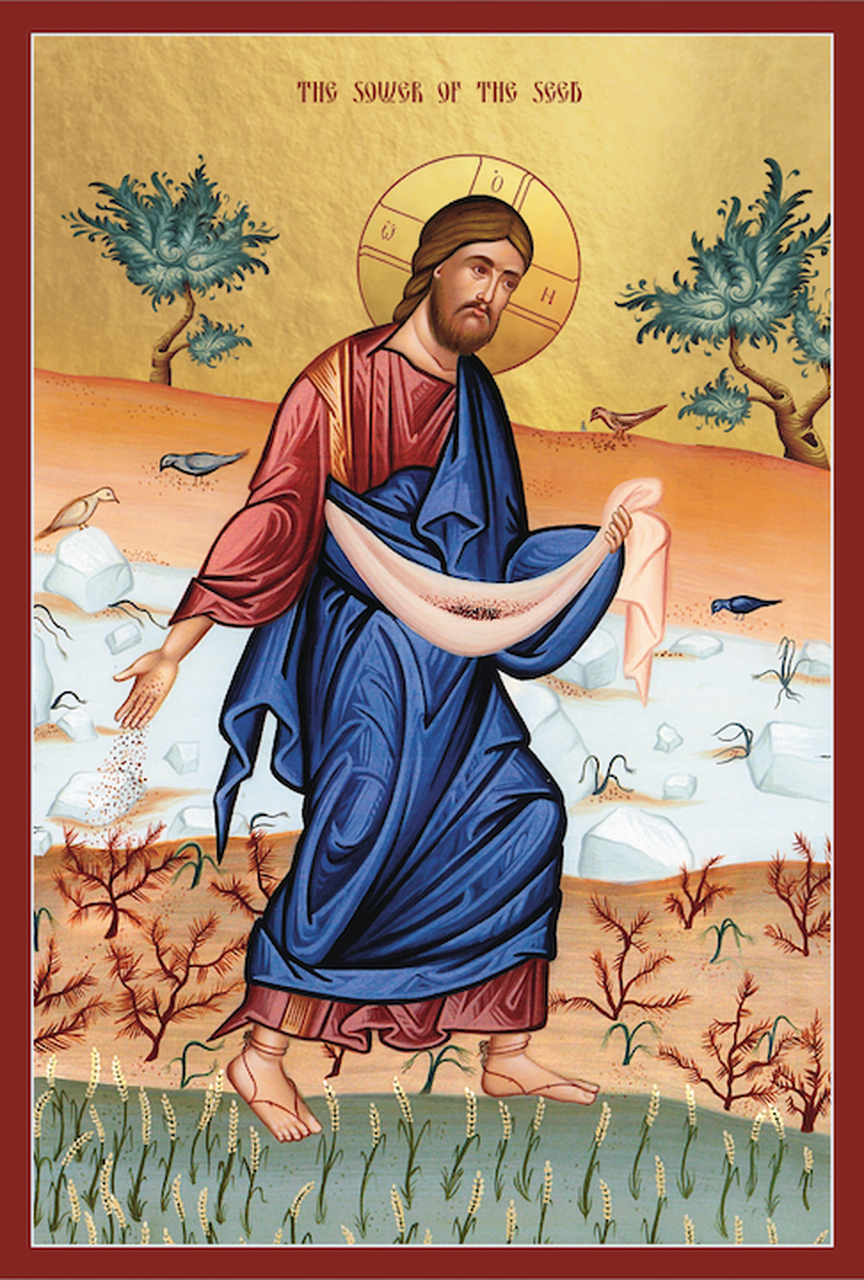


 Todd Decker