Jared and Todd talk about ontological pluralism: What exists? How do we categorize what exists? Are those categories intrinsic or man-made? A related idea is perspectival realism. We discuss the ideas of William Wimsatt and Scott Page, among others. Is reality monistic, dualist, pluralistic? Is the question even meaningful? And what (if any) practical implications would there be?
Outline – Ontological Pluralism
People
William Wimsatt
Scott Page
Johannes Jaeger
Lawrence Cahoone
Spencer Greenberg
Ideas
Rainforest Ontology (Wimsatt)
Realms of Truth (Greenberg)
Perspectival realism
Meta-modernism (post-postmodernism)
Ontologies
Monism
Dualism
Matter
Mind
Trialism (Penrose)
Physical world
Mental world
Platonic mathematical world
Pluralism
Reductionism
Ontological: reality is composed of a minimum number of kinds of entities and substances
Epistemological: reality is best explained by reduction to its most basic kinds of entities and substances
Todd: in-principle epistemological reductionist but not an ontological reductionist. Everything that happens in a physical system evolves according to physical laws but those physical processes don’t constitute all there is.
Can a macro-scale entity really be completely inexplicable in terms of micro-scale entities?
Micro-scale events may only make sense in terms of macro-scale events.
Ex: Enzymes and reactants
Enzyme is larger and more complex than the reactants
The speed of the reaction only makes sense by accounting for the enzyme
But the enzyme is still explained in terms of smaller-scale entities (amino acids, atoms, etc.)
Seven Realms of Truth – Spencer Greenberg
Some things “exist” in the sense that they are in physical reality, like atoms (in “Matter Space”).
Other things may “exist” in the sense that they are real experiences conscious beings have, like the taste of pineapple (in “Experience Space”).
Still, other things may “exist” in the sense that they are shared constructs across multiple minds, like the value of money (in “Consensus Space”).
Other things may “exist” in the sense of being conclusions derived from frameworks or sets of premises, like consequences of economic theories (in “Theory Space”).
Some may “exist” in the sense that they are represented in systems that store or process information, such as the information in a database (in “Representation Space”).
If universal moral truths “exist” (e.g. objective facts about what is right and wrong), then we can talk about moral rules existing (in “Morality Space”).
Finally, if supernatural entities “exist”, such as spirits (meaning that not all beings inhabit Matter Space), then these beings are in a different realm than us (in “Supernatural Space”).
Tropical Rainforest Ontology (Wimsatt)
Contra Quine
Willard van Orman Quine once said that he had a preference for a desert ontology.
Robustness
Criterion for what is real
“Things are robust if they are accessible (detectable, measurable, derivable, defineable, produceable, or the like) in a variety of independent ways.
Local
Criteria used by working scientists
“The nitty-gritty details of actual theory, actual inferences from actual data, the actual conditions under which we poised and detected entities, calibrated and ‘burned in’ instruments, identified and rejected artifacts, debugged programs and procedures, explained the mechanisms behind regularities, judged correlations to be spurious, and in general, the real complexities and richness of actual scientific practice.”
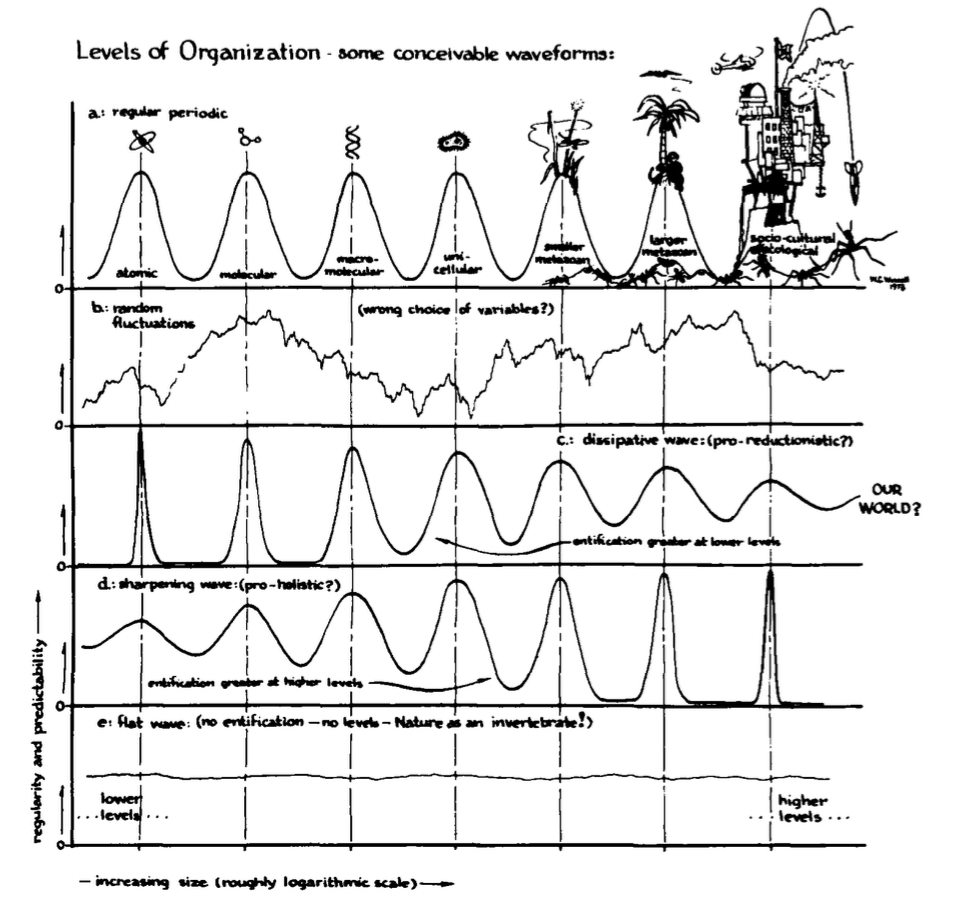
Levels
Dissipative wave (pro-reductionistic)
Sharpening wave (pro-holistic)
Perspectives
“As long as there are well-defined levels of organization, there are relatively unambiguous inclusion or compositional relations relating all of the things described at different levels of organization… But conversely, when neat compositional relations break down, levels become less useful as ways of characterizing the organization of systems–or at least less useful if they are asked to handle the task alone. At this point, other ontological structures enter, either as additional tools, or as a replacement. These are what I have called perspectives–intriguingly quasi-subjective (or at least observer, technique or technology-relative) cuts on the phenomena characteristic of a system,which needn’t be bound to given levels.”
“What I am calling perspectives is probably a diverse category of things which nonetheless appear to have at least some of the properties of being ‘from a point of view’ or to have a subjective or quasi-subjective character.”
Causal Thickets
“This term is intended to indicate a situation of disorder and boundary ambiguities. Perspectives may still seem to have an organizing power (just as viewing a thicket or shrub from different sides will reveal a shape to its bushy confusion), but there will be too many boundary disputes.”
Noether’s theorem is an important theorem that relates invariance of space-time transformations to the laws of conservation: space-translation invariance to the conservation of linear momentum, space-rotation invariance to the conservation of angular momentum, and time-translation invariance to the conservation of energy. The models of physics are point-of-view invariant: physical models cannot depend on any particular position in space or moment in time.
A video version of this episode showing the equations is available on YouTube.
Where do the laws of physics come from? This question is the subtitle of Victor Stenger’s 2006 book Comprehensible Cosmos. I think this question is one version of the more general guiding question of my whole intellectual life: why are things the way they are? Stenger has a very interesting response to this question, which is based on what he calls principle of point-of-view invariance “The models of physics cannot depend on any particular point of view.”
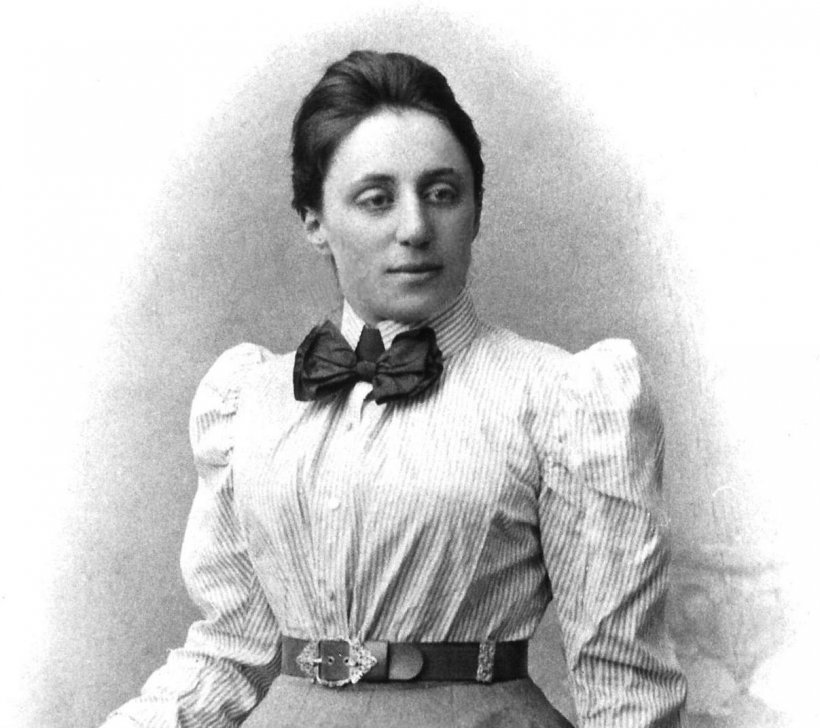
The path from this principle to the laws of physics goes through an important theorem known as Noether’s Theorem. This theorem was developed by Emmy Noether in 1918. Put briefly, the theorem says that symmetries in a system generate conserved quantities. Anyone who’s studied (and remembers) physics will know of the conservation of momentum, conservation of angular momentum, and the conservation of energy. These conservation laws are absolutely foundational. And what’s remarkable is that there’s a reason for them. These conservation laws come from symmetries. The conservation of momentum, angular momentum, and energy come from symmetries of translation, rotation, and time.
Stenger puts it this way: “In any space-time model possessing time-translation invariance, energy must be conserved. In any space-time model possessing space-translation invariance, linear momentum must be conserved. In any space-time model possessing space-rotation invariance, angular momentum must be conserved. Thus, the conservation principles follow from point-of-view invariance. If you wish to build a model using space and time as a framework, and you formulate that model so as to be space-time symmetric, then that model will automatically contain what are usually regarded as the three most important ‘laws’ of physics, the three conservation principles.”
To me this is quite remarkable. But maybe I’m just easily impressed. So I went online to see how others view all this. I looked up on Quora responses to the question:“What is the significance of Noether’s theorem?” Here are some of the responses:
“I think it is almost the thing that makes sense of physics. Physics is based on a large number of conservation rules – conservation of energy, momentum etc. Without Noether’s Theorem, all you can say is that they are conserved – they are just givens. With the Theorem, you can say that they arise from the symmetries of the space we live in. [In] a space which did not have these symmetries… these conservations would be so different from the space we know as to be unrecognizable. It derives the otherwise arbitrary conservation rules from intuitively understood symmetries. Brilliant.” (Alec Cawley)
“Most of fundamental physics could be interpreted as positing a symmetry, then handing that symmetry off to Ms. Noether and asking her to tell us what the resulting physics is. In other words, without Noether’s Theorem, there wouldn’t be most of modern physics.” (Brent Follin, PhD in Theoretical Cosmology)
And my favorite.
“It’s a matter of life and death! Being a Physics student, the Noether’s theorem is extremely important with everything I do. If it were falsified, the whole structure of modern physics would crumble!” (Abhijeet Borkar, PhD in Physics (Astrophysics))
So it’s a pretty big deal. Hopefully that sparks some interest. Now let’s dig into it and see how it works.
Invariance and Transformations
First, let’s revisit this idea of point-of-view invariance. One of the first things you do in a physics problem is define your coordinates. If you’re on the surface of the Earth you usually set one axis pointing up from the center of the Earth. This is what we’re used to thinking of as “up”. That’s because in our everyday experience there pragmatically is an obvious coordinate system to use. There’s an up and a down. But that’s because we reference our everyday experience relative to Earth, which we’re living on. But we know, at least since the Copernican revolution, that this coordinate system isn’t absolute. The Earth isn’t the center of the universe, even if it is the center of our lived experience. But it’s not just that. There is no center of the universe at all. There’s no absolute up or down.
That doesn’t mean that we don’t use coordinates. Of course we do. We have to. But it does mean that the coordinate system we use is not absolute. We’ll usually use one that makes things easy for our calculations. But the system we represent in one coordinate system can also be represented in a different coordinate system.
This is easy to see with vectors. Let’s represent a vector on an x-y Cartesian coordinate system. The vector will start from the origin (0,0) and go out to point (4,3). What’s the magnitude of this vector? We calculate that by the equation:
Now let’s change the coordinate system shifting it 2 to the right and 7 up. Now this same vector starts at (-2,-7) and goes out to (2,-4). What’s the magnitude?
Now let’s go back to the first coordinate system and rotate it 30 degrees counter-clockwise. 30 degrees in radians is π/6 radians. We make this transformation using the rotation matrix
R = [[cos θ,-sin θ], [sin θ, cos θ]]
And multiply R by our vector [[x],[y]].
The result is
Rv = [[x cos θ – y sin θ], [x sin θ + y cos θ]]
Rv = [[3/2 * √(3) – 2], [3/2 * 2 x √(3)]]
Rv = [0.598], [4.964]]
For our transformation θ is π/6 radians. Our new vector coordinates are (0,0) and approximately (0.598,4.964). Now the moment of truth, after all of that. What’s the magnitude? It’s
When we look at this visually, it’s actually not surprising. The vector stays the same in all these cases. It’s just the coordinate system that’s moving around. This is the basic idea of invariance. And I think it gives a general sense about how something can remain constant if it doesn’t depend on these coordinate system transformations.
The Lagrangian
Before getting to Noether’s Theorem itself, we need to talk about the Lagrangian because Noether’s Theorem is expressed in terms of it. The Lagrangian is a function that describes the state of a system and is equal to the difference between the total kinetic energy, T, and the total potential energy, V, of a system.
L = T – V
The Lagrangian is used in Lagrangian mechanics and is a different way of looking at systems than Newtonian mechanics. Instead of looking at forces, as in Newtonian mechanics, in Lagrangian mechanics we’re looking at energies. The Lagrangian is a function of spatial coordinates and their derivatives with respect to time. Spatial coordinates could be the familiar Cartesian x,y,z coordinates but it’s customary to generalize these with a single variable. For example, q. For multiple spatial coordinates we can just number them off, q = {q1, q2,…, qn]. The time derivative of q is, q̇. The time derivative of a spatial coordinate is velocity.
So some of the familiar quantities from Newtonian mechanics will be expressed differently in Lagrangian mechanics. Most notably, momentum. In Newtonian mechanics we express momentum as mass times velocity.
p = mv
To express this in terms of a Lagrangian let’s change v to q̇. So,
p = mq̇
Now the Lagrangian is the difference between kinetic energy and potential energy.
L = T – V
Kinetic energy is
T = 1/2 mv^2
Or
T = 1/2 m q̇^2
So we can rewrite the Lagrangian as
L = 1/2 mq̇^2 – V
Now taking the derivative with respect to q̇
δL/δq̇ = mq̇
And mq̇ = p, so
p = δL/δq̇
And that’s the equation for momentum in terms of the Lagrangian.
p = δL/δq̇
So momentum is the derivative of the Lagrangian with respect to velocity. Also the derivative of the kinetic energy with respect to velocity.
The Hamiltonian
Another function I want to go over before moving on to Noether, and that’s the Hamiltonian function. The Hamiltonian is similar to the Lagrangian, except that it’s the sum of kinetic energy and potential instead of the difference between them.
H = T + V
The Hamiltonian is the total energy of the system. And we can express this in terms of the Lagrangian. Since L = T – V we can express the potential energy as
V = T – L
Substituting this into the Hamiltonian
H = T + V
H = T + (T – L)
H = 2T – L
H = 2(1/2 mq̇^2) – L
H = (mq̇)q̇ – L
Since p = mq̇
H = pq̇ – L
And since also p = δL/δq̇
H = (δL/δq̇)q̇ – L
This is the expression for the total energy in terms of the Lagrangian.
H = (δL/δq̇)q̇ – L
The Lagrange-Euler Equation of Motion
One more equation we should introduce before getting into Noether’s theorem is the Lagrange-Euler equation, also called the equation of motion. This has the form
d/dt (δL/δq̇) = δL/δq
What is this equation saying? Let’s translate this out of the Lagrangian form into the more familiar Newtonian quantities. An equivalent form of this equation is:
dp/dt = -δV/δq = F
d(mv)/dt = F
ma = F
This is Newton’s second law. It’s just expressed in a different form with the Lagrangian, which again is:
d/dt (δL/δq̇) = δL/δq
We’ll be plugging this equation into a lot of things in the foregoing so it’s important.
Noether’s Theorem
Now, let’s move to Noether’s theorem. We’ll look at Noether’s theorem for the conservation of momentum, the conservation of angular momentum, and for the conservation of energy.
We start with the Lagrangian as a function of position, q, and velocity, q̇.
L(q, q̇)
What we’re going to do is apply the following transformation on q and q̇.
q → q(s)
q̇ → q̇(s)
If our Lagrangian has symmetry it should not change under this transformation to s. Expressed mathematically this means
d/ds L(q(s), q̇(s)) = 0
Let’s propose that under this transformation that there is a conserved quantity, C, of the following form:
C = (δL/δq̇)(δq/δs)
And since it is a conserved quantity it does not change over time. That is
dC/dt = 0
And here’s the proof for that. Take the proposed conserved quantity C and take the time derivative of it.
C = (δL/δq̇)(δq/δs)
dC/dt = d/dt ((δL/δq̇)(δq/δs))
Since we have two variables, q and q̇, we need to apply the product rule:
Now, recall the Euler-Lagrange equation of motion.
d/dt (δL/δq̇) = δL/δq
We’re going to plug that in here to get.
dC/dt = (δL/δq)(δq/δs) + (δL/δq̇)(δq̇/δs)
What do we have here? The right hand side of this equation is what we get when we apply the chain rule to the derivative of the Lagrangian with respect to s.
So what’s been proved here is that if the Lagrangian, L, does not change with respect to transformation, s, than the conserved quantity, C, doesn’t either.
That’s Noether’s Theorem. Now let’s look at some applications, examples of conserved quantities that result from different symmetries.
Conservation of Linear Momentum
To get the conservation of linear momentum we’re going to say that the Lagrangian is symmetric under continuous translations in space. Our spatial coordinates are
q = {q1, q2,…, qn].
And we’ll apply the transformation
q → q(s)
where
q(s) = q + s
So we’re just sliding our coordinate system over by an interval, s.
The conserved quantity C is
C = (δL/δq̇)(δq/δs)
Taking the derivative of q with respect to s
δq/δs = δ/δs (q + s) = 1
So C becomes
C = (δL/δq̇) = p
Which is momentum. So when we apply the spatial transformation
q à q(s)
The conserved quantity, C, is momentum, p. In other words, the conservation of momentum results from symmetry in space. To give some interpretation, this means that the system has no dependence on where it is in space. It’s not being acted upon by any external forces. If there were an external force then it would depend on it’s location in space.
Recall that force is equal to
F = ma
F = m(dv/dt)
F = d/dt (mv)
F = dp/dt
Force is equal to the rate of change in momentum with respect to time. So clearly if there is a non-zero external force acting on the system momentum is not constant.
If there is an applied force external to the system, like with a spring, then momentum is obviously not conserved. And with such forces location makes a difference. With a spring it matters how much the spring is stretched. So momentum is not conserved in such cases where there’s not symmetry in space for that system. But in systems that do have symmetry in space, momentum is conserved.
Conservation of Angular Momentum
To get the conservation of angular momentum we’re going to say that the Lagrangian is symmetric under continuous rotations in space.
We apply the transformation.
q → q(s)
In which case s is some angle of rotation. This is a two-dimensional case where q is represented by the matrix
[[q1],[q2]]
We make this transformation using the rotation matrix
That’s from Taylor’s series expansion to the first order. This makes the rotation matrix is equal to
[[1, -s], [s, 1]]
So the transformation is
[[1, -s], [s, 1]] * [[q1],[q2]]
The result of this transformation is that
q1 → q1 – s * q2
q2 → q2 + s * q1
For reasons that will be clear shortly, let’s differentiate these.
dq1/ds = -q2
dq2/ds = q1
Now let’s bring in our conserved quantity, C
C = (δL/δq̇)(δq/δs)
And since
q = {q1,q1}
C = (δL/δq̇1)(δq1/δs) + (δL/δq̇2)(δq2/δs)
Or in terms of momentum, p
C = p1 * (δq1/δs) + p2 * (δq2/δs)
The derivatives in this equation are equal to the derivatives we just calculated for q1(s) and q2(s). So, plugging those in:
C = q1 * p2 – q2 * p1
And this is equal to the cross product
C = q x p
Which is angular momentum L. Angular momentum is equal to the cross product of linear momentum and the position vector. So
C = L
The conserved quantity, C, is angular momentum, L. In other words angular momentum results from symmetry of rotation. To give some interpretation again, this is the condition in which the system has no external rotational forces, i.e. torque. To use the example of a spring again, if this were a system where we’re winding up a torsion spring then angular position very much matters. The tighter we wind it up the higher the torque. In that kind of system angular momentum is not conserved. But in the absence of that kind of torque, angular position and rotation don’t matter. So angular momentum is conserved.
Conservation of Energy
To get the conservation of energy we’re going to say that the Lagrangian is symmetric in time. So we have our Lagrangian
L(q, q̇)
And we’re going to say that it doesn’t change with time
dL/dt = 0
Let’s see what follows from this. First let’s to the derivative of the Lagrangian with respect to time. To do this we apply the chain rule.
So we can plug that in to get this more compact result:
dL/dt = d/dt (q̇ * (δL/δq̇))
Rearranging we get:
0 = d/dt (q̇ * (δL/δq̇) – L)
Maybe this looks familiar. Recall that the Hamiltonian, which is equal to the sum of kinetic and potential energy has the following form, expressed in terms of the Lagrangian.
H = (δL/δq̇)q̇ – L
So we can plug this into our equation to get
d/dt (H) = 0
Let’s go ahead express this in terms of kinetic energy, T, and potential energy, V.
H = T + V
d/dt (T + V) = 0
So from our starting condition
dL/dt = 0
We get
d/dt (T + V) = 0
If we set the condition where the Lagrangian doesn’t change with time then the total energy is conserved. This is the Noether symmetry-conservation relation.
What would it be like if things weren’t this way? Under time symmetry things like the gravitational constant and the masses of fundamental particles are constant across time. What if they weren’t? An object elevated above the Earth’s surface has potential energy
V = mgh
Where m is mass, g is acceleration due to gravity, and h is height. Acceleration due to gravity is a function of the gravitational constant G.
g = – GM/r^2
Where M is the mass of the gravitational field source, like the Earth, and r is the distance from the center of the Earth. For the elevated object in our example, none of these values is changing. But what if we could change the gravitational constant G? Say we increase it. Now acceleration due to gravity, g, is higher and potential energy, V, is higher. We’ve created energy from nowhere.
Or another example. At one moment in time you throw a ball up into the air with a certain velocity. So it starts off with a kinetic energy that gets converted to potential energy as it goes up into the sky. But then right as it reaches its highest point you turn the gravitational constant, G, way up and the ball slams to the ground at a much faster velocity than you started with. Again, we’ve created energy from nowhere.
But that doesn’t happen because the laws of physics don’t change over time.
Philosophical reflections
If you were to create a universe how would you do it? I don’t know how to create a universe but if I did my inclination would be to make it as self-designing as possible. Set a few basic rules and let things develop from there. This seems to be the most efficient and elegant way to configure things. I think what makes Noether’s Theorem so marvelous is that we get a great deal of purchase from a rather simple principle: symmetry.
This reminds me a little of what Immanuel Kant tried to do in his moral philosophy. In his 1785 Groundwork of the Metaphysics of Morals he proposed that all moral principles could be derived from one master principle, called the categorical imperative, which was the following:
“Act only according to that maxim whereby you can, at the same time, will that it should become a universal law.”
This is also known as the principle of universalizability. This reminds me of Noether’s Theorem in two ways. First, it’s a simple principle from which others can be derived. Second, it’s a principle of universalizability. We could say that Kant is making his ethics point-of-view invariant. I should act only according to a maxim that could be a universal law, that is not only applicable to me, but to anyone. That’s what it means for it to be universalizable.
In Comprehensible Cosmos Victor Stenger also proposed a principle of universalizability, but for physics. “The models of physics cannot depend on any particular point of view.” That’s the principle of point-of-view invariance. Stenger says of this principle:
“Physics is formulated in such a way to assure, as best as possible, that it not depend on any particular point of view or reference frame. This helps make possible, but does not guarantee, that physical models faithfully describe an objective reality, whatever that may be… When we insist that our models be the same for all points of view, then the most important laws of physics, as we know them, appear naturally. The great conservation principles of energy and momentum (linear and angular) are required in any model that is based on space and time, formulated to be independent of the specific coordinate system used to represent a given set of data. Other conservation principles arise when we introduce additional, more abstract dimensions. The dynamical forces that account for the interactions between bodies will be seen as theoretical constructs introduced into the theory to preserve that theory’s independence of point of view.”
Sort of like Kant’s principle of universalizability, point-of-view invariance keeps us honest. Repeatability of experiments by multiple observers, holding constant only those factors relevant to the experiment, is what ought to finally convince others of the validity of our observations. It won’t do much good if I have a singular experience that only I observe that, in other words, is not universalizable, not point-of-view invariant, but rather strictly tied to me and my point of view. That’s not to say that we don’t have private, subjective experiences that are real. They’re just phenomena of a different nature. Here’s more from Stenger on this point:
“So, where does point-of-view invariance come from? It comes simply from the apparent existence of an objective reality—independent of its detailed structure. Indeed, the success of point-of-view invariance can be said to provide evidence for the existence of an objective reality. Our dreams are not point-of-view invariant. If the Universe were all in our heads, our models would not be point-of-view invariant. Point-of-view invariance generally is used to predict what an observer in a second reference frame will measure given the measurements made in the first reference frame.”
I think that’s well put. And that line that “Our dreams are not point-of-view invariant” is one I think about a lot.
Noether’s Theorem is absolutely foundational. It’s been said that Noether’s theorem is second only to the Pythagorean theorem in its importance for modern physics. It’s remarkable that just one, compact principle can produce so much of what we observe in the world.
Reference Material
Baez, J. (2020b, February 17). Noether’s Theorem in a Nutshell. University of California, Riverside. Retrieved March 25, 2022, from https://math.ucr.edu/home/baez/noether.html
Christianity has many unknowns, which makes possible many differing beliefs. This can be discouraging. There are limits in the extent of our reasoning, something Immanuel Kant explored in his theory of antinomies. And there are limits in the answers resolvable in scripture, in response to which Pseudo-Dionysius admonished that theology must remain within the bounds of revelation. But the unknowns need not stop us from knowing God. Key is to persist in way of holiness and nurture a life with the Holy Spirit.
Anyone familiar with a religion will have noticed that there are a lot of disagreements. Every religion has multiple versions even if they share common origins and common sacred texts. Christianity is replete with unknowns, which makes possible multiple interpretations as different people try to fill in the gaps. These differences are not only over minor matters but concern even the most fundamental doctrines like the nature of God, Jesus Christ, and the process of salvation. With so much underdetermined how is it possible to know God and follow him? I’ve been thinking about this a lot and I don’t know of any way to answer all the unknowns. But I do think that even with many unknowns it is nevertheless possible to know God and to follow him. The unknowns don’t need to be a cause for despair.
My original working title for this episode was “theological antinomies and apophatic theology”. I’ll explain what those terms mean in short order. But I scrapped that title for a few reasons. For one thing, it’s kind of alienating and pretentious. And I also don’t really want to endorse apophatic theology wholesale. Still it’s the title that got the wheels turning. And that was by putting two important thinkers into imaginary dialogue with each other: Pseudo-Dionysius and Immanuel Kant. The reason for doing that was to think through how to persist in the joyful celebration of the ideas of Christianity even in light of the many unknowns that remain unresolved.
Pseudo-Dionysius was a philosopher and Christian theologian in the 5th or 6th century. He’s called Pseudo-Dionysius because in his texts he takes on the persona of Dionysius the Areopagite, a 1st century disciple of Paul. He wasn’t that Dionysius, so we just call him Pseudo-Dionysius. The texts I’ve been reading are On the Divine Names and The Mystical Theology. These are very significant works in the history of Christian philosophy. His theology is a standard case of apophatic theology. Apophatic theology is also called “negative theology”. Rather than make statements about the way things are it makes statements about the way things are not.
Immanuel Kant was a German philosopher who lived from 1724 – 1804. Kant’s greatest work was his 1781 Critique of Pure Reason. In the Critique Kant came up with a very interesting model for the way that the mind works and how we reason. What’s most relevant in it to my topic here is his notion of antinomies. An antinomy is a contradiction between beliefs or conclusions that are each in themselves reasonable. Kant proposed that it is part of our human nature to try to understand things beyond the limits of what reason can establish. And so our reasoning eventually leads us into antinomies. Kant’s antinomies had to do with the finitude or infinitude of time and space, the existence of fundamental, indivisible substances, causality versus spontaneity, and the existence of necessary being. Those all have some overlap with theological ideas but I don’t want to focus on Kant’s particular antinomies but rather this general idea that as we continue reasoning about things we eventually run into antinomies that, for one reason or another, we’re not able to resolve.
Dionysius wasn’t addressing the same problem of antinomies that Kant was but I think his thought is applicable to it. Here’s my basic idea. Christians devote themselves to God in many ways; through obedience, sacrifice, prayer, song, art, service, love, and through study. Theology is a rational study of God and of the religion. But since it is a rational activity it’s susceptible to the kinds of antinomies that Kant talked about. As we push further and further in our thinking about God and religion we reach limits that are intrinsic to the reasoning process itself. Also in the case of theology we come up against the limits of the finitude of revelation, in at least two ways. First, the scriptures just don’t answer all the questions we want to ask. And second, different parts of the scriptures lead us to different answers. You might say that the scriptures themselves contain antinomies.
One classic example of this is in regards to the godhood of the Father, Son, and Holy Spirit. This is the theological topic of the Trinity. Take the following ideas:
The Father is God. The Son is God. The Holy Spirit is God. The Father is not the Son. The Son is not the Holy Spirit. The Holy Spirit is not the Father. There is only one God.
We can find scriptures to support all of those. But it’s pretty apparent that this just doesn’t all fit together very nicely. There’s something unusual going on here. There’s been a lot of theology on this topic and I think a lot of it has been quite productive, even if indirectly. For example, the philosopher Joseph Koterski made the case that the philosophical concept of a “person” as understood in natural law theory arose in large part over the intellectual effort to make sense of this Trinitarian puzzle (Koterski, Natural Law and Human Nature. 2002). And that’s useful. Still, I can’t say that any theology has ever resolved the puzzle. And to be fair, it’s usually understood to be a holy mystery anyway, one that we can’t resolve, which is a bit like a Kantian antinomy.
Dionysius’s apophatic approach was to forebear from theorizing and even to deny any particular positive theological formulations. It reminds me a bit of twentieth century deconstruction, though it’s of course rather different in its underlying motivations. Dionysius had a keen sense of the way many religious ideas go beyond our capabilities to understand through our reason. And that was one reason for his apophatic approach. But he was also especially sensitive to our reliance on scripture. For example, here’s a passage from the opening paragraph of On The Divine Names:
“And here also let us set before our minds the scriptural rule that in speaking about God we should declare the Truth, not with enticing words of man’s wisdom, but in demonstration of the power which the Spirit stirred up in the Sacred Writers, whereby, in a manner surpassing speech and knowledge, we embrace those truths which, in like manner, surpass them, in that Union which exceeds our faculty, and exercise of discursive, and of intuitive reason.”
So that’s the first motivation, that these truths exceed our faculty and exercise of discursive and intuitive reason. Continuing on:
“We must not then dare to speak, or indeed to form any conception, of the hidden super-essential Godhead, except those things that are revealed to us from the Holy Scriptures.”
And there’s the kicker. I think that’s the even bigger issue for Dionysius. He is very sensitive to our dependence on revelation.
We might ask here, was Dionysius always true to his own standards? In my assessment he was not. He actually made a lot of positive assertions in his writings that were not based in revealed scripture but rather in Neoplatonist philosophy. That’s not to say those assertions were wrong. They might be correct. I find Neoplatonism rather compelling and attractive. But I also think it tends to make God look too impersonal and inaccessible, which is exactly the opposite of what a life with the Holy Spirit presupposes. So he wasn’t perfect or perfectly consistent. But I find him an interesting and valuable thinker. And his standards were good ones.
One more passage from Dionysius:
“For a super-essential understanding of It is proper to Unknowing, which lieth in the Super-Essence Thereof surpassing Discourse, Intuition and Being; acknowledging which truth let us lift up our eyes towards the steep height, so far as the effluent light of the Divine Scriptures grants its aid, and, as we strive to ascend unto those Supernal Rays, let us gird ourselves for the task with holiness and the reverent fear of God. For, if we may safely trust the wise and infallible Scriptures, Divine things are revealed unto each created spirit in proportion to its powers, and in this measure is perception granted through the workings of the Divine goodness, the which in just care for our preservation divinely tempereth unto finite measure the infinitude of things which pass man’s understanding.” (On The Divine Names 1:1)
This is great stuff. I think this is consummate theology right here. Dionysius is exceedingly astute and a gifted philosopher and that’s wonderful, but even more important to his success as a theologian is his piety, his humility, and his reverence for God. I think that makes a huge difference. It’s one thing for an intelligent person to be able to expertly articulate the fine details of a theological theory. But in the words of Paul, if he doesn’t have the pure love of Christ it’s like sounding brass or a tinkling cymbal (1 Corinthians 13:1).
It’s important not to claim to know more than we do. It’s alright, actually admirable to acknowledge the unknowns, the limits of our knowledge. It’s an act of reverence for God to acknowledge that we are dependent on his revealed word and that he has chosen not to reveal answers to all of our theological and doctrinal questions. But what is critical in the life of faith is to know God in a personal way. Something I consider indispensable and irreplaceable in religious life is direct communication with the Spirit. It’s crucial to remember that God the Father, Jesus Christ, and the Holy Spirit are persons and that we come to know persons through personal encounters. Our personal encounters with people don’t give us exhaustive knowledge about them in every possible detail. In my relationships with human beings there’s a ton of information that I don’t know about them. It would certainly be valuable to know more about them in that manner. But ultimately that’s not what it means to have a personal relationship.
The Holy Spirit is the indispensable gift in the life of a Christian. Jesus said:
“If you love Me, keep My commandments. And I will pray the Father, and He will give you another Helper, that He may abide with you forever—the Spirit of truth, whom the world cannot receive, because it neither sees Him nor knows Him; but you know Him, for He dwells with you and will be in you. I will not leave you orphans; I will come to you… These things I have spoken to you while being present with you. But the Helper, the Holy Spirit, whom the Father will send in My name, He will teach you all things, and bring to your remembrance all things that I said to you. Peace I leave with you, My peace I give to you; not as the world gives do I give to you. Let not your heart be troubled, neither let it be afraid.” (John 14:15-18.25-27) A life with the Holy Spirit is a life of keeping the commandments and of prayer. The Holy Spirit is sent to bring the words of Christ to remembrance and to give peace. This is a life of a personal relationship with God.
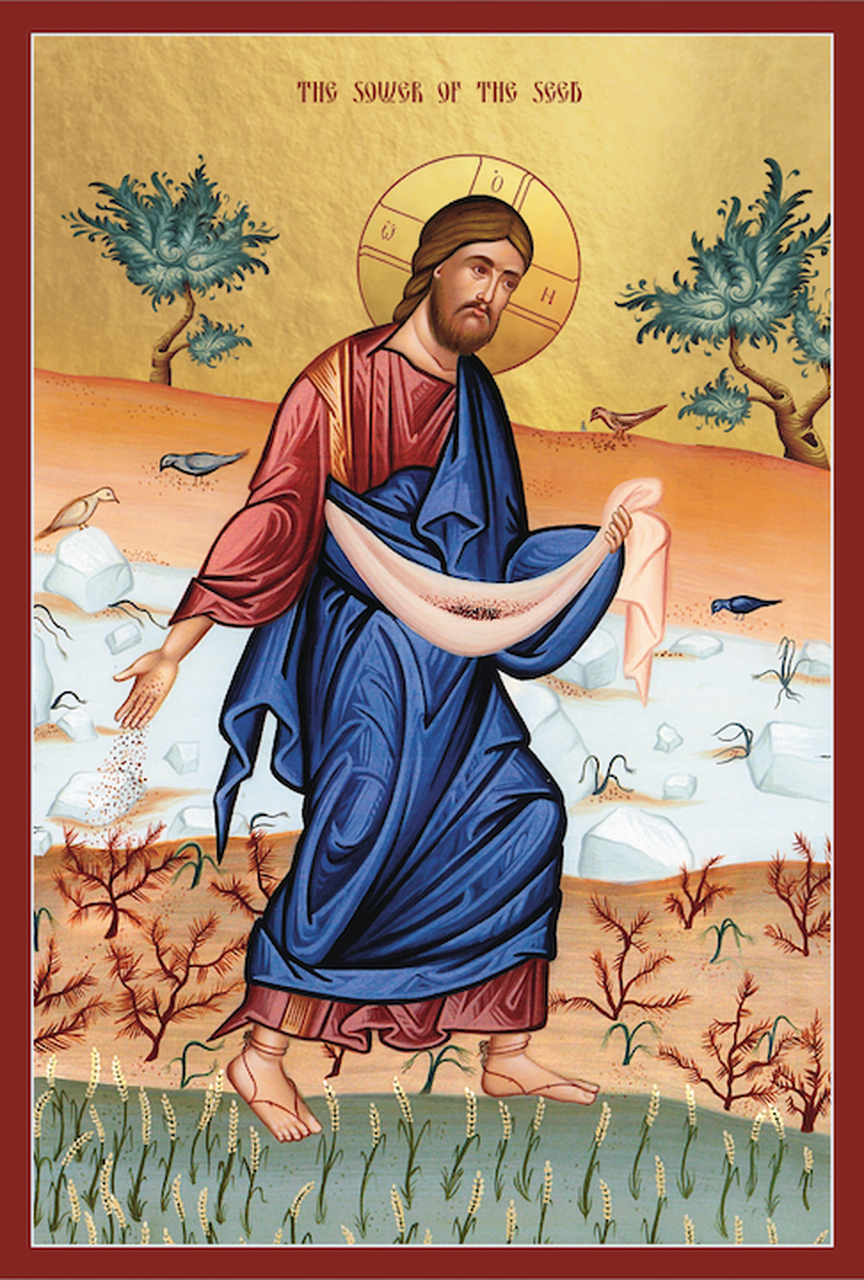
“There went out a sower to sow.” In his parable of the sower Jesus gives various active and passive roles: sower, seed, good soil, soil among thorns, stony ground, and waysides. This meditation on Mark 4 considers the seed as the word and the Word Christ, our receptivity to Christ, how he can enter, germinate, grow, and transform us into new creatures.
One of the Church’s greatest theologians, Thomas Aquinas (1225 – 1274) was an astonishingly prolific writer. He’s especially known for his Summa Theologiae, which is one of my first go-to theology resources. His style was analytic and detailed. Each of the “Questions” in the Summa reads like a geometrical proof out of Euclid, each with some assertion, supporting points, counter-assertions, and detracting points, and a conclusion. It was a masterful intellectual achievement. Yet near the end of his life Aquinas had a mystical experience that seemed to lead him away from that stage of life and into another. He was no longer able to write, not out of physical incapacity but because of the greatness of his revelation. He felt his writings, great as they were, couldn’t possibly match the greatness of the revelation he had been given. The direct experience of his revelation transcended the rationality of this most rational of thinkers. That’s a sobering thought, still, I’m inclined to think of this overwhelming experience of his as a reward for all the work that he had done in a previous stage of life. His mystical stage, if we can call it that, only lasted a few months since he died shortly after. But it’s something I think about a lot. The analytical, rational stage of the adult in his younger and middle ages, succeeded by a later super-rational, mystical stage. Something about that seems quite appropriate. I approach religion and scripture in that very analytical, rational way. It’s just more natural for me right now. But I wouldn’t be surprised or at all disappointed if that changed at some point. As satisfying as the intellectual nature of theology is, the infusion of the Spirit is so much greater. I spoke in a previous episode about a life with the Holy Spirit. Those moments of spiritual elevation are invaluable.
On this subject I’d like to share a meditation Mark 4, a chapter in which we read of Jesus’s parable of the sower, a masterful parable. I’d like to focus on two aspects of it: (1) the seed and (2) the soil. When Jesus explained the parable of the sower to his disciples he said that the seed was “the word”; “The sower soweth the word.” (Mark 4:14). For readers familiar with John’s gospel this can have at least a double meaning: (1) the word of the Gospel, the words that people speak to preach the message, and (2) the Word, Logos, is also Christ himself (John 1:1-3).
Another story about Thomas Aquinas. One day while Aquinas was in prayer before the crucifix the voice of Christ called out to him and said, “You have written well of me, Thomas. What reward will you receive from me for your labor?” And Aquinas answered, “Lord, nothing except you.”
I love the Christmas hymn “O Little Town of Bethlehem”, especially this verse:
“O holy Child of Bethlehem, descend to us, we pray, cast out our sin and enter in, be born in us today.”
I thought about this a lot this past Christmas. I tried to put myself in Mary’s state of mind as one who receives and carries the Lord himself within her body. She declared so much with that statement, “Behold the handmaid of the Lord” (Luke 1:38). I think it’s powerful – also for men, who probably aren’t used to thinking in this way – to think of being the mother Mary, bearing God in her body. It’s one vivid image of something that the scriptures and the ritual practices of the Church communicate in various ways, the Eucharist for example: that we are to take Christ into ourselves and allow him to transform us into new creatures.
This is how I think about the seeds in Jesus’s parables. The seed is “the word”, the message of the Gospel, as well as “the Word”, Christ himself.
In the parable of the sower, the sower plays the active role. “Behold, there went out a sower to sow” (Mark 4:3). He is the one sowing the seeds. By the time the sower passes by the soil is either ready or it isn’t. The soil is passive but its condition makes all the difference.
“And it came to pass, as he sowed, some fell by the way side, and the fowls of the air came and devoured it up. And some fell on stony ground, where it had not much earth; and immediately it sprang up, because it had no depth of earth: But when the sun was up, it was scorched; and because it had no root, it withered away. And some fell among thorns, and the thorns grew up, and choked it, and it yielded no fruit. And other fell on good ground, and did yield fruit that sprang up and increased; and brought forth, some thirty, and some sixty, and some an hundred. And he said unto them, He that hath ears to hear, let him hear.” (Mark 4:4-9)
Let’s talk first about the active role of the sower. One of the things that strikes me about moments of spiritual revelation is that they don’t happen whenever we want them to. They come as a gift of grace. That’s because they’re not manufactured. And they’re not the product of an individual. Rather, they are special encounters between us and Spirit. The Spirit, as the other person in these encounters, has to decide to participate. The philosopher Martin Buber (1878 – 1965) called this an “I-You” encounter. He contrasted this with the “I-It” experience in which a person can individually and unilaterally perceive and consider objects, ideas, and people in a way that doesn’t require another’s free participation. Basically, how we live most of the time. But our lives are sometimes interrupted by encounters of a different kind. And he says these come by “grace”:
“The You encounters me by grace–it cannot be found by seeking. But that I speak the basic word to it is a deed of my whole being, is my essential deed. The You encounters me. But I enter into a direct relationship to it. Thus the relationship is election and electing, passive and active at once: An action of the whole being must approach passivity, for it does away with all partial actions and thus with any sense of action, which always depends on limited exertions. The basic word I-You can be spoken only with one’s whole being. The concentration and fusion into a whole being can never be accomplished by me, can never be accomplished without me. I require a You to become; becoming I, I say You. All actual life is encounter.” (Martin Buter, I and Thou, 61)
What’s crucial to understand is that the Father, Son, and Holy Ghost are persons. We can’t manufacture encounters with persons on our own. It requires the full cooperation of the other person. The Holy Ghost needs to act. And that happens when he chooses. But we can act to be receptive and prepare ourselves. We are the soil and we can condition ourselves as soil to receive Christ.
Jesus interpreted the parable for his disciples in this way:
“The sower soweth the word. And these are they by the way side, where the word is sown; but when they have heard, Satan cometh immediately, and taketh away the word that was sown in their hearts. And these are they likewise which are sown on stony ground; who, when they have heard the word, immediately receive it with gladness; And have no root in themselves, and so endure but for a time: afterward, when affliction or persecution ariseth for the word’s sake, immediately they are offended. And these are they which are sown among thorns; such as hear the word, And the cares of this world, and the deceitfulness of riches, and the lusts of other things entering in, choke the word, and it becometh unfruitful. And these are they which are sown on good ground; such as hear the word, and receive it, and bring forth fruit, some thirtyfold, some sixty, and some an hundred.” (Mark 4:14-20)
A lot here to think about. One part that stands out to me at the moment is the case of the seeds sown among thorns. The thorns are “the cares of this world, and the deceitfulness of riches, and the lusts of other things”. These create unfruitful conditions. To be fruitful it is necessary to be set apart from these things. Some Christians throughout history have applied this kind of setting apart in a physical sense, actually taking up a monastic life. But I think what’s most important is to apply this existentially, to be set apart from the world in the way we live and in our way of being. Especially in the things we care about.
Following Christ is not a light matter and Jesus made this clear.
“And it came to pass, that, as they went in the way, a certain man said unto him, Lord, I will follow thee whithersoever thou goest. And Jesus said unto him, Foxes have holes, and birds of the air have nests; but the Son of man hath not where to lay his head. And he said unto another, Follow me. But he said, Lord, suffer me first to go and bury my father. Jesus said unto him, Let the dead bury their dead: but go thou and preach the kingdom of God. And another also said, Lord, I will follow thee; but let me first go bid them farewell, which are at home at my house. And Jesus said unto him, No man, having put his hand to the plough, and looking back, is fit for the kingdom of God.” (Luke 9:57-62)
Wow! Clearly the kind of life Jesus requires is quite different from the way normal people live. In thinking about these verses it makes me reflect on the things I care about and whether they enable or impede my receptivity to the Holy Spirit. Jesus warns about the cares of the world. The Greek for “care” is μέριμνα (mérimna). The corresponding verb is μεριμνάω (merimnao): to be anxious or worried about something. It’s used several times in the following passage from the Sermon on the Mount:
“Therefore I say unto you, Take no thought [μὴ μεριμνᾶτε, me merimnate] for your life, what ye shall eat, or what ye shall drink; nor yet for your body, what ye shall put on. Is not the life more than meat, and the body than raiment? Behold the fowls of the air: for they sow not, neither do they reap, nor gather into barns; yet your heavenly Father feedeth them. Are ye not much better than they? Which of you by taking thought [μεριμνῶν, merimnon] can add one cubit unto his stature? And why take ye thought [μεριμνᾶτε, merimnate] for raiment? Consider the lilies of the field, how they grow; they toil not, neither do they spin: And yet I say unto you, That even Solomon in all his glory was not arrayed like one of these. Wherefore, if God so clothe the grass of the field, which to day is, and to morrow is cast into the oven, shall he not much more clothe you, O ye of little faith? Therefore take no thought [μὴ οὖν μεριμνήσητε, me oun merimnesete], saying, What shall we eat? or, What shall we drink? or, Wherewithal shall we be clothed? (For after all these things do the Gentiles seek:) for your heavenly Father knoweth that ye have need of all these things. But seek ye first the kingdom of God, and his righteousness; and all these things shall be added unto you. Take therefore no thought [μὴ οὖν μεριμνήσητε, me oun merimnesete] for the morrow: for the morrow shall take thought [μεριμνήσει, merimnese] for the things of itself. Sufficient unto the day is the evil thereof.” (Matthew 6:25-34)
Do we need food, drink, and clothing? Yes, Jesus said as much. “Your heavenly Father knoweth that ye have need of all these things.” But he said not to seek after them. And this interesting, he says that seeking after food, drink, or clothing is what the Gentiles do. Gentiles are those who have not entered into the covenant. The Gentile way of life is a completely different way of life, and really the normal way of life. But it’s not the way of Jesus. Jesus said these cares “choke the word, and it becometh unfruitful”.
Jesus explained the good soil represents people who “hear the word, and receive it”. And again, I like to consider the double meaning in which the Word here is also Christ himself. The good soil receives Christ. Christ enters into it, germinates, and grows. Like with Mary, the God-Bearer, the Spirit can enter into us and Christ can abide in us. This reception is also mutual abiding. We abide in Christ and he abides in us. In the Trinity this kind of relation is sometimes called interpenetration and a similar kind of mutual abiding and interpenetration is happening here:
“Abide in me, and I in you. As the branch cannot bear fruit of itself, except it abide in the vine; no more can ye, except ye abide in me. I am the vine, ye are the branches: He that abideth in me, and I in him, the same bringeth forth much fruit: for without me ye can do nothing.” (John 14:4-5)
I believe this is ultimately what Christian holiness looks like. Understanding, yes. By all means. Learn the doctrine, study the principles, develop a sophisticated philosophical and theological understanding. I think that’s appropriate and good, especially for certain periods of life. But beyond that is this direct receptivity to the Spirit and this planting of Christ into the core of our being to be transformed into new creatures.



 Todd Decker