A Second Look at Religion

It’s undeniable that living in a secular age brings significant challenges to belief in God and to religious practice. And it’s understandable. Still, there are reasons to give it a second look, or maybe a new first look with a fresh perspective.

I’ve titled this episode “A Second Look at Religion”, which is a kind of working title I’ve been sitting with to express an idea I’ve had bouncing around in my head for a while. The idea being that religion deserves a second look and to express that to people who might doubt it or think otherwise. And why might people think otherwise? Well, I think it’s hard to deny that we live in a secular age. This isn’t new. We’ve been in a secular age for several centuries, though its reach may be expanding and more people may be aware of it. The philosopher Charles Taylor talked about this in his book A Secular Age and referred to this kind of secularism as a condition where religious belief is no longer axiomatic, or just a given. It’s possible to imagine not believing in God. And that’s certainly the world we live in. Even for religious people believing in God is not just a given. We’re at least aware that there are other options. And we know many people who take up the other options. And we can’t realistically just ignore that. Or at least it wouldn’t be very healthy, certainly not healthy for our relationships. We have to find ways of talking to each other even with differing world views.

I think it’s best for people to work to reach each other from both sides. But since I’m a religious person I take up the burden to try and relate to secular people and to translate ideas into terms that make more sense in a secular framework. In a previous episode with Mike on object-oriented theology we talked about this idea of “porting” concepts into different frameworks. I think that’s a fascinating process. And I’m far from knowing how to do that really. I’m in the middle of this, what I expect to be a lifelong process. And I get a lot of inspiration from Paul. Paul was a fascinating cosmopolitan figure, living in a cosmopolitan world. A diaspora Jew from Tarsus, not Judea, well-spoken in Greek and well-versed in Greek thought, rhetoric, and ideas. And focused primarily on a Greek audience. He was able, quite self-consciously, to be different things to different people. He told the Corinthians that to the Jews he became as a Jew, to those under the law as one under the law, to those outside the law as one outside the law (1 Corinthians 9:20-21).

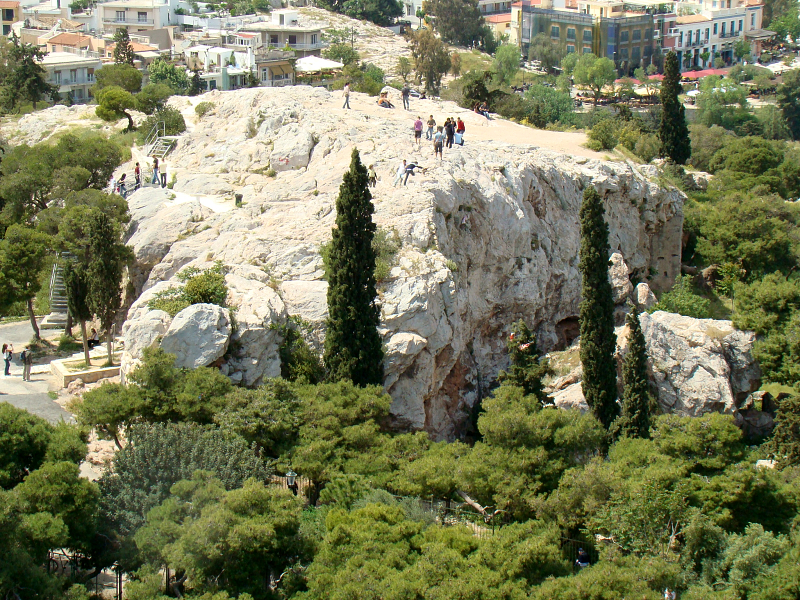
One of my favorite examples of Paul’s Hellenic porting of the God of Israel was on Mars Hill in Athens, where he referenced and appropriated a number of ideas from Greek thinkers and Greek thought (Acts 17:28). For example, he said:

“In him, therefore, we live and move and have our being.” This line is probably associated with Posidonius (135 BC – 51 BC). Also sometimes attributed to Epimenides (7th or 6th century BC).

Paul also quotes this line: “For we too are his offspring,” which he got from Aratus (315 BC/310 BC – 240 BC), a Greek poet from Cilicia who was educated as a Stoic.

I just think this is a fascinating method from Paul. He certainly knew the Hebrew scriptures. And he knew them in the Greek of the Septuagint translation. And he certainly quoted them and interpreted them frequently. But here he went even farther and expressed his ideas in terms that he translated not only linguistically but culturally. I find that wonderfully inspiring.

So anyway, I think the corollary today, to what the Greeks were to Paul, is the secular age. That is the wider world that religion in general and Christianity in particular comes into contact with. And maybe these are incommensurable but I don’t think so.

One of the first things I think I should say as a Christian is, “I get it.” I get the reasons why religion and Christianity can be hard pills to swallow in the modern world. Part of that is because of the supernatural stuff which seems out place in the modern, scientific and technological world. And part of it is a matter of values. The world of the Bible, well really there are several different worlds since it was written over several centuries, but let’s go ahead and generalize to say that many of the values of the Bible are different from the ones we have today. In recent times differences in values regarding LGBT sexual identities are some of the most obvious. So there are many reasons people turn away from God and religion.

But, I think a second look is warranted, maybe after some time away to clear the head and clear the palate. I’m calling it a second look. The Biblical scholar and Christian author Marcus Borg often called it “seeing again for the first time”. I think that’s kind of cool. He had books with titles like Meeting Jesus Again for the First Time and Reading the Bible Again for the First Time. The God We Never Knew follows a similar track. From that last book, The God We Never Knew, he has an idea that’s stuck with me for a long time and that I keep coming back to about something more. This is an idea that there is more to things than is apparent on the surface. And looking closer and deeper is a consummate religious act. Borg says:

“The sacred is ‘right here’ as well as ‘the beyond’ that encompasses everything. This way of thinking about God, I claim, is not only faithful to the biblical and Christian tradition but also makes the most sense of our experience. For there is much in our experience–of nature, human love, mystery, wonder, amazement–that conveys the reality of the sacred, a surpassingly great ‘more’ that we know in exceptional moments. Many of us experience life as permeated and surrounded by a gracious mystery, a surplus of being that transcends understanding, and when we come to know that mystery as God, our faith becomes full of meaning and vitality.”

And let me step back here a second to bring this home to our daily life. I don’t know about you but going about my daily life in the world of work, commuting, paying bills, paying taxes, worrying about the economy, and politics, etc. I sometimes feel a lack and dissatisfaction from all that and wonder, “Is this all there is?” I think one of the first acts of faith is to consider the possibility that it is not. That there is more there. And I like how Borg mentions that this can be both right here and beyond. I personally believe in a more-ness in both, but the right here is probably the more accessible of the two for present purposes, especially from the secular viewpoint.

I was talking with a friend of mine the other day about the importance of having a sense of awe in things. And he’s not a church-goer or religious in the traditional sense but I would say there’s a recovery or reconstitution there of religious activity from a secular direction. When you think about things deeply enough and long enough they can start to seem remarkable.

Borg mentioned a “surplus of being” and I like that too. David Bentley Hart, a Christian scholar of the early church fathers, has this great line that “everything is out of place”. Why is that? There’s this thought experiment from the philosopher Richard Taylor that if you were just wandering in the woods and suddenly came upon a large translucent sphere you’d naturally wonder about that, how it should happen to be there. You wouldn’t just think, well, it’s just one of those things. But in a sense this is true of everything. Life, matter, the universe – it’s a remarkable that any of it is here really. It’s all “out of place”. We just get used to it so we forget to be struck by how remarkable the mere fact of existence, much less our own existence, really is. Recovering that sense of awe at the world around us is a very religious act I think.

In our episode on object-oriented theology we quoted a line from Adam Miller in his book Speculative Grace that, “religion is what breaks our will to go away.” I think that’s great. To go away from what? What’s right here in front of us. To really attend to it. Another quote from that same book: “Religion corrects for our farsightedness. It addresses the invisibility of objects that are commonly too familiar, too available, too immanent to be seen.” An important moment in my religious from a number of years ago, one of these lines that sticks with you, I was attending an event with Marcus Borg – I actually met him and talked with him a little before hand, very nice guy – anyway, someone asked a question to the effect of how to become closer to God or see the hand of God more in the world. And Borg’s answer was to “pay attention”. Just in general, “pay attention”. I think that’s pretty great. Another line I tried to quote in the conversation with Mike but kind of butchered was a line from Hugh B. Brown, a Latter-day Saint leader: “First then we say be aware, for the degree of your awareness will determine the measure of your aliveness.”

This may seem kind of removed from what we think of as religious but I actually think it’s quite relevant and on target to it. But it does seem different certainly. And that’s part of the second look, seeing again for the first time thing. I understand that there are reasons people get disturbed with religion. I know many people who have gone through the New Atheist heyday of the early 2000s with Richard Dawkins, Sam Harris, and company. Or in my own backyard, Latter-day Saints who’ve read the CES Letter, which catalogues a bunch of issues in church history and doctrine. That’s all there. It causes concerns and that’s not insignificant. And this perspective of religion as awe, awareness, more-ness, looking deeper into things doesn’t address those concerns directly. But I think it’s possible and worth considering those aspects separately. Those things that are concerning don’t have to disappear or be resolved. Even if all those things are true I think it doesn’t undermine the core religious truth and religious practice.

And this is something I think I’ll be talking a lot about in the future because it’s both a personal interest and a topic of interest/concern in my social circles. And in the secular world as a whole.


The Tikal-Calakmul Wars

One of the great things about Mesoamerican history is that we know so much about it. Names of places like Tikal, Calakmul, and Copán might inspire images of stone temples with a mysterious, long-lost history. This may have been true one hundred years ago. But today we know a great deal about their history because we can read their writing. We know the names of their rulers. We know important things that they did. In fact, they put a lot of effort into making sure their histories were preserved for posterity. Thanks to these records we have some very exciting and interesting history.

One of the great things about Mesoamerican history is that we know so much about it. Names of places like Tikal, Calakmul, and Copán might inspire images of stone temples with a mysterious, long-lost history. This may have been true one hundred years ago. But today we know a great deal about their history because we can read their writing. We know the names of their rulers. We know important things that they did. In fact, they put a lot of effort into making sure their histories were preserved for posterity. Thanks to these records we have some very exciting and interesting history.

One of the most important things to understand about Mayan politics in the Classic Period was the rivalry between Tikal and Calakmul. The clashes between these two states dominated the region. These are often called the Tikal-Calakmul Wars and they took place between 537 to 744. These two states forged complicated networks of alliances with other states as they competed for dominance. It’s great history, full of violence and intrigue. Other key players in the great wars included Dos Pilas, Copán, Quiriguá, Naranjo, and Caracol. This period of warefare can be divided into three warring periods: The First Tikal-Calakmul War (537–572), The Second Tikal-Calakmul War (650–695), and the Third Tikal-Calakmul War (720–744).

In what follows I will give a historical narrative of events in the Tikal-Calakmul Wars without referring to all the archeological evidence and glyphs that were used to construct it. This kind of detailed background is available in Robert Sharer and Loa Traxler’s excellent book The Ancient Maya.

Background

Before the ascendancy of Calakmul, Tikal had been the dominant power in the region. One of the most important events in the history of Tikal occurred in 378 when it’s ruler, Chak Tok Ich’aak I (Great Jaguar Paw), was killed by foreign invaders. Chak Tok Ich’aak was defeated by one Siyaj K’ak’ (Fireborn) ostensibly under the auspices of Teotichuacan. Siyaj K’ak’ was serving under Spearthrower Owl, possibly the ruler of Teotichuacan. The first ruler of the new dynasty was Yax Nuun Ayiin I. The new dynasty installed in Tikal was thereafter influenced by Teotihuacan culture mixed with Mayan culture. Tikal exercised significant influence over states in the region in ways that would set the stage for the alliances in the Tikal-Calakmul wars. In 426, Tikal installed K’inich Yax K’uk’ Mo’ as the first ruler of Copán. Copán in turn founded the vassal state of Quiriguá in 426. Calakmul was a less important power in the region until the onset of the First Tikal-Calakmul War in 537.

The First Tikal-Calakmul War (537-572)

Calakmul began to wield more influence in the region after Yaxchilan captured the rulers of Bonampak, Lakamtuun, and Calakmul in 537. After its defeat by Yaxchilan, Calakmul retaliated and conquered Yaxchilan. Calakmul then began to show more ambition, conquering other states. In 546 Calakmul defeated Naranjo and installed Aj Wosal as ruler. This gave Calakmul hegemony over Naranjo and extended its sphere of influence. Meanwhile, in Tikal, Wak Chan K’awill oversaw the inauguration of Yajaw Te’ K’inich II in Caracol. Wak Chan K’awill may have been reacting to Calakmul’s growing power by strengthening an alliance with Caracol. In any event a Tikal-Caracol alliance was not to last.

Tikal and Caracol broke whatever alliance they had and the two states went to war with each other in 556. But things were going to get worse for Tikal. In 561, a new ruler named Sky Witness came to power in Calakmul. One year later, in 562, Wak Chan K’awill was captured by Caracol, which had switched alliances and joined Calakmul. Under this new Calakmul-Caracol alliance Wak Chan K’awill was offered as sacrifice and Tikal suffered significant loss of prestige and influence. Tikal did win some less significant battles in the years following, such as a victory over Caracol in 564. But by 572 Tikal was thoroughly defeated and the First Tikal-Calakmul more came to a close. That same year Sky Witness died.

After the First Tikal-Calakmul War, Tikal entered a period of hiatus. During this time Calakmul strengthened its hegemony. In 579 Scroll Serpent came to power in Calakmul. In 611 Scroll Serpent launched a major campaign against Palenque. The reason for this campaign is not known for certain but Palenque may have been a Tikal ally and this may have been part of the larger conflict between the two states. This attack on Palenque was an impressive logistical achievement and a fine demonstration of Calakmul’s power and ambition. It was a long-distance campaign. Palenque lies nearly 300 km from Calakmul and the army needed to cross several rivers, including the Usumacinta, to get there. As an aside, it was during this time that the future king of Palenque, K’inich Janaab Pakal I, was a young boy. K’inich Janaab Pakal I (603-683), or Pacal the Great, would later become one of the most famous rulers in Mesoamerican history. Pacal’s tomb is also one of the most impressive tombs to have been discovered in the Americas.

There was also trouble within the Calakmul alliance. Caracol and Naranjo were both allies of Calakmul but they were also longtime enemies of each other. In 626 Caracol launched two attacks on Naranjo. Caracol’s king, Tajoom Uk’ab’ K’ak’ was dead shortly after in 630, possibly from conflict with Naranjo. In 631 it seems that Calakmul’s ruler, Yuknoom Head, dealt with these inter-alliance conflicts by conquering Naranjo and torturing its ruler.

Meanwhile in Tikal, Ajaw K’inich Muwaan Jol II founded the vassal state of Dos Pilas in 629, installing his own son, B’alaj Chan K’awiil, as its ruler. B’alaj Chan K’awiil was going to have an important part to play in the upcoming resurgence of conflict with Calakmul. Tikal’s influence was beginning to resurface and become a threat to Calakmul, which was now becoming accustomed to its preeminent position.

The Second Tikal-Calakmul War (650–695)

In 636 one of the most important rulers in Maya history came to power in Calakmul. His name was Yuknoom Ch’een II, also known as Yuknoom the Great. He was to reign for 50 years from 636 to 686. In 650 Yuknoom the Great launched an attack on Dos Pilas, Tikal’s recently formed vassal state. This began the Second Tikal-Calakmul War. The ruler of Dos Pilas, B’alaj Chan K’awiil, was the son of the late Tikal ruler Ajaw K’inich Muwaan Jol II. B’alaj Chan K’awiil was forced to flee from Dos Pilas to Aguateca.

In 657 Yuknoom the Great attacked Tikal itself, which was now under the rule of Nuun Ujol Chaak. If Nuun Ujol Chaak was the son of previous ruler, Ajaw K’inich Muwaan Jol II, he would have been the brother of the exiled Dos Pilas ruler B’alaj Chan K’awiil. If these two were indeed brothers they were about to be engaged in a fracticidal conflict of shifting alliances. In any event, Nuun Ujol Chaak was forced to flee Tikal. That same year B’alaj Chan K’awiil accepted Yuknoom the Great as his overlord and Dos Pilas, the vassal state Tikal had founded, moved into the Calakmul alliance.

After submitting to Calakmul, B’alaj Chan K’awiil was able to return to Dos Pilas but 15 years later, in 672, he was forced to flee again. That year Nuun Ujol Chaak attacked Dos Pilas and B’alaj Chan K’awiil fled to Chaak Naah. Seemingly in relentless pursuit, Nuun Ujol Chaak burned down Chaak Naah, forcing B’alaj Chan K’awiil to flee yet again, this time to Hix Witz. In 677 Calakmul defeated Nuun Ujol Chaak at Pulil and B’alaj Chan K’awiil was once again able to return to Dos Pilas.

The conflict between Tikal, Dos Pilas, and Calakmul came to a head in 679, when Dos Pilas and Calakmul finally defeated and killed Nuun Ujol Chaak. The battle was apparently very bloody and celebrated for this fact. In 682 B’alaj Chan K’awiil commissioned inscriptions to commemorate his struggles and ultimate, glorious victory over Tikal. Famously, the inscriptions speak of “pools of blood” and “piles of heads” in the great battle. B’alaj Chan K’awiil spent a lot of effort to assure his legacy, quite successfully it seems. B’alaj Chan K’awiil also strenghtened his position through marriage alliances. He produced his heir, Itzamnaaj Balam, through a wife from the nobility of Itzan. Through his second wife came a daughter, named Lady Six Sky.

Meanwhile, Caracol’s influence began to decline after a defeat at the hands of its old rival, Naranjo, in 680. Caracol’s deposed king, K’ak’ Ujol K’inich II, fled. In 682 the daughter of Dos Pilas ruler B’alaj Chan K’awiil, Lady Six Sky, was chosen as ruler of Naranjo. She proved to be an exceptional leader and appears on several monuments. She was never formally ruler herself but carried out royal functions and seems to have been the de facto ruler. In 688 K’ak’ Tiliw Chan Chaak become official ruler of Naranjo but he was only 5 years old at the time. He was probably Lady Six Sky’s son and she almost certainly acted as regent for quite some time. Lady Six Sky seems to have lead Naranjo in 8 military campaigns in the first 5 years of K’ak’ Tiliw Chan Chaak’s reign, including a victory against Tikal in 695.

Meanwhile, in Tikal a sleeping giant was growing. In 682 Jasaw Chan K’awill I came to power and launched an ambitious cultural revitalization program. This program included the construction of temples and tombs that pointed back to Tikal’s glorious past, before it lost it’s preeminence to Calakmul. It was clear that Jasaw Chan K’awill I’s revitalization not only pointed to a glorious past but looked forward to a similarly glorious future. This was an ominous sign for Calakmul.

In 695 the Second Tikal-Calakmul War came to a climax. Tikal recorded that it successfully confronted Calakmul, “bringing down the flint and shield” of its ruler, Yuknoom Yich’aak K’ak’. In an important symbolic move, in a world rich in symbolism, Tikal captured a huge effigy of one of Calakmul’s patron deities. Jasaw Chan K’awill I celebrated his victory with ceremony and inscriptions. Ever one to connect Tikal’s glory to the past, he chose to hold his victory celebration on the anniversary of the death of Spearthrower Owl, father of the Yax Nuun Ayiin I, who had replaced Chak Tok Ich’aak I as ruler back in 379.

The Third Tikal-Calakmul War (720-744)

The great victory of Tikal over Calakmul in 695 changed the course history in the region. It went a long way to restore Tikal’s prestige and dominance. But there were still some important events in the region following this great battle. The Third Tikal-Calakmul War involved two very key players: Copán and Quiriguá. Recall that before the wars, Tikal had founded Copán in 426, installing as its ruler K’inich Yax K’uk’ Mo’. Copán in turn founded its own vassal state of Quiriguá in 426. This system of relations was critical to what would follow.

In 725 the ruler of Copán, Uaxaclajuun Ub’aah K’awiil (18-Rabbit), installed K’ak’ Tiliw Chan Yopaat as a subordinate ruler in Quiriguá. But by 734 K’ak’ Tiliw Chan Yopaat had declared Quiriguá independent from Copán. Things got even more complicated a couple years later. As a subordinate state to Copán, Quiriguá had been, by extension, subject to Tikal. Quiriguá had been part of a network of alliances tied to Tikal. But in 736 Calakmul’s ruler, Wamaw K’awiil, met with K’ak’ Tiliw Chan Yopaat and forged an alliance. Quiriguá had switched sides.

Quiriguá was a smaller state than Copán and presumably less powerful on its own. But with a superpower like Calakmul backing it, Quiriguá was able to challenge and actually defeat Copán. In 738 K’ak’ Tiliw Chan Yopaat captured his former overlord, Uaxaclajuun Ub’aah K’awiil, and beheaded him. It was a dramatic reversal.

However, Calakmul was ultimately not able to permanently thwart Tikal’s regained dominance. In 743 Tikal conquered El Peru. In 744 also defeated Naranjo and then Calakmul itself ending the Third Tikal-Calakmul War.

Aftermath

The history of both kingdoms was much less glorious following the events of the great battle of 695 and the battles between Copán and Quiriguá. In fact, the entire region seems to have entered into a decline, at least as far as organizational complexity is concerned. The reasons for the decline of the Classic Maya civilization are heavily debated. One theory is that the Tikal-Calakmul Wars took such a toll on the inhabitants of Mesoamerica that it led to a collapse. Other theories include drought, climate change, overpopulation, and mismanagement of natural resources. Popular theories like drought focus on external forces that we can measure and quantify archeologically. But it is also possible that various cultural trends contributed to a change in the structure of the civilization. But a simultaneous decrease in the amount records being kept at this time makes cultural causes difficult to corroborate. Eventually new powers like Uxmal and Chichen Itza came to dominate in Terminal Classic and Postclassic.

Additional Reading

Sharer, Robert J., and Loa P. Traxler. The Ancient Maya. Stanford, CA: Stanford UP, 2006.

Edwin Barnhart. Maya to Aztec: Ancient Mesoamerica Revealed. Chantilly, VA: The Teaching Company, 2015.

Simon Martin, and Nikolai Grube. Chronicle of the Maya Kings and Queens: Deciphering the Dynasties of the Ancient Maya. 2nd ed. New York, NY: Thames and Hudson, 2008.

Object-Oriented Theology

Mike and Todd discuss Adam S. Miller’s “Speculative Grace: Bruno Latour and Object-Oriented Theology”, possibly the most rigorous, speculative, and systematic attempt at a professional take on Mormon philosophy ever, that never directly mentions Mormonism. We read between the lines and look at the revolutionary ideas of the Mormon moment in world religious history that are arguably still not fully realized in the ongoing Restoration.

State Spaces, Representations, and Transformations

Sunny Y. Auyang gives a useful model for thinking about the way states and state spaces of objective reality are represented in ways accessible to us and how transformations between a plurality of representations imply not relativism but common states and state spaces that they represent.

I’ve been reading a fascinating book that’s been giving me lots of ideas that I’ve been wanting to talk about. I was thinking to wait until I had finished it but I changed my mind because there are some ideas I want to capture now. It’s one of the books I call my “eye-reading” books because I’m usually listening to a number of audiobooks simultaneously. And I don’t have much time to sit down and actually read a book in the traditional way. But I sometimes save space for one if it looks really interesting and it’s not available in audio. And that applies to this one. The book is How is Quantum Field Theory Possible?, written by Sunny Y. Auyang. I heard about it while listening to another podcast, The Partially Examined Life, which is a philosophy podcast. One of the guys on there, Dylan Casey, mentioned it in their episode on Schopenhauer. It peaked my interest and I knew I had to get it.

The part of the book I want to talk about today is a model she puts together to think about the different ways an objective state can be represented in our scientific theories. To the extent that our scientific models and measurements are conventional what should we think if they represent things differently? Are we condemned to relativism and the arbitrariness of convention? She argues that we are not gives a model that takes things up a level to see different representations from the outside, how they relate to each other through transformations and how they relate to the objective states that they represent. This is necessarily a philosophical project, particularly a question in the philosophy of science. It is to get behind the work of science itself to think about what it is we’re doing when we do science and what it means when we say that things are a certain way and work in a certain way, as described by some theory.

I’d like to give a brief overview of some of those concepts and the vocabulary Auyang uses. And this will just be to get the concepts in our head. John von Neumann had a very funny quip that “in mathematics you don’t understand things. You just get used to them.” Now, I think that’s an overstatement. But in a way I think it’s kind of helpful whenever we’re getting into a discipline that has lots of unfamiliar terms and concepts that can seem really overwhelming. I think it’s helpful to just relax and not worry about fully understanding everything right away. But to take time to just get used to stuff, which takes time. Eventually things will start to come together and make more sense.

So the first idea I want to talk about is a phase space or state space. A phase space is the set of all possible states of a system. That’s very abstract so I’ll start with a concrete example. Say we have a single particle. At any given time this particle has a position in three-dimensional space that we can specify with three numbers along three spatial axes. For example, you could have a north-south axis, an east-west axis, and an elevation axis. You can also add momentum to this. So a particle’s momentum would be its mass multiplied by its velocity. Mass is scalar quantity – it doesn’t have direction – but velocity is a vector, so it does have direction. And in three-dimensions the velocity has three components along the same spatial axes as position. So you can specify the particle’s position and momentum with six numbers: three numbers to give its position and three numbers to give its momentum.

The really cool move from here is that you can then make use of what’s called a phase space. So for a single particle with these six axes we’ve selected this is a six-dimensional space. This is also called a manifold. Don’t worry about trying to visualize a six dimensional space. It’s not necessary. Just go along with the idea that we’re using such a thing. This is an abstract space. It’s not supposed to represent the kind of space we actually live it with length, width, and height. Any point in this six-dimensional space represents a possible state of the particle. You can represent any combination of position and momentum as a point in this phase space. So for example, the 6-tuple in parentheses with the six numbers (0,0,0,0,0,0) represents a state where a particle is at rest and it is sitting at the origin of whatever spatial reference frame we’ve set up. And you can put in any set of numbers to get any possible state of that particle. If we’re looking at multiple states of this particle through time we can think of it tracing out a trajectory in this state space.

Now, here’s where things get crazy. You can add more than one particle to this system. Say we add a second particle. How many dimensions does our phase space have now? It has twelve dimensions because we have axes for the positions and momentum components for both particles in three-dimensional space. And then we’ll have a 12-tuple, twelve numbers in parentheses, to call out the state of the system. And you can add as many particles as you like. For whatever N number of particles we have in our system the phase space will have 6N dimensions. So you can imagine that dimensions will start to pile up very quickly. Let’s say we take a liter of air. That has something on the order of 1022 molecules in it; over a billion billion. The number of dimensions in our phase space for that system will be six times that. Now, in practice we’d never actually specify a state in this kind of system. With gases for instance we don’t worry about what’s going on with every single particle in the system. We use properties like temperature and pressure to generalize the average behavior of all the particles and that’s much, much more practical. But as a conceptual device we can think of this phase space underlying all of that.

In quantum mechanics the state space of a system is called a Hilbert space. So this is the space of all possible states of a quantum system. Then any particular state of the quantum system is represented by a state vector, usually written with the Greek letter phi: |φ⟩. When we run an experiment to get information about the quantum system we look at a particular property that is called an observable. And you can think of an observable as pretty much what it sounds like, i.e. something that can be observed. And this is associated mathematically with an operator. An operator, as the name implies, operates on a function. And there are all kinds of operators. There are operators for position, momentum, total energy, kinetic energy, potential energy, angular momentum, and spin angular momentum. One way to think of this is that with an operator you’re conducting an experiment to measure the value of some property type. Then the result of that experiment is some number. The name for the resulting value is an eigenvalue. So for all those different operators I just listed off they will spit out corresponding eigenvalues. But an eigenvalue is an actual value. So with a kinetic energy operator, for example, your eigenvalue will actually be a number for the value of kinetic energy in some unit for energy, like Joules or whatever your choice of units.

Recall that in our phase space for particles each dimension, and there were many, many dimensions, had an axis in that phase space. In quantum mechanics the state space, the Hilbert space, has a collection of axes that are called a basis. And the basis of a Hilbert space is composed of eigenstates. And we can think of this as the coordinate system, the axes, of the state place of the system. The eigenvalue is what we get when we run an experiment but one of the interesting things about quantum systems is that we don’t always get the same value when we run an experiment, even if we’re applying the same operator to the same system. That’s because a quantum system is a combination (more specifically a linear combination or superposition) of many eigenstates. And each eigenstate has a certain amplitude. As we repeat several measurements of an observable we’ll observe eigenstates with higher amplitudes more often than eigenstates with lower amplitudes. We can actually quantify this. For any given eigenstate the probability that it will be observed with a measurement of an operator is its amplitude squared. So amplitude is a very important property in a system.

So there are many similarities there between the phase space of the system of classical particles and the Hilbert space of a quantum mechanical system. I just wanted to give an overview of those to introduce and talk about the vocabulary in the interest of starting to “get used to it” as von Neumann said, even if that’s a long way from having a comprehensive understanding of it.

Having laid that groundwork down I want to summarize this section of the book where Auyang introduces a model to analyze the relationship between the objective state space of system and its representations in different scientific theories. The objective state space is what is “out there” independent of our observations or awareness of it. The representations are what we interact with. We could definitely invoke Immanuel Kant here with his concepts of the “thing in itself”, that he calls the “noumena”, and the “phenomena” that we experience of it. And Auyang definitely draws on Kant repeatedly in her book.

There’s a figure she refers to over several pages and I’ve posted this on the website. But for those listening on the podcast I’ll try to describe it in a way that hopefully isn’t too difficult to follow. In her diagram she has three boxes. The top box is the state space, “M”. So that’s the set of all possible states of a system. Then in this state space there’s one state, “x”. x is what is objectively out there, independent of our observations and theories of it. But we don’t observe or interact with x directly. What we observe are the representations of x. And those are the lower two boxes.

These lower two boxes are fα(M) and fβ(M). These are the representations of certain properties of state space M. fα and fβ are property types that we could be looking for and then fα(M) and fβ(M) are the possible representations we can find when we run experiments to measure for those properties. Inside each of these lower boxes is a smaller box for the representation of the single objective state x. So these would be fα(x) and fβ(x). These are the definite predicates or values we get from our experiments. These are the things we come into contact with.

To tie this back to quantum mechanics real quick, in the quantum mechanical case the way this general picture would play out is that M would be a Hilbert space, x would be a state vector (x being one state in that state space), fα would be an observable, fα(M) would be a representation, and fα(x) would be an amplitude of x in the basis of the observable fα.

What’s important to understand here is that the values measured by the two representations are not equivalent. Someone trying to get at the objective state x in the objective state space M from fα will see something different than someone trying to get at it from fβ. One will get fα(x) and one will get fβ(x). Which one is right? Well they’re both right. But what does that mean? It depends on how much of this picture we see.

So we’ll look at parts of this model in pieces before we get back to the whole, comprehensive picture. But first I want to make another comparison because this is all quite abstract. I think it’s helpful to compare this to sentences in different languages. Say we have a sentence in English and Spanish. In English we say “The dog eats his food” and in Spanish we say “El perro come su comida”. These are different utterances. They sound very different. But we want to say that they mean roughly the same thing. We can translate between the two languages. And people can respond to the utterances in similar ways that indicate that there is something in common to both. But whatever it is that is common to both is not expressible. We only express the sentences in particular languages. But because they are translatable into each other it makes sense to think that there is some third thing that is the meaning the both share.

OK, so keep that example in mind as we get back to physical theories and the objective states they represent. Looking at our model again say we look only at one of the lower boxes, fα(M). In this picture as far as we’re concerned this is all there is. So one thing to say about this is that the meaning of fα(x) is what Auyang calls “unanalyzable”. And why is that? Well, it’s because fα(x) is “absolute, self-evident, and theory-free”. It’s just given. There is no objective state space M that fα(M) is representing. Rather fα(M) is the immediate bottom level. So there’s nothing here to analyze. We don’t have to think about the process of representation.

OK, well let’s add the second lower box, fβ(M). So now we have just the two lower boxes but still no objective state space M. What do we have now? Well we have plurality. There are multiple representations of the same thing and we don’t have a way of knowing which one is true. And neither can we say that they point to one common thing. So this gets to be a very confusing situation because we have both plurality and unanalyzability. Plurality in that we have two different values representing a state, fα(x) and fβ(x). Unanalyzability because, as with the previous view with only the one box, there’s not objective state space that either of these correspond to. No process of representation to analyze here. What we have are conventions. This is the kind of picture Thomas Kuhn gives in his book The Structure of Scientific Revolutions. And this is a picture of relativism. The conventions are incommensurate and the choice among them is arbitrary. I think it’s fair to say that there’s much that’s unsatisfying with this picture.

Well, now let’s add the top box back in so we have everything. This brings what I’d consider an explanatorily robust conceptual device. As Auyang says, “the introduction of the physical object whose state is x not only adds an element in our conceptual structure; it enriches the elements discussed earlier,” fα(M) and fβ(M). In other words. fα(M) and fβ(M) look a lot different with M than without it. And I’d say they also make a lot more sense.

For one thing, the picture is no longer unanalyzable but analyzable. We understand that there is a process of representation occurring when we collect numerical data from experiments. When we look at property types fα and fβ we understand that these both represent M in different ways. As Auyang says, “Various representations can be drastically different, but they represent the same object.” She gives a concrete example: “The same electromagnetic configuration that is a mess in the Cartesian coordinates can become simplicity itself when represented in the spherical coordinates. However, the two representations are equivalent.” What’s key to understand here, and what makes this third, fuller picture, more powerful and coherent is that there is one objective state space, one object that the various representations point back to. So we circumvent relativism. The picture only looks relativistic when we only have the partial view. But when we see state space M and that fα(M) and fβ(M) map onto it we can appreciate that even though fα(x) and fβ(x) are different, they both correspond to one objective state x.

Another important thing to consider is that there is a transformation between fα(M) and fβ(M) that Auyang calls fβ•fα-1. The transformation is the rule for transforming from representation fα(M) to fβ(M). That there is such a transformation and that it is possible to transform between representations arguably evinces the existence of the objective state space that they represent. As Auyang states: “Since fα to fβ are imbedded in the meaning of [fα(x) to fβ(x)], the transformation fβ•fα-1 connects the two representations in a necessary way dictated by the object x. fβ•fα-1 is a composite map. It not only pairs the two predicates [fα(x) to fβ(x)], it identifies them as representations of the same object x, to which it refers via the individual maps fα-1 and fβ. Since fβ•fα-1 always points to an object x, the representations they connect not only enjoy intersubjective agreement; they are also objectively valid. To use Kant’s words, the representations are no longer connected merely by habit; they are united in the object.” This is related to the example I gave earlier about two sentences in different languages as representations of a common referent.

And I just think that’s a lovely picture. One of my favorite thinking tools is to take things up a level to try and see things that weren’t observable before. Like how you can see more from an airplane than when you’re on the ground. It’s not that the way things are has changed. But we see more of it. And with a more complete pictures the parts that seemed random or even contradictory make more sense and work together as a rational system.

So that’s one bit of the book I wanted to talk about. There are a few other things I’ve read that I want to talk about later too. And I’m only about halfway through. And if it continues to be as jam-packed with insights as it has been up to now I’m sure there will be more I’ll want to talk about.