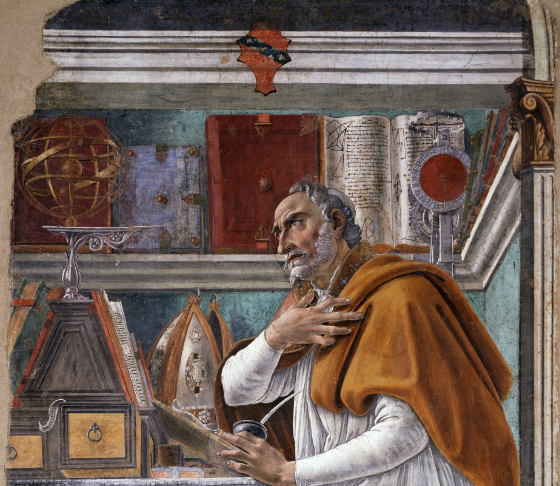
The Existence of God and the Principle of Sufficient Reason

On arguments for the existence of God from the principle of sufficient reason. The principle of sufficient reason is the principle that everything must have a reason, cause, or ground. This principle has been applied to argue for the existence of God as the ultimate reason behind all things.

In previous episodes I have discussed a couple arguments for the existence of God: the argument for “the One” and the argument from eternal truths. Both are kinds of cosmological arguments, characteristic of the thought of Plotinus and Augustine respectively. The central notion of a cosmological argument is that everything depends on something else for its existence and nature, except for one thing that is the ultimate source for everything else, one thing that is absolutely independent and necessary. With this episode I’d like to talk about another kind of cosmological argument that attends to this same central notion but in a slightly different way. This is the argument from the principle of sufficient reason. This argument was given its classical form by the German mathematician Gottfried Wilhelm Leibniz (1646 – 1716). Leibniz was also the one to use the term sufficient reason to refer to the principle, though it had certainly been expressed by many people previously.

The principle of sufficient reason, often abbreviated as PSR, is that “everything must have a reason, cause, or ground” (Stanford Encyclopedia of Philosophy). Leibniz said in his Monadology:

“Our reasonings are grounded upon two great principles, that of contradiction, in virtue of which we judge false that which involves a contradiction, and true that which is opposed or contradictory to the false; And that of sufficient reason, in virtue of which we hold that there can be no fact real or existing, no statement true, unless there be a sufficient reason, why it should be so and not otherwise, although these reasons usually cannot be known by us.”

Leibniz expands on this, leading to an argument for God, in a passage worth quoting extensively:

“In short, there are simple ideas, of which no definition can be given; there are also axioms and postulates, in a word, primary principles, which cannot be proved, and indeed have no need of proof; and these are identical propositions, whose opposite involves an express contradiction. But there must also be a sufficient reason for contingent truths or truths of fact, that is to say, for the sequence or connexion of the things which are dispersed throughout the universe of created beings, in which the analyzing into particular reasons might go on into endless detail, because of the immense variety of things in nature and the infinite division of bodies. There is an infinity of present and past forms and motions which go to make up the efficient cause of my present writing; and there is an infinity of minute tendencies and dispositions of my soul, which go to make its final cause. And as all this detail again involves other prior or more detailed contingent things, each of which still needs a similar analysis to yield its reason, we are no further forward: and the sufficient or final reason must be outside of the sequence or series of particular contingent things, however infinite this series may be. Thus the final reason of things must be in a necessary substance, in which the variety of particular changes exists only eminently, as in its source; and this substance we call God.”

Alexander Pruss picked out the key ideas from Leibniz’s argument and put it in the following, succinct form (The Blackwell Companion to Natural Theology, The Leibnizian Cosmological Argument, by Alexander R. Pruss, pp.25-6):

  1. Every contingent fact has an explanation.
  2. There is a contingent fact that includes all other contingent facts.
  3. Therefore, there is an explanation of this fact.
  4. This explanation must involve a necessary being.
  5. This necessary being is God.

Leibniz speaks of “an infinity” of “present and past forms and motions” of “minute tendencies and dispositions”. Basically an infinity of contingent facts. We can lump all these contingent facts into one, the logical conjunction of all contingent facts. This conjunction of all contingent facts has been called the Big Conjunctive Contingent Fact (abbreviated BCCF). Because all these facts are contingent and because their sum total is contingent it all requires explanation. But the explanation for all contingent facts cannot itself be contingent, otherwise it would be among the very set of facts in need of explanation. As Leibniz says, “the sufficient or final reason must be outside of the sequence or series of particular contingent things”. So this explanation must be the opposite of contingent, i.e. necessary. And Leibniz proposes that we call this God.

Like most arguments for the existence of God what is demonstrated, while important and significant, is also limited. There’s nothing demonstrated here about God’s activity in history or as revealed in scripture. It doesn’t tell us which religion or which sacred scripture, if any, is correct. It doesn’t tell us what kinds of ethical demands God might make of us. Such things might be demonstrated by other means and I think they very well can be. But that’s not where the argument has taken us so far. I think this is important because one actually doesn’t need to be religious to be a convinced theist. Being a Christian involves a lot more than this. For one thing it usually, and maybe always, involves transformative spiritual experience. Or one might be convinced just intellectually but in a way that would necessarily involve a great deal of familiarity with history, scriptural texts, and probably ancient languages. In modernity the reasonableness of theism itself is somewhat obscured by a lot of the cultural barriers, negative perceptions, and aversion to organized religion. But simple theism itself is fairly straightforward. I think theism is very rational and something that most people could easily accept, if not otherwise conditioned.

More later on the way that the principle of sufficient reason leads to an argument for the existence of God. Let’s first spend some time on the principle itself. Why accept it? What are some possible objections to it?

The best reasons for accepting the principle would seem to be indirect ones through arguments with a reductio ad absurdum form. Such arguments ask, what would follow if we rejected the principle? What would we expect the world to be like if everything did not have a reason? One thing we might expect is that it would be very common to find things and events that didn’t have any evident explanation or that were completely unintelligible. This would be very different from what we observe scientifically. It’s also just very different from the experience of regular life which is, well, quite regular. We just don’t see things happening or being certain ways for no reason at all. That’s what we could expect, let’s say, in the physical world. But it would go even deeper than this, into our minds and thoughts. The principle of sufficient reason pertains to connections between thoughts and ideas. We think one thing to be so by reason of some other thing and so on. But absent the principle of sufficient reason all of this is gone. We’d just have a bundle of thoughts and ideas without any way of structuring them to give support to one another and to know which ones to think are true and which are false. In other words, we wouldn’t be able to trust our own cognitive faculties.

Arthur Schopenhauer (1788 – 1860) distinguished between four forms of sufficient reason. Regardless of whether the four forms he picked out are the right ones or the only forms possible to pick out, I think that distinguishing between the different forms that sufficient reason can take is a good idea. Schopenhauer believed that philosophers throughout history had failed to make proper distinctions between various forms of the principle. In particular he thought most philosophers had failed to distinguish the other forms of PSR from the principle of causality, cause and effect in nature, which is only one form that the principle can take. Schopenhauer’s four forms were the principle of sufficient reason of becoming, knowing, being, and willing. These correspond to causality, rules of logic, mathematics, and motivations.

Causality is a major topic in philosophy with a whole host of objections and responses. Those are pertinent to PSR but, since causality is only one form of PSR, not to all forms of it. There are also objections to causality that are more properly objections to determinism rather than causality as such. For example, after the development of quantum mechanics we might think that many things happen without a cause. And we might similarly suppose that many things happen for no reason at all. For example, in radioactive decay the precise moment that any particular radioactive atom will decay is unpredictable. However the decay rate of many atoms of the same type over time is actually highly predictable, so that a given material has a characteristic half-life. A material’s half-life is consistent and related to its other properties. In more general terms the quantum state of a quantum system is characterized by a wave function. Under the Copenhagen Interpretation of quantum mechanics the square modulus of the wavefunction is a probability density. This gives the probability of different states being experimentally observed. Upon observation the wave function “collapses” into a single state. And we can’t predict with certainty which state will be observed.

Now this is certainly a different way of understanding how things work than we would otherwise have thought. But does it mean that things happen for no reason at all? I maintain that this is not the case because these events are still highly constrained and highly ordered. In quantum chemistry, for example, it is wave functions called orbitals that characterize the behavior of electrons in atoms and molecules. And yes, wavefunctions are inherently probabilistic. But the structure of these orbitals imparts tremendous explanatory power to chemistry at the level of atomic and molecular bonds, and consequently also to chemical reactions. I propose that it’s not the case that with the development of quantum mechanics we have found more things that happen for no reason at all. I think it’s the opposite. Before quantum mechanics chemistry was more dependent on macro-scale empirical observations of regularities. Although we could observe that certain chemical phenomena occurred regularly in certain ways we didn’t have as much understanding about why they occurred in the ways that they did.There was more arbitrariness in our explanations. But with quantum chemistry we have a much more developed understanding and we actually know more of the reasons why things happen the way they do.

Another important point is that although wave functions are inherently probabilistic in quantum mechanics this does not mean that the quantum states that are observed occur for no reason at all. That would only be the case if there were no laws of quantum mechanics. Then anything at all really could happen, without any kind of pattern. But such quantum phenomena do have a reason and that reason is the laws of quantum mechanics themselves.

Now returning to the way the principle of sufficient reason connects to the existence of God. A short description of the logic is that everything has to have a reason. Most things have their reason in something else. But ultimately all reasons have to lead back to one thing. And this one thing has to have very unique properties in order to be the reason for everything. For everything else and even for itself. The unique properties that this ultimate reason would have to have are those of God. Now to get into more detail.

The first important concepts to follow on to PSR are of contingency and necessity. If we grant that everything has to have a reason, cause, or ground the next step is to categorize the ways that they have these reasons. And there are two: contingency and necessity. A thing can have a reason in something else, which means it’s contingent. Or a thing can have its reason in its own nature, which means it’s necessary. And if we grant PSR there’s no third alternative.

Clearly almost everything is contingent. If you think of almost anything you can see how something else is a reason for it. And there are chains of reasons, as we see in a child’s relentless “Why?” game. Where a child asks some “Why?” question and follows up the answer with “Why?”, and follows up the next answer with “Why?”, over and over again. Eventually you give up answering, not because there is not a reason but because you don’t know what the reason is. This is a great illustration of contingency.

With these kinds of chains of reasons an issue that comes up is the infinite regress and the question of whether you can have an infinite regress. There are different opinions and arguments on that point but I think the possibility of infinite regress is untenable. William Lane Craig has done a lot of work on this subject. I also like what David Bentley Hart has called the “pleonastic fallacy”, which he defines as “the belief that an absolute qualitative difference can be overcome by a successive accumulation of extremely small and entirely relative quantitative steps.” (The Experience of God, 98) As it pertains to the case at hand, the difference between an infinite regress and a finite regress is an absolute qualitative difference. A finite regress terminates at some determinate point. An infinite regress does not. That’s an absolute qualitative difference. An infinite regress of reasons still lacks an ultimate reason. It doesn’t matter that there’s an infinite number of them. That’s the idea behind the joke that “it’s turtles all the way down.” If the world rests on the back of a turtle that rests on the back of another turtle and so on you can always ask what the next turtle is resting on. And it doesn’t help to say that it’s turtles all the way down. The stack of turtles is still unsupported. It doesn’t matter that there’s an infinite number of them. There has to be a termination in the chain. And that termination point has to be something with a unique set of qualifying properties.

So much for contingent things. What about necessary things? What would a necessary entity have to be like? There are reasons to think that a necessary being would have to be:

  1. purely actual
  2. absolutely simple or noncomposite, and 
  3. something which just is subsistent existence itself

A word on actuality. Actuality and potentiality are concepts going back to Aristotle and the Medieval Scholastics. An entity can have some attribute actually or potentially. Actuality is an entity’s already having an attribute. Potentiality is an entity’s capacity to have an attribute. Almost everything has both actuality and potentiality for different things. Since things are certain ways they have actuality for those ways that they are. But they also have potentiality for all the ways that they are not yet but could be. There’s a connection here to contingency. If a thing could be many different ways but happens to be only certain of those ways, the ways that it happens to be are contingent, because it could have been otherwise. When an entity has potentiality for an attribute that attribute can only become actual if it is actualized. And it can only be actualized by another entity that has that attribute already, i.e. has actuality for it. Heat is an illustrative example. All materials have a certain heat capacity, which is the amount of heat they can absorb for a given increase in temperature. Materials have this capacity even when they are not increasing in temperature. In order to increase in temperature the material has to receive an energy input from some heat source. The heat source has actuality that it imparts to the material, actualizing its potential for the higher temperature. This is a physical example but the principles of actuality and potentiality also apply to ideas.

What are the reasons to suppose that a necessary being would have to be purely actual, noncomposite, and self-subsistent? A necessary being is one that cannot not exist. A contingent being is the opposite because it is possible for it not to exist and for it to have been otherwise than it is. Because a contingent being could be otherwise than it actually is it has unactualized potentiality. A necessary being cannot have unactualized potentiality. It has to be purely actual. The way it is is the only way that could be. Furthermore, all other things ultimately trace their source of actualization back to this necessary being. A necessary being is purely actual and also the entity that actualizes everything else. A necessary being has to be concomposite because anything composite could have been composed differently. Anything composite is composed of parts. These could be physical parts or abstract parts. Anything composed of parts cannot be necessary because it is possible for its parts to be put together in different ways or not at all. Finally a necessary being has to be self-subsistent in its existence because if it depended on some other entity for its existence it wouldn’t be self-subsistent.

In a previous episode, An Argument for the One, I shared a Neo-Platonic argument for why an entity possessing these attributes would have to be unique. There can in principle be only one thing which is purely actual, absolutely simple or noncomposite, and something which just is subsistent existence itself. Why is that? If there were more than one necessary being each would have to have some differentiating feature that the others lacked. Otherwise they would just be the same entity. But to have any differentiating features they would have to have potentialities. The potentialities of each would be whatever features the others did not have. But since a necessary being is purely actual it cannot have any such potentialities and so no differentiating features. This would preclude there being any more than one. So there can be only one necessary being.

It’s worth noting here for a moment that these attributes that the one necessary entity would have to have preclude certain candidates that might naturally occur to us. The big one, I think, is the universe itself. Can’t the universe itself just be the one explanation for everything? But this won’t do because the universe lacks the qualities that a necessary entity has to have. The universe is not necessary; it’s contingent. It doesn’t have to exist. The universe is not purely actual, noncomposite, or self-subsistent. The universe has many unactualized potentialities, potentialities that we know a lot about now thanks to the science of cosmology. The universe is certainly not noncomposite. The observable universe is thought to contain 10^80 particles. So the universe does not qualify as the kind of thing that could be the one necessary entity.

If we grant the foregoing there are also reasons to think that a necessary being would also have to be:

  1. Immutable
  2. Eternal
  3. Immaterial
  4. Incorporeal
  5. Perfect
  6. Omnipotent
  7. Fully good
  8. Intelligent, and 
  9. Omniscient

These are clearly attributes associated with God. At this stage we’re looking at identifying the one necessary being with the attributes of God. Why would a necessary being have all of these attributes? These trace back to its being purely actual, noncomposite, and self-subsistent. Immutability is changelessness, which relates to actuality and potentiality. Things with potentiality have the capacity to change. But something that is purely actual is already fully actualized. It doesn’t have any potentialities that need to be actualized. Such changelessness also applies across time. Because God is the same across time he is eternal, the same at all moments. God is also immaterial and incorporeal because he is noncomposite. Matter and bodies are essentially composite, both because they are composed of particles and because matter is a plurality; there are many different material and bodily entities, each with distinguishing features. God, being noncomposite, cannot be like that.

Because God is pure actuality and doesn’t have any potentialities that need to be actualized he is already perfect. He’s already everything that he can be. This perfection includes moral perfection. For the one necessary being to be fully good is actually the attribute that is, on its face, least obvious to me and also the one of greatest existential concern. Apart from all the foregoing, it would be easy for me to imagine that the ultimate source of all things with all power might not be morally good but might actually be amoral. And that would be rather distressing. Maybe morality is a human invention and not pertinent to the one necessary being behind all things. But in relation to everything else we can reason about God there is good reason to think that the one necessary being is also fully good. The goodness of the necessary being relates to his pure actuality. To see the relation requires a certain understanding of goodness. In this understanding goodness is the actualization of an entity’s potentialities. This is the understanding of goodness expounded by Aristotle and articulated in modern times by Alisdair MacIntyre. The good is that at which things aim. Living things have natures with potentialities to become the kinds of things that they are meant to be. Goodness is the actualization of these potentialities. It’s essentially creative and fruitful. Its opposite, evil, is essentially destructive and privative. We think of something like the Holocaust as the ultimate evil, and very rightly so. This was supremely destructive and the complete opposite of creation, multiplying, and replenishing. Other evils may be much less total in their destructive force but also work against growth and realization of our potentialities. The one necessary being is decidedly on the side of creation and goodness. As pure actuality God is the very source of all creation and growth that empowers all entities to move toward the things for which they aim.

Omnipotence is another way of understanding God’s pure actuality. Actuality means making things happen, which is essentially what power is. Everything that happens and that can happen is dependent on being actualized by the ultimate actualizer, and so God is the source of all power and is all-powerful.

Intelligence and omniscience are probably the most bold assertions about God’s nature. We might imagine a single source for all things but still resist that this ultimate source itself possesses human-like consciousness. Why should we suppose this to be the case? The reason for this relates to an important Platonic insight about the nature of reality. And this is the existence of abstractions. I discussed this in another episode about an argument for the existence of God from eternal truths. Examples of abstraction include mathematical concepts and theorems that would seem to hold independent of anything physical. Abstractions have the character of ideas. They can certainly subsist in our minds. But they would also seem to transcend any particular, finite mind, like the minds of human beings. These abstract forms can be actualized in the physical universe, as in the form of physical laws or in the form of created entities. As Edward Feser has stated: “To cause something to exist is just to cause something having a certain form or fitting a certain pattern.” (Five Proofs of the Existence of God, 33). If these abstractions have real existence they have to exist somewhere. The various modes of subsistence they might have is a huge topic but for our purposes here we’ll just note that as entities of a mental character the most reasonable way for them to exist is as ideas in God. It is the intellectual and mental nature of these abstractions, existing in God, that gives reason to think that God must have intelligence. In fact, his intelligence must be very great indeed because it comprises all abstractions. And because all actualization, including actualization involving these sorts of mental abstractions, originates from God, God’s intelligence must be all-encompassing; in other words, omniscient.

Let’s return to the expression of all these ideas in the forms of arguments for the existence of God. I shared earlier the argument from Leibniz, as re-expressed by Alexander Pruss:

  1. Every contingent fact has an explanation.
  2. There is a contingent fact that includes all other contingent facts.
  3. Therefore, there is an explanation of this fact.
  4. This explanation must involve a necessary being.
  5. This necessary being is God.

This is a nice, concise argument. But a longer argument has the benefit of explaining a little more that is taken for granted here. For example, why we should understand a necessary being to be God and to have the attributes traditionally associated with God. The kinds of reasons I’ve been discussing. A longer version of the argument that lays all this out is given by Edward Feser in his book Five Proofs of the Existence of God, in his fifth proof which he calls the Rationalist Proof, since Leibniz was a rationalist. It proceeds in 27 steps. The terms and ideas should be familiar now after everything discussed so far. The argument is the following:

  1. The principle of sufficient reason (PSR) holds that there is an explanation for the existence of anything that does exist and for its having the attributes that it has.
  2. If PSR were not true, then things and events without evident explanation or intelligibility would be extremely common.
  3. But this is the opposite of what common sense and science alike find to be the case.
  4. If PSR were not true, then we would be unable to trust our own cognitive faculties.
  5. But in fact we are able to trust those faculties.
  6. Furthermore, there is no principled way to deny the truth of PSR while generally accepting that there are genuine explanations in science and philosophy.
  7. But there are many genuine explanations to be found in science and philosophy.
  8. So, PSR is true.
  9. The explanation of existence of anything is to be found either in some other thing which causes it, in which case it is contingent, or in its own nature, in which case it is necessary; PSR rules out any purported third alternative on which a thing’s existence is explained by nothing.
  10. There are contingent things.
  11. Even if the existence of an individual contingent thing could be explained by reference to some previously existing contingent thing, which in turn could be explained by a previous member, and so on to infinity, that the infinite series as a whole exists at all would remain to be explained.
  12. To explain this series by reference to some further contingent cause outside the series, and then explain this cause in terms of some yet further contingent thing, and so on to infinity, would merely yield another series whose existence would remain to be explained; and to posit yet another contingent thing outside this second series would merely generate the same problem yet again.
  13. So, no contingent thing or series of contingent things can explain why there are any contingent things at all.
  14. But that there are any contingent things at all must have some explanation, given PSR; and the only remaining explanation is in terms of a necessary being as cause.
  15. Furthermore, that an individual contingent thing persists in existence at any moment requires an explanation; and since it is contingent, that explanation must lie in some simultaneous cause distinct from it.
  16. If this cause is itself contingent, then even if it has yet another contingent thing as its own simultaneous cause, and that cause yet another contingent thing as its simultaneous cause, and so on to infinity, then once again we have an infinite series of contingent things the existence of which has yet to be explained.
  17. So, no contingent thing or series of contingent things can explain why any particular contingent thing persists in existence at any moment; and the only remaining explanation is in terms of a necessary being as its simultaneous cause.
  18. So, there must be at least one necessary being, to explain why any contingent things exist at all and how any particular contingent thing persists in existence at any moment.
  19. A necessary being would have to be purely actual, absolutely simple or noncomposite, and something which just is subsistent existence itself.
  20. But there can in principle be only one thing which is purely actual, absolutely simple or noncomposite, and something which just is subsistent existence itself.
  21. So, there is only one necessary being.
  22. So, it is this same one necessary being which is the explanation of why any contingent things exist at all and which is the cause of every particular contingent thing’s existing at any moment.
  23. So, this necessary being is the cause of everything other than itself.
  24. Something which is purely actual, absolutely simple or non-composite, and something which just is subsistent existence itself must also be immutable, eternal, immaterial, incorporeal, perfect, omnipotent, fully good, intelligent, and omniscient.
  25. So, there is a necessary being which is one, purely actual, absolutely simple, subsistent existence itself, cause of everything other than itself, immutable, eternal, immaterial, incorporeal, perfect, omnipotent, fully good, intelligent, and omniscient.
  26. But for there to be such a thing is for God to exist.
  27. So, God exists.

Feser’s argument covers the core points of the argument from the principle of sufficient reason as well as all related issues, tying this not only to God as the one necessary being but also to God with all of his classical divine attributes.

Now to speak more reflectively on all of this, I sometimes feel like we are all far too incurious and complacent about our existence. We’re all just thrown into life as infants without the ability to reflect on it and ask what should be a pretty obvious question: “What’s going on here?!” By the time we’re old enough to speak and reason we settle in and just go along with things. But we can still go back to the beginning, before we’ve taken everything for granted, and ask: “Where does all of this come from?” And there are important related questions like, “What’s our part in all of this?” “What are we supposed to be doing here?”

Maybe these are unreasonable questions to ask. But I don’t think so. Things don’t just happen for no reason at all. It may be practical to ignore these questions in order to just get along with the daily business of our lives. But we shouldn’t push them off forever. We are made for more than just our particular day to day affairs. The big questions are also the ones that give intelligibility and meaning to our life’s details.

The reason to believe in God is also the reason for asking for reasons for everything and anything at all.

The Practice of Prayer

There is a condition of looking for something without knowing what we are looking for, or even that we are looking for anything at all. Augustine called it restlessness. Jesus described it as a thing that we would ask for if we knew to ask for it. It is a thirst for living water that will quench all thirst. All religions give witness to this act of reaching out. Jesus taught us to reach out by calling upon God in prayer. Prayer is not just one act among many. It works directly on that essential thirst that can only be satisfied in God.

With this episode I’d like to talk about some things I’ve been studying about prayer. This may be one of the most practical topics I’ve ever gotten into since it’s essentially about a practice, something that you do. We can talk about it and reflect on it, which is what I’ll be doing here. But prayer is ultimately a spiritual practice. Theology can certainly be theoretical and intellectual. And that’s something that I really like about it. But I always try to remember something that Evagrius Ponticus (345 – 399) said about theology: “A theologian is one who prays, and one who prays is a theologian.”

I try to live my life in imitation of Christ and one thing that stands out to me in the scriptures is that Jesus prayed. And I think this is very significant. In his book Jesus of Nazareth Pope Benedict XVI said:

“Again and again the Gospels note that Jesus withdrew ‘to the mountain’ to spend nights in prayer ‘alone’ with his Father. These short passages are fundamental for our understanding of Jesus; they lift the veil of mystery just a little; they give us a glimpse into Jesus’ filial existence, into the source from which his action and teaching and suffering sprang. This ‘praying’ of Jesus is the Son conversing with the Father; Jesus’ human consciousness and will, his human soul, is taken up into that exchange, and in this way human ‘praying’ is able to become a participation in this filial communion with the Father.” (7)

As is typical with Benedict, he packs a lot into very condensed passages. Three points stand out to me here about Jesus’ practice of prayer.

1. It is fundamental for our understanding of him.

2. It is the source from which his action and teaching and suffering sprang.

3. Our prayer is a way of participating in the communion that Jesus has with the Father.

That prayer was something fundamental to Jesus’ behavior and identity was apparently something that his disciples noticed as well. On one occasion after he returned from prayer they asked him to instruct them.

“And it came to pass, that, as he was praying in a certain place, when he ceased, one of his disciples said unto him, Lord, teach us to pray, as John also taught his disciples.” (John 11:1, KJV)

And we have many examples in the Gospels of Jesus teaching about prayer and how to pray, especially in Luke.

As I’ve reflected on prayer I keep sensing its great importance. It’s such a simple thing. And we even tend to dismiss it as insignificant. Like many things, the phrase “thoughts and prayers” is politicized and maybe that’s an apt indicator of our attitudes about prayer, that it’s something empty and ineffectual. And it’s certainly true that prayer can be empty and vain. Jesus even said as much (Matthew 6:5-8). But I actually believe that sincere prayer, far from being empty and ineffectual, is actually the most important thing that we can do. If we want to change the world, starting especially with changing ourselves, we must pray.

Prayer touches on the fundamental issues of who we are and what we exist for. Augustine of Hippo (354 – 430) said to God in his Confessions, “You have made us for Yourself.” Why do we exist? We exist for God. That’s not what most of us think. We may think we exist for any number of other things, or nothing at all. We could say, as Jesus said to Martha, that we “are worried and troubled about many things” (Luke 10:41, NKJV). Ultimately all of these things, all our desires, interests, projects, and concerns are imperfect reflections of the most fundamental and innate desire for our creator and sustainer. But we often don’t know that that’s what we’re looking for, or even that we’re looking for anything at all.

Each of us is, in many ways, the Samaritan woman at the well to whom Jesus said:

“If you knew the gift of God, and who it is who says to you, ‘Give Me a drink,’ you would have asked Him, and He would have given you living water.” (John 4:10, NKJV)

What an interesting hypothetical. You would be asking for something. You’re not asking for it now. But you would ask for it if you knew about it. It’s this fascinating situation where we’re looking for something without knowing what we are looking for or even that we are looking for anything at all.

I think this is an apt description of the human condition generally. There’s this kind of generalized discontent and incompleteness to our existence. Augustine called it restlessness.

“You have made us for Yourself, and our hearts are restless until they rest in You.” 

I think a scripturally appropriate term would be thirst. Jesus described the object of this thirst as “living water”:

“Whoever drinks of this water [meaning literal, physical water] will thirst again, but whoever drinks of the water that I shall give him will never thirst. But the water that I shall give him will become in him a fountain of water springing up into everlasting life.” (John 4:13-14, NKJV)

This living water is both our source and purpose. It’s the culmination of all our longing but we know, both from scripture and just from experience, that the challenges of finding it are significant. Paul said we seek in the hope that we might grope for and find the Unknown God, even “though He is not far from each one of us” (Acts 17:27, NKJV)  Paul also acknowledged that prayer itself is difficult: “We do not know what we should pray for as we ought” (Romans 8:26, NKJV)

In my conversations with fellow Christians we’ve shared this experience that prayer can be difficult. We don’t feel like we’re doing it right or that we’re making that spiritual connection with God. That’s a common experience and has been from the beginning. But we have help. Paul said:

“Likewise the Spirit also helps in our weaknesses. For we do not know what we should pray for as we ought, but the Spirit Himself makes intercession for us with groanings which cannot be uttered.” (Romans 8:26, NKJV)

It seems appropriate and perfect to me that the Spirit would intercede for our nondescript, generalized restlessness for the Unknown God with unutterable groanings. Even if we don’t know what we’re looking for or that we’re looking for anything at all the Spirit can intercede and act on this most vague longing with groanings which cannot be uttered.

Something that I’ve found helpful in the practice of prayer is making use of the different forms of prayer from the Christian tradition. The Catechism of the Catholic Church identifies three major expressions of the life of prayer in the Christian tradition (2699, 2721):

Vocal Prayer

Meditation

Contemplative Prayer

I find that one or the other of these three expressions of prayer is often most suitable at certain times. I think that sometimes we find prayer difficult because we only know of one form. And even though that one form may be very suitable in many situations it might not be most suitable in others. I’ve found it helpful to weave these three forms together in my practice of prayer.

I tend to think of these three expressions of prayer as sitting on a spectrum of expressibility and expressive content. Vocal prayer is most characterized by expressible content in the sentences that we speak. Contemplative prayer mostly transcends anything that can be expressed in words. And meditation, centering mostly in the words scripture and the life of Christ, sits between vocal prayer and contemplative prayer in its degree of expressibility.

The first major expression of prayer in the Christian tradition is vocal prayer. There are a couple things that strike me about Jesus’s teachings about vocal prayer. And I think they’re related. The first is that in our petitions we must have faith. The second is that we should be relentless in our petitions. I think those two things are related. And they strike me because I don’t feel like I live in an age and culture where we really believe in miracles, especially not to a degree that we would pursue them relentlessly in our prayers. Part of that may be our secularism. And part of it may be a concern that relentlessness would be irreverently presumptuous. But Jesus seemed to have precious little concern about presumptuousness. Consider the following parable:

“Then He spoke a parable to them, that men always ought to pray and not lose heart, saying: There was in a certain city a judge who did not fear God nor regard man. Now there was a widow in that city; and she came to him, saying, Get justice for me from my adversary. And he would not for a while; but afterward he said within himself, Though I do not fear God nor regard man, yet because this widow troubles me I will avenge her, lest by her continual coming she weary me. Then the Lord said, Hear what the unjust judge said. And shall God not avenge His own elect who cry out day and night to Him, though He bears long with them? I tell you that He will avenge them speedily. Nevertheless, when the Son of Man comes, will He really find faith on the earth?” (Luke 18:1-8, NKJV)

Jesus was insistent that God is the most disposed to grant petitions for those who seek after them.

“Ask, and it will be given to you; seek, and you will find; knock, and it will be opened to you. For everyone who asks receives, and he who seeks finds, and to him who knocks it will be opened. Or what man is there among you who, if his son asks for bread, will give him a stone? Or if he asks for a fish, will he give him a serpent? If you then, being evil, know how to give good gifts to your children, how much more will your Father who is in heaven give good things to those who ask Him!” (Matthew 7:7-12, NKJV)

I’m struck by the directness and complete lack of qualification in these teachings. But if you’re like me you have doubts that it can really be so straightforward. Why? Because we’ve all had the experience that Jesus’s disciples had, where we pursued a miracle that didn’t come:

“Then the disciples came to Jesus privately and said, Why could we not cast it [the demon] out? So Jesus said to them, Because of your unbelief; for assuredly, I say to you, if you have faith as a mustard seed, you will say to this mountain, Move from here to there, and it will move; and nothing will be impossible for you. However, this kind does not go out except by prayer and fasting.” (Matthew 17:19-21, NKJV)

We’ve all had this experience. We pray for something and we don’t get it. I’ve even considered this an important spiritual developmental step, moving from a more naive conception of God to one that’s more sophisticated, where we can appreciate the various reasons that our petitions in prayer might not be granted. But I’m coming around to question that. I wonder if we’re too quick in our sophistication to enable underdeveloped faith.

This is why I think prayer, far from being vain and ineffectual, is the most important thing we can do. We need, as individuals and as societies and nations, things that we cannot produce on our own. We need God to intervene. There are societies and sub-cultures where these things do happen, where people expect, pursue, and receive miracles. God knows how to give good gifts to his children.

The second major expression of prayer in Christian tradition is meditation. Meditation might not be something we popularly associate with Christianity but it’s definitely part of the tradition. It’s often facilitated by texts of scripture and devotional writings. Also visual arts like icons. Lectio divina is one venerable practice of reading scripture for the special purpose of focusing and meditating on it in prayer. I often use one of the Psalms for this purpose. Events from the life of Christ are also very powerful. 

The Rosary is a classic example of a practice of prayer that is focused on events from the life of Christ. Each cycle of the Rosary goes through five “Mysteries” from the life of Christ.

The Joyful Mysteries are:

  • The Annunciation
  • The Visitation
  • The Nativity
  • The Presentation in the Temple
  • The Finding in the Temple

The Sorrowful Mysteries are

  • The Agony in the Garden
  • The Scourging at the Pillar
  • The Crowning with Thorns
  • The Carrying of the Cross
  • The Crucifixion and Death

The Glorious Mysteries are

  • The Resurrection
  • The Ascension
  • The Descent of the Holy Spirit
  • The Assumption
  • The Coronation of Mary

The Luminous Mysteries are

  • The Baptism of Christ in the Jordan
  • The Wedding Feast at Cana
  • Jesus’ Proclamation of the Coming of the Kingdom of God
  • The Transfiguration
  • The Institution of the Eucharist

We can read the accounts of these events in scripture and learn about their contents. But in meditative prayer we can go deeper into them to be moved and edified by them. As an example, concerning the mystery of the Carrying of the Cross, Bishop Robert Barron remarked that, “Carrying the cross must become the very structure of the Christian life.” This idea has had a profound impact on me as I’ve meditated on it.

Something I enjoy about scripture is that it’s very intellectually challenging and stimulating. And interdisciplinary. It involves topics of history, philosophy, and linguistics. I think that’s wonderful. But I think there’s sometimes a temptation to compete over who can be the most knowledgeable about the content of scripture. I don’t think that serves the purposes of scripture at all. In The Imitation of Christ Thomas à Kempis (1380 – 1471) warned: “If you wish to derive profit from your reading of Scripture, do it with humility, simplicity, and faith; at no time use it to gain a reputation for being one who is learned.” (Book I, Chapter V) Rather, Thomas said: “Let it then be our main concern to meditate on the life of Jesus Christ.” (Book I, Chapter I)

In addition to meditation of the life of Christ I cannot speak highly enough about the edifying influence of the Psalms. I’ve said at times, and I still think it’s true, that the fastest way to learn about the narrative arc of the Old Testament is to read 1 Samuel through 2 Kings. And of course those four books are books of holy scripture, so well worth reading. But I think now that the most direct path into the spiritual world of the Old Testament is in the Psalms. I admit that I didn’t always appreciate them and couldn’t get into them. Maybe I wasn’t ready for them. But I really appreciate them now. Sometimes if I find it difficult to get into prayer the Psalms are a great way to get started, to get into the right frame of mind.

To paraphrase Ecclesiastes (3:1), there is a Psalm for every season.

Psalms of joy:

“O how love I thy law! it is my meditation all the day.” (Psalm 119:97, KJV)

“How sweet are thy words unto my taste! yea, sweeter than honey to my mouth!” (Psalm 119: 103, KJV)

“Thy word is a lamp unto my feet, and a light unto my path.” (Psalm 119:103, KJV)

“Let every thing that hath breath praise the Lord. Praise ye the Lord.” (Psalm 150:6, KJV)

Psalms of grief and frustration:

“How long wilt thou forget me, O Lord? for ever? how long wilt thou hide thy face from me?” (Psalm 13:1, KJV)

“My God, my God, why hast thou forsaken me?” (Psalm 22:1)

And Psalms of reflection:

“When I consider thy heavens, the work of thy fingers, the moon and the stars, which thou hast ordained; What is man, that thou art mindful of him? and the son of man, that thou visitest him?” (Psalm 8:3-4, KJV)

“One thing have I desired of the Lord, that will I seek after; that I may dwell in the house of the Lord all the days of my life, to behold the beauty of the Lord, and to enquire in his temple.” (Psalm 27:1, KJV)

In his book Jesus of Nazareth, Pope Benedict XVI said: “The Psalms are words that the Holy Spirit has given to men; they are God’s Spirit become word.” (131) Speaking about the Psalms and the Lord’s Prayer he remarks that certain formulaic prayers like these can help us to get started in prayer and in approaching God.

“Our prayer can and should be a wholly personal prayer. But we also constantly need to make use of those prayers that express in words the encounter with God experienced both by the Church as a whole and by individual members of the Church… In the formulaic prayers that arose first from the faith of Israel and then from the faith of praying members of the Church, we get to know God and ourselves as well. They are a ‘school of prayer’ that transforms and opens up our life… Normally, thought precedes word; it seems to formulate the word. But praying the Psalms and liturgical prayer in general is exactly the other way around: The word, the voice, goes ahead of us, and our mind must adapt to it. For on our own we human beings do not ‘know how to pray as we ought’ (Rom 8:26) – we  are too far removed from God, he is too mysterious and too great for us. And so God has come to our aid: He himself provides the words of our prayer and teaches us to pray. Through the prayers that come from him, he enables us to set out toward him; by praying together with the brothers and sisters he has given us, we gradually come to know him and draw closer to him.” (130-131)

The third major expression of prayer in the Christian tradition is contemplative prayer. This is the form of prayer that I think of as being the furthest on the spectrum away from expressibility and expressive content. In the Eastern Christian tradition it’s sometimes called “hesychasm”, derived from the Greek hesychia (ἡσυχία), meaning “stillness, rest, quiet, or silence”. Another descriptive term is “apophatic”, from the Greek apophēmi (ἀπόφημι), meaning “to deny”, which is characterized by negative content rather than positive content. I sometimes think of it as empty space into which the Spirit can freely enter. 

Perhaps appropriately some of the greatest spiritual writers in this tradition are anonymous (or pseudonymous). One lived sometime in the 5th or 6th century, writing under the pseudonym Dionysius, whose major work was On The Divine Names. Another was an English writer living sometime in the 14th century, whose major work was The Cloud of Unknowing.

Contemplative prayer is the most unexpressible form of prayer, but it often still involves single words or phases, similar to a mantra in Indian religious traditions. In The Cloud of Unknowing the author instructs that we should use one word of just one syllable in which to enfold our intent:

“If you like, you can have this reaching out, wrapped up and enfolded in a single word. So as to have a better grasp of it, take just a little word, of one syllable rather than of two; for the shorter it is the better it is in agreement with this exercise of the spirit. Such a one is the word ‘God’ or the word ‘love.’ Choose which one you prefer, or any other according to your liking – the word of one syllable that you like the best. Fasten this word to your heart, so that whatever happens it will never go away. This word is to be your shield and your spear, whether you are riding in peace or in war. With this word you are to beat upon this cloud and this darkness about you. With this word you are to strike down every kind of thought under the cloud of forgetting.” (Chapter VII, James Walsh edition)

Other contemplatives haven’t necessarily restricted themselves to one word alone but have also used phrases. The most notable example, especially in Eastern Christianity, is the Jesus Prayer. The Jesus Prayer is this:

“Lord Jesus Christ, Son of God, have mercy on me, a sinner.”

The scriptural roots of this prayer are in the Parable of the Pharisee and the Publican in Luke 18:9-14.

“And the tax collector, standing afar off, would not so much as raise his eyes to heaven, but beat his breast, saying, ‘God, be merciful to me a sinner!’” (NKJV)

Paul, in his first letter to the Thassolonians, counseled to “pray without ceasing” (1 Thessalonians 5:17). The Jesus Prayer is traditionally thought to be a prayer that a person can eventually learn to pray continually at every moment. In the 19th century Russian text, The Way of a Pilgrim, the pilgrim learns to pray without ceasing by incorporating the Jesus Prayer into his very breath.

“Begin bringing the whole prayer of Jesus into and out of your heart in time with your breathing, as the Fathers taught. Thus, as you draw your breath in, say, or imagine yourself saying, ‘Lord Jesus Christ,’ and as you breathe again, ‘have mercy on me.’ Do this as often and as much as you can, and in a short space of time you will feel a slight and not unpleasant pain in your heart, followed by a warmth. Thus by God’s help you will get the joy of self-acting inward prayer of the heart.”

I have found the Jesus Prayer to be the most powerful prayer for my practice of contemplation.

The Cloud of Unknowing invites what I interpret to be an inversion in perspective and attitude toward the experience of unknowing. Usually we want to know things but when we approach God in his infinity we find ourselves unable to comprehend him because he exceeds our comprehension. But this very experience of unknowability is itself a form of knowledge. It is in this cloud of unknowing that we must dwell.

“This darkness and cloud is always between you and your God, no matter what you do, and it prevents you from seeing him clearly by the light of understanding in your reason, and from experiencing him in sweetness of love in your affection. So set yourself to rest in this darkness as long as you can, always crying out after him whom you love. For if you are to experience him or to see him at all, insofar as it is possible here, it must always be in this cloud and in this darkness. So if you labour at it with all your attention as I bid you, I trust, in his mercy, that you will reach this point.” (Chapter III)

In scripture the cloud is often where we find and hear the voice of God.

“While he was still speaking, behold, a bright cloud overshadowed them; and suddenly a voice came out of the cloud.” (Matthew 17:5, NKJV)

“Now the glory of the Lord rested on Mount Sinai, and the cloud covered it six days. And on the seventh day He called to Moses out of the midst of the cloud. The sight of the glory of the Lord was like a consuming fire on the top of the mountain in the eyes of the children of Israel. So Moses went into the midst of the cloud and went up into the mountain.” (Exodus 24:16-18, NKJV)

The cloud is not an easy place to be. It requires practice and conditioning. As the author says, “So set yourself to rest in this darkness as long as you can”.

The author also counsels that such contemplation is the one act that it is not possible to pursue to excess.

“If you ask me the further question, how you are to apply discretion in this exercise, I answer and say, ‘none at all!’ In all your other activities you are to have discretion, in eating and drinking, in sleeping, and in protecting your body from the extremes of heat and cold, in the length of time you give to prayer or reading or to conversation with your fellow-Christians. In all these things you are to observe moderation, avoiding excess and defect. But in this exercise there is no question of moderation; I would prefer that you should never leave off as long as you live.” (Chapter 41)

Not only is excess of contemplation not a possibility or a problem. Unrestrained indulgence in contemplation also rightly orders the soul in regards to all other things, such that they are not taken to excess, but in proper measure.

“Now perhaps you will ask how you shall observe prudence in eating and sleeping and everything else. My answer to this is brief enough: ‘Understand it as best you can.’ Work at this exercise without ceasing and without moderation, and you will know where to begin and to end all your other activities with great discretion. I cannot believe that a soul who perseveres in this exercise night and day without moderation should ever make a mistake in any of his external activities.” (Chapter 42)

Why might this be? The Catechism says, “Contemplation is a gaze of faith, fixed on Jesus.” (2715) With a gaze fixed on Christ all other things become rightly ordered and proportioned. As Jesus said:

“But seek ye first the kingdom of God, and his righteousness; and all these things shall be added unto you.” (Matthew 6:33, KJV)

I think this coheres with what I said earlier about how I believe prayer is the most important thing we can do. Because prayer, especially prayer of contemplation focuses our gaze singly on Christ. Jesus said to Martha: “You are worried and troubled about many things.” (Luke 10:41, NKJV) That’s all of us. The Greek word merimnao (μεριμνάω), to be anxious, is a word I always pay close attention to in the New Testament when I see it. It occurs a number of times in the Sermon on the Mount in Matthew 6: me merimnate (μὴ μεριμνᾶτε), do not worry. “Do not worry about your life, what you will eat or what you will drink; nor about your body, what you will put on… For your heavenly Father knows that you need all these things. But seek first the kingdom of God and His righteousness, and all these things shall be added to you.” (Matthew 6:25; 32-33, NKJV) As Jesus said to Martha: “One thing is needed.” (Luke 10:42, NKJV) That one thing is the gaze of faith, fixed on Jesus in prayer.

The World Comes From Reason and This Reason Is a Person

A reflection on the idea that “The world comes from reason, and this reason is a Person.” (Joseph Ratzinger). The intelligibility of the world and the personal nature of the Logos.

I was recently reading Introduction to Christianity, written in 1968 by Joseph Ratzinger, later Pope Benedict XVI. One line from the introduction really stood out to me:

“The world comes from reason, and this reason is a Person.”

I think this may be the most perfect and succinct expression of what I believe. Most of the topics that interest me could be traced back to this sentence. It contains two important ideas:

1. The world is rational.

2. The world’s rationality comes from God.

That the world is rational is consistent with scientific realism, which is the view that the world described by science is real. It’s a view that I think, or at least hope, most people would agree with. Its connection to the second idea – that the world’s rationality comes from God – is not obvious. Many people believe that the world described by science is real without believing in God. Or believe in God and that the world described by science is real without connecting these two ideas. But I think these two ideas are necessarily linked. The reason the world is rational is because its rationality is God’s rationality.

Another thing I like about this statement is that it can be understood in a few ways, all of which I agree with. And the different interpretations have to do with different meanings of “come from” and “reason”, at least in this English translation of Ratzinger’s statement. That the world “comes from” reason we can understand to mean that God creat-ed (past tense) the world and that God is continually creat-ing (present tense) and sustaining the world. By “reason” we can understand “reason” as the power of the mind to think, understand, and form judgments and “reason” as a cause, explanation, or justification. Both work. So we get these four interpretations and their combinations:

“The world comes from reason”

1. At the point in time when the world came into existence it came from reason.

2. The world continues to exist in the way that it does from reason.

“And this reason is a Person”

1. Reason, as such, is a Person.

2. A Person is the reason, or cause, for the world existing.

Before digging further into this let’s look at a longer version of the quote from Ratzinger:

“The God who is logos guarantees the intelligibility of the world, the intelligibility of our existence, the aptitude of reason to know God and the reasonableness of God, even though his understanding infinitely surpasses ours and to us may so often appear to be darkness. The world comes from reason, and this reason is a Person, is Love–this is what our biblical faith tells us about God.”

The intelligibility of the world is fundamentally connected to scientific realism because it’s really what makes science possible. What are some ways in which the world is intelligible scientifically? Here are four:

1. When controlled experiments have predictable and repeatable results.

2. When the results of controlled experiments have predictable and repeatable distributions.

3. When variables in controlled experiments vary in proportion to other variables.

4. When previously unknown laws can be derived from previously known laws and confirmed by experiment. 

I include predictable and repeatable distributions because the results of experiments very often are distributions. This can either be because of variations in conditions that we can’t completely account for or because the aspect of nature itself that is being measured actually is a distribution in essence. In the first case the reason for the distribution is a limitation on our knowledge, something epistemological. In the second case the distribution is actually a property in nature itself in its essence or being, something ontological. In either case there is regularity and predictability. Even if the individual data points are not predictable their distributions are. And I think that still counts.

These four kinds of intelligibility are all basic to scientific practice. In an unintelligible world science would not be possible.

I think the novelist Cixin Liu portrayed this well in The Three Body Problem. In that novel aliens are interfering with the results of particle collider experiments to keep humans from making any progress in their scientific knowledge. One scientist describes it to a colleague using an analogy with billiard balls, a classic case of predictable physics:

“Imagine another set of results. The first time, the white ball drove the black ball into the pocket. The second time, the black ball bounced away. The third time, the black ball flew onto the ceiling. The fourth time, the black ball shot around the room like a frightened sparrow, finally taking refuge in your jacket pocket. The fifth time, the black ball flew away at nearly the speed of light, breaking the edge of the pool table, shooting through the wall, and leaving Earth and the Solar System.” (The Three Body Problem, 70)

Of course science would be impossible in that kind of world. And really we wouldn’t even get as far as attempting science because the existence of physical life depends on the regularity of matter, cellular structures, and biochemical reactions. A truly unintelligible world is difficult to imagine because it’s not the kind of world we could live in. It would be a lot like the formlessness and void, the tohu va-bohu (תֹ֙הוּ֙ וָבֹ֔הוּ) in Genesis 1:2, before God imposed order on it.

In science we are in the business of characterizing the world’s regularities. That there are such regularities in the first place we appropriately take for granted. Why and how these regularities are there in the first place is not a scientific question but a philosophical, and specifically metaphysical question. Though we can certainly be interested in that question as scientists as well. It seems like the kind of question that would not be answerable from inside the system. As a comparison, computer programs and video games also have regularities. But these come from their developers. The program has a programmer who is not part of the program. The original regularity and structure of the system comes from the outside. I understand the regularity and structure of the real world to come about in a similar way.

If the world comes from reason then what would it mean for this reason to be a person? Both that the world comes from reason and that this reason is a person are statements of faith. But there are also reasons to believe them that support that faith. That reason is a person has both philosophical and scriptural support. 

First on the philosophical support. In a previous episode I looked at the argument from eternal truths, an argument for the existence of God. In Edward Feser’s version of the argument he considers three possible versions of realism: Platonic realism, Aristotelian realism, and Scholastic realism. He describes these three possibilities in this way:

Platonic realism: abstract objects exist in a “third realm” distinct from either the material world or any intellect. 

Aristotelian realism: abstract objects exist only in human or other contingently existing intellects. 

Scholastic realism: abstract objects exist not only in contingently existing intellects but also in at least one necessarily existing intellect.

These options have some similarity to three options I’ve proposed as possible explanations for the rationality of the world:

1. The rationality of the world is independent of any intelligent beings.

2. The rationality of the world is a conditional property, conditional on there being intelligent beings in the world.

3. The rationality of the world is the rationality of a mind that grounds the world.

I think the idea of the world’s rationality being a conditional property is the most immediately plausible and straightforward, even though I think it is ultimately inadequate. It would be something of the form:

1. IF there are intelligent beings in reality.

2. AND IF any existing intelligent beings obtain some degree of accurate understanding of reality.

3. THEN such intelligent beings will find reality to be intelligible and rational.

I think that happens to be true as far as it goes. But it doesn’t explain or give grounding for the world’s intelligibility, why it is that way in the first place.

Edward Feser establishes scholastic realism, the view that abstract objects exist in at least one necessarily existing intellect, by a process of elimination; eliminating Platonic realism and Aristotelian realism for what he sees as insuperable objections. I won’t go into the insuperable objections to Platonic realism and Aristotelian realism here but just refer those interested to Feser’s text, and move on now to the scriptural foundation for seeing reason as a person.

First, what is the alternative to a personal nature? It would be an impersonal nature. For example, in the times of classical Greece and the Roman Empire the stoics and other educated people understood the world to be governed by logos (λόγος).  Heraclitus (535 – 475 BC) said all things come to pass in accordance with the logos (γινομένων γὰρ πάντων κατὰ τὸν λόγον, ginomenon gar panton kata ton logon). The Stoics had a concept of logos spermatikos (λόγος σπερματικός), understood as the generative principle of the world that creates all things. Very similar to Ratzinger’s statement that the world comes from reason. But an important difference was that the Greeks and Romans did not understand the logos to be personal, but impersonal; law without a lawgiver. What then are we to understand from the following Biblical passage?:

“In the beginning was the Word (Λόγος), and the Word was with God, and the Word was God. The same was in the beginning with God. All things were made by him; and without him was not any thing made that was made.” (John 1:3, KJV)

From this passage alone, in the prologue to John’s gospel, we might still understand the Logos to be an impersonal, generative power. Both share a common principle that it is by the Logos that all things are made. But the Gospel writer then makes clear that this Logos is not impersonal at all and actually became, of all things, a human being:

“And the Word was made flesh, and dwelt among us.” (John 1:14, KJV)

The Logos was made flesh, the man Jesus of Nazareth. This Incarnation allowed other human beings to see and know God. Up to that point man had seen no form in God, as had been made reiterated to the Israelites in the Torah:

“Take careful heed to yourselves, for you saw no form when the Lord spoke to you at Horeb out of the midst of the fire, lest you act corruptly and make for yourselves a carved image in the form of any figure: the likeness of male or female” (Deuteronomy 4:15-16, NKJV)

John acknowledges that this had been the case. But with the Incarnation of Jesus things change.

“And we beheld his glory, the glory as of the only begotten of the Father, full of grace and truth.” (John 1:14, KJV)

“No man hath seen God at any time, the only begotten Son, which is in the bosom of the Father, he hath declared him.” (John 1:18, KJV)

Jesus then could rightfully say:

“He that hath seen me hath seen the Father” (John 14:9, KJV)

Not that they are the same person. That would be a misunderstanding of the Trinity, “confounding the persons”. But in Jesus of Nazareth human beings could see God in the flesh, as a fellow human being and as a person.

As a person God has a mind, a will, self-consciousness, and awareness. What’s more God has all these things in greater and in more perfect measure than we do. We are created in God’s image. So these personal attributes as we find them in ourselves are patterned after their more perfect form in God’s personal attributes.

Thomas Aquinas (1225-1274) described this well in his Summa Theologiae:

“‘Person’ signifies what is most perfect in all nature—that is, a subsistent individual of a rational nature. Hence, since everything that is perfect must be attributed to God, forasmuch as His essence contains every perfection, this name ‘person’ is fittingly applied to God; not, however, as it is applied to creatures, but in a more excellent way; as other names also, which, while giving them to creatures, we attribute to God… Although the word ‘person’ is not found applied to God in Scripture, either in the Old or New Testament, nevertheless what the word signifies is found to be affirmed of God in many places of Scripture; as that He is the supreme self-subsisting being, and the most perfectly intelligent being.” (Summa Theologiae 1.29.3)

What’s the upshot of that? Here’s how I think about it. Do we really matter? We certainly matter to each other. But we’re not always fair to each other. And we’re not in control of the world so we’re limited in how much we can actually do for each other. If the world comes from an impersonal source that source is indifferent to us. Whether we live or die, thrive or suffer. But if the world comes from a person we can matter to him. And the witness of scripture is that we do. We matter to God and God is powerful over all other forces. Paul’s message in Romans 8:31-39 is spot on:

“What then shall we say to these things? If God is for us, who can be against us? He who did not spare His own Son, but delivered Him up for us all, how shall He not with Him also freely give us all things? Who shall bring a charge against God’s elect? It is God who justifies. Who is he who condemns? It is Christ who died, and furthermore is also risen, who is even at the right hand of God, who also makes intercession for us. Who shall separate us from the love of Christ? Shall tribulation, or distress, or persecution, or famine, or nakedness, or peril, or sword? As it is written: ‘For Your sake we are killed all day long; We are accounted as sheep for the slaughter.’ Yet in all these things we are more than conquerors through Him who loved us. For I am persuaded that neither death nor life, nor angels nor principalities nor powers, nor things present nor things to come, nor height nor depth, nor any other created thing, shall be able to separate us from the love of God which is in Christ Jesus our Lord.”

The Existence of God: Argument from Eternal Truths

I think that there are certain ideas – like in mathematics and logic – that are necessarily true in a way that is separate from space, time, and material things. Such ideas must exist in a way that is very different from material things. We could suppose that these ideas are products of our minds; and there does seem to be something mental about them. But these ideas also seem to have real effects in the material world. All matter in the universe behaves in consistently mathematical ways that don’t depend on our minds. Still, I think we’re right to understand these ideas as mental. They just have to be features of a very different kind of mind, a mind that is eternal and that has effects on all the matter in the universe.

Theology, as the study of God and the things of God, naturally takes the existence of God as a first principle. When studying other theological topics like God’s nature, humanity, and salvation we take God’s existence for granted. And in our own religious development many of us concern ourselves with these other topics before concerning ourselves with the existence of God. Especially in times when belief in God was more universal, people probably worried more about salvation from their sins and how to get right with God, whose existence they took for granted. Still, in systematic theology, where we’re considering the logical relations between ideas it makes sense to start with God’s existence.

Why do people believe in God? I’ve actually asked a lot of people why they believe in God and in most cases the people I’ve talked to don’t believe in God for intellectual reasons. Some have had spiritual experiences that lead them to believe. Some are led to believe because they take seriously the issues of life’s purpose, death, pain, and the need for meaning; what I call existential issues. I think those are good reasons to believe in God. I share those reasons. But I think in my own life intellectual reasons have actually come first, with spiritual and existential reasons coming after. Maybe that’s unusual but that’s just how it’s happened. So that’s what I want to focus on presently; not because intellectual reasons are the most important, but because they’re the most natural for me. And because they lay out the first principles for the rest of systematic theology as a rational structure.

Intellectual reasons for believing in God are expressed most formally as arguments. Arguments here in the technical sense, not in the sense of being ornery and quarrelsome. An argument is a group of statements put together to show that certain statements provide reasons to believe another statement. These different statements are premises and conclusions. An argument is put together to show how certain premises provide reasons to believe a certain conclusion. There are many arguments for the existence of God. By the nature of what an argument is then this means that there are reasons to believe in God. It doesn’t mean that they are automatically good reasons, but there are reasons.

Valid deductive arguments are understood to follow absolutely from their premises. If an argument is deductively valid the conclusion cannot fail to follow from its premises. If the premises are true the conclusion must be true. This means then that a lot of discussion about arguments focuses on the premises. There are definitely deductively valid arguments for the existence of God. But it’s obviously still possible to reject these arguments, not because the conclusions don’t follow from the premises – they do – but because not everyone accepts the premises of the arguments. There’s no argument for the existence of God that seals the deal and convinces everyone. But there are arguments that I find convincing.

The most prominent arguments for the existence of God are:

– The Cosmological Argument

– The Teleological Argument

– The Moral Argument

– The Ontological Argument

I think the cosmological, teleological, and moral arguments are all very good arguments and I find them convincing. I’m not sure about the ontological argument. I think it’s either untenable or absolutely brilliant. But I don’t grasp it well enough to know yet. Regardless, I’m actually not going to talk about any of these arguments any more right now because they aren’t the most compelling for me personally. Instead I want to focus presently on an argument that I personally find the most compelling and interesting:

– The Argument from Eternal Truths

This argument is not as well known and it’s not an easy argument to understand. So I’d like to present it in stages of increasing detail, starting with a short version of just a few sentences and moving toward a longer, more formal version. It was actually the short version that I’ve put the most effort into. For one thing, with the longer, more formal versions I’ve relied on the work of others. And even though I understood their expressions of the argument and found them persuasive I didn’t find them succinct enough to share with people. It can be quite difficult to refine longer arguments into short statements. It necessarily eliminates supporting details and you have to just let that go.

My own version is not an argument in the technical sense but an informal explanation. Here’s the short version:

I think that there are certain ideas that are true in a way that is separate from space, time, and material things. We could suppose that these ideas are products of our minds; and there does seem to be something mental about them. But they would have to be features of a very different kind of mind, a mind that is eternal and that has effects on all the matter in the universe.

That’s the gist, as best as I can think to put it this briefly. That is, informally, an explanation for why I believe in God intellectually. Three key components here to point out:

1. Ideas

2. Mind

3. Eternity

The ideas in question here are things like mathematical truths, logical truths, laws of physics and chemistry; things that are true anywhere and everywhere, all the time. Here’s a slightly longer version of the above statement that adds some of this detail:

I think that there are certain ideas – like in mathematics and logic – that are necessarily true in a way that is separate from space, time, and material things. Such ideas must exist in a way that is very different from material things. We could suppose that these ideas are products of our minds; and there does seem to be something mental about them. But these ideas also seem to have real effects in the material world. All matter in the universe behaves in consistently mathematical ways that don’t depend on our minds. Still, I think we’re right to understand these ideas as mental. They just have to be features of a very different kind of mind, a mind that is eternal and that has effects on all the matter in the universe.

I think I find this kind of explanation compelling because of my background working in chemistry and materials science. I spend a lot of time thinking about matter and the way it behaves, the patterns in the behavior of matter. So I’m especially inclined to think about what governs matter. Versions of the argument from eternal truths that I’ll talk about subsequently focus on different aspects but I think they get at much the same core principles.

The classical statement of the argument from eternal truths comes from Augustine of Hippo (354 – 430) in his book On Free Choice of the Will. In Book II he gives the argument from eternal truths in the form of a dialogue with a character named Evodius. He uses mathematics as an example of eternal truths:

“The intelligible structure [ratio] and truth of number is present to all reasoning beings. Everyone who calculates tries to apprehend it with his own reason and intelligence.” (2.8.20.80)

And he stresses that such truths are eternal, i.e. valid at all times:

“I do not know how long anything I touch with the bodily senses will last, for example when I sense the Earth or the sky or any physical objects in them. But seven and three are ten not only at the moment, but always; it never was and never will be the case that seven and three are not ten. I therefore declared that this incorruptible numerical truth is common to me and to any reasoning being.” (2.8.21.83)

Later he proposes three options:

“Then, in regard to this truth we have long been talking about and in which we recognize so many things: Do you think it is (a) more excellent than our mind is, (b) equal to our minds, or even (c) inferior?” (2.12.34.133)

The option that these truths are inferior to our minds would be the idea that they are wholly products or our creation. This would be a very strong form of social constructionism. Augustine doesn’t accept this option:

“When anyone says that eternal things are more valuable than temporal things, or seven and three are ten, no one says that it ought to be so; he simply knows that it is so. He is not an inspector making corrections but merely a discoverer taking delight.” (2.12.34.134-136)

The second option is that truths are equal to our minds. This is a weaker form of social constructionism and I think is more commonly held. Truths aren’t just arbitrary but they’re still essentially dependent on our minds. Truths are products of our mind’s ways of constructing a mental picture of the world, of our mental “categories”. But Augustine objects to this on account of our mind’s changeability:

“Now if (b) were the case, that this truth is equal to our minds, then it would itself be changeable. For our minds sometimes see more of the truth and sometimes less. And for this reason, they acknowledge themselves to be changeable. The truth, remaining in itself, neither increases when we see more of it nor decreases when we see less, but instead it is intact and uncorrupted, bringing joy with its light to those who turn towards it and punishing with blindness those who turn away from it.” (2.12.34.135-136)

Another way he might have said this is that three and seven would make ten even if no one in the world believed it, or even if there were no people at all. There are certainly arguments to the contrary, some of which will be addressed later, but I think this conforms pretty well to the way most people think about truth.

Another example would be truths of advanced mathematics, which are much more complicated and the question of whether they were true before they were discovered or only became true when they were first expressed. Roger Penrose refers to the example of the Mandelbrot set:

“The particular swirls of the Mandelbrot set… did not attain their existence at the moment that they were first seen on a computer screen or printout. Nor did they come about when the general idea behind the Mandelbrot set was first humanly put forth… Those designs were already ‘in existence’ since the beginning of time, in the potential timeless sense that they would necessarily be revealed precisely in the form that we perceive them today, no matter at what time or in what location some perceiving being might have chosen to examine them.” (Penose, The Road to Reality, 17)

Augustine thought similarly and from this he concluded that the truths must be more excellent than our minds:

“Consequently, if the truth is neither inferior nor equal, it follows that it is superior and more excellent. Now I had promised you, if you recall, that I would show you that there is something more exalted than our mind and reason. Here you have it: the truth itself!” (2.13.35.137)

Augustine then identifies that which is superior to our minds and reason as God. This is the classical formulation of the argument from eternal forms. I think it does a good job of laying out all the essential ideas. Some of the more modern versions that follow I think improve on it and make the argument more formal.

One modern version of the argument is given by Lorraine Juliano Keller in her 2018 paper “The Argument from Intentionality (or Aboutness): Propositions Supernaturalized”. In that paper she gives a few versions of the argument. First she gives this informal expression of the “rough idea”:

“Truth involves representation–something is true only if it represents reality as being a certain way, and reality is that way. But representation is a function of minds. So, truth is mind-dependent. Yet there are truths that transcend the human mind, e.g. eternal truths. So, there must be a supreme mind with the representational capacity to “think” these transcendent truths. Therefore, a supreme mind (viz., God) exists.” (Dougherty, Wallis, Two Dozen (or so) Arguments for God: The Plantinga Project, 11)

One important thing to point out here is how Keller juxtaposes two ideas that are in tension and then synthesizes them together. The two ideas are:

1. Truth is a product of mind

2. Truths are independent of our minds

The second idea, that truths are independent of our minds, is one I very much want to endorse. But the first idea, that truth is a product of mind also seems right. As I said in my own explanation, there does seem to be something mental about true ideas. Keller links truth with representation. What does that mean? I think Richard Rorty gave a good explanation of this:

“We need to make a distinction between the claim that the world is out there and the claim that truth is out there. To say that the world is out there, that it is not our creation, is to say, with common sense, that most things in space and time are the effects of causes which do not include human mental states. To say that truth is not out there is simply to say that where there are no sentences there is no truth, that sentences are elements of human languages, and that human languages are human creations. Truth cannot be out there – cannot exist independently of the human mind – because sentences cannot so exist, or be out there. The world is out there, but descriptions of the world are not. Only descriptions of the world can be true or false. The world on its own – unaided by the describing activities of human beings – cannot.” (Rorty, Contingency, Irony, and Solidarity)

I don’t agree with Rorty’s statement in its entirety but I think there’s a lot here that he does get right and it supports Keller’s point about truth involving representation. Rorty says that, “Where there are no sentences there is no truth.” Let’s grant that. He also says that, “sentences are elements of human languages, and that human languages are human creations.” Here’s where I disagree. And I think this difference is key. Recall the two key ideas I picked out in Keller’s statement above:

1. Truth is a product of mind

2. Truths are independent of our minds

Are these two ideas contradictory? No, actually. They’re in tension certainly. And Rorty picks up on that. But note that Rorty points to human languages and human creations. But things change significantly if we do not so restrict ourselves. We can say both that (1) truth is a product of mind but also that (2) truths are independent of our minds, of human minds. We can do that if we also consider other minds, or another mind. The mind of God.

With all that in mind let’s now look at her formal expression of the argument:

1. Propositions represent essentially [Premise]

2. Only agents represent fundamentally [Premise]

3. So propositions depend for their existence on agents. [from 1,2]

4. There are propositions that no finite agent entertains (transcendent propositions).

5. The representation of transcendent propositions is independent of the representation of finite agents. [from 4]

6. So, transcendent propositions cannot depend on finite agents. [from 3,5]

7. Therefore, there’s an infinite agent.

Hopefully this is clear enough in light of all the foregoing. The argument starts with the nature of propositions and the nature of representation. Propositions are representational in nature, like Rorty insisted. And only agents can represent. Nevertheless there are propositions that no humans are representing: talking about or thinking about. So who is thinking these propositions? Rorty denies that such propositions would exist at all. But I’m rejecting that idea. If propositions exist even when no human being is thinking them someone else has to be thinking them. Furthermore these propositions are transcendent and eternal. They can only exist in that way if they are thought by an infinite thinking agent.

I think this is a good argument. There are two main ways to get around it.

1. Deny that propositions represent essentially

2. Deny that there are transcendent propositions, propositions that no finite agent entertains

I’ll address the first denial in the next argument from Edward Feser. Alternatives to this premise include Platonism and Aristotelianism.

The second denial is a very big topic that I won’t go into here in detail. But I’ll touch on it. It’s a debate about universals, a debate going back to at least the Middle Ages in Europe and in other forms before that. The two major positions are realism and nominalism. With the example of mathematics two positions are mathematical realism and mathematical anti-realism, the basic question there being whether mathematical truths are things we discover or create.

I’m a mathematical realist but there are some important clarifications necessary to make this positions sufficiently sophisticated. The issue that complicates things is that there are many different mathematical systems we can work in and they have different rules. For example in Euclidean geometry parallel lines never converge or diverge. But we can change the rules to make different geometries to allow parallel lines to converge (elliptic geometry) or diverge (hyperbolic geometry). That sure makes it seem like we are free to invent mathematics in any way we like. But is that the case? No, I don’t think so. Because in whatever geometry we choose we are still constrained by the conditions of that geometry.

I think Alex Kontorovich put it well when he said: “The questions that are being asked are an invention. The answers are a discovery.” Having said that, I think it’s also important that any questions we ask be well-formed. For example, you can’t just ask the question, “Is it green?” and expect for there to be a right answer without specifying what “it” is. But as you set conditions to your system it shapes its structure for certain right and wrong answers that are not arbitrary.

As another example of this principle, I’m reading an excellent book that just came out this year (2022) by Eugenia Cheng called The Joy of Abstraction. It’s a book about a general theory of mathematical structures called category theory. I highly recommend it. Early in the book she addresses the issue of whether a proposition like “2+2=4” is absolutely true. She gives the example of modular arithmetic in which this may or may not be true. For example in modulus 3 2+2=1. Or another, more practical every-day example, in modulus 12 (like with a clock) 5+9=2 (5 PM plus 9 hours is 2 AM). So, she maintains, mathematics is different in different contexts:

“Mathematical objects behave very differently in different contexts; thus they have no fixed characteristics, just different characteristics in different contexts. The truth is not absolute but is contextual, and so we should always be clear about the context we’re considering… Pedantically one might declare that the ‘truth-in-context’ is then absolute, but I think this amounts to saying that truth is relative to context. Your preferred wording is a matter of choice, but I have made my choice because I think it is important to focus our attention on the context in which we are working, and not regard anything as fixed.” (Cheng, 44)

I have no disagreement with that; other than being called “pedantic”, but that’s OK. I’ll take that allowance that our preferred wording is a matter of choice. And I actually think that for purposes of category theory Cheng’s preference makes sense. But for my present purposes I prefer the other option, that “truth-in-context” is absolute.

That’s all I’ll say for now about realism for universals. It’s a big topic. But those are some of my reasons for thinking the way I do around it. And I think they’re reasonable.

The last version of the argument from eternal truths I want to share is from Edward Feser in his 2017 book Five Proofs of the Existence of God. His third proof he calls the “the Augustinian Proof”, as a nod to Augustine’s exposition of it in On Free Choice of the Will. Feser summarizes it in this way:

“It begins by arguing that universals (redness, humanness, triangularity, etc.), propositions, possibilities, and other abstract objects are in some sense real, but rejects Plato’s conception of such objects as existing in a “third realm” distinct from any mind and distinct from the world of particular things. The only possible ultimate ground of these objects, the argument concludes, is a divine intellect—the mind of God.” (Feser, 13)

It’s the same general set of ideas and structure as we’ve seen in the other versions. In his chapter on this proof he gives a formal version of the argument in 29 statements. I like this argument because it’s very thorough. But it’s also very long so it is harder to follow. But I think having looked at the earlier versions of the argument it will help. Let’s go ahead and go through all 29 statements of Feser’s argument and then comment on certain parts of it.

1. There are three possible accounts of abstract objects such as universals, propositions, numbers and other mathematical objects, and possible worlds: realism, nominalism, and conceptualism. 

2. There are decisive arguments in favor of realism. 

3. There are insuperable objections against nominalism. 

4. There are insuperable objections against conceptualism. 

5. So, some version of realism is true. 

6. There are three possible versions of realism: Platonic realism, Aristotelian realism, and Scholastic realism. 

7. If Platonic realism is true, then abstract objects exist in a “third realm” distinct from either the material world or any intellect. 

8. If Aristotelian realism is true, then abstract objects exist only in human or other contingently existing intellects. 

9. If Scholastic realism is true, then abstract objects exist not only in contingently existing intellects but also in at least one necessarily existing intellect. 

10. There are insuperable objections against the claim that abstract objects exist in a “third realm” distinct from either the material world or any intellect. 

11. So, Platonic realism is not true. 

12. There are insuperable objections against the claim that abstract objects exist only in human or other contingently existing intellects. 

13. So, Aristotelian realism is not true. 

14. So, Scholastic realism is true. 

15. So, abstract objects exist not only in contingently existing intellects but also in at least one necessarily existing intellect. 

16. Abstract objects such as universals, propositions, numbers and other mathematical objects, and possible worlds are all logically related to one another in such a way that they form an interlocking system of ideas. 

17. The reasons for concluding that at least some abstract objects exist in a necessarily existing intellect also entail that this interlocking system of ideas must exist in a necessarily existing intellect. 

18. So, this interlocking system of ideas exists in at least one necessarily existing intellect. 

19. A necessarily existing intellect would be purely actual. 

20. There cannot be more than one thing that is purely actual. 

21. So, there cannot be more than one necessarily existing intellect. 

22. An intellect in which the interlocking system of ideas in question existed would be conceptually omniscient. 

23. So, the one necessarily existing intellect is conceptually omniscient. 

24. If this one necessarily existing intellect were not also omniscient in the stronger sense that it knows all contingent truths, then it would have unrealized potential and thus not be purely actual. 

25. So, it is also omniscient in this stronger sense. 

26. What is purely actual must also be omnipotent, fully good, immutable, immaterial, incorporeal, and eternal. 

27. So, there is exactly one necessarily existing intellect, which is purely actual, omniscient, omnipotent, fully good, immutable, immaterial, incorporeal, and eternal. 

28. But for there to be such a thing is just what it is for God to exist. 

29. So, God exists.

See Feser, pages 109 – 110

The first part of the argument concerns the nature of eternal truths, what he calls abstract objects. How to account for them? And he proposes three options: realism, nominalism, and conceptualism. We’ve talked about this before and why I think realism is the best option. Realism is the view that abstract objects “are real, and neither reducible to anything material nor sheer constructs of the human mind”. Nominalism “denies that abstract objects are real”. Conceptualism “allows that they are real but insists that they are wholly constructed by the human mind”. (90)

Feser gives 10 arguments in favor of realism, which I won’t go over here but just list. You can either read about them further in his book or just look them up online. His 10 arguments in favor of realism are:

– The “one over many” argument

– The argument from geometry

– The argument from mathematics in general

– The argument from the nature of propositions

– The argument from science

– The argument from the nature of possible worlds

– The vicious regress problem

– The “words are universals too” problem

– The argument from the objectivity of concepts and knowledge

– The argument from the incoherence of psychologism

Some of these have already been touched on. I’ll just say a little more about the argument from science because I find that one especially interesting personally. Feser says:

“Scientific laws and classifications, being general or universal in their application, necessarily make reference to universals; and science is in the business of discovering objective, mind-independent facts. Hence, to accept the results of science is to accept that there are universals that do not depend for their existence on the human mind. Science also makes use of mathematical formulations, and since (as noted above) mathematics concerns a realm of abstract objects, to accept the results of science thus commits one to accepting that there are such abstract objects.” (92)

I touched on this earlier talking about how eternal truths seem to have real effects in the material world, that all matter in the universe behaves in consistently mathematical ways, that don’t depend on our minds. Eugene Wigner called this “The Unreasonable Effectiveness of Mathematics in the Natural Sciences”. Though I would call it the remarkable effectiveness of mathematics in the natural sciences, because I don’t think it’s unreasonable, rather, divine reason is precisely what is behind it.

After having argued for realism about universals in the next part of the argument Feser touches on the nature of such universals. In what way do these universals exist? He proposes three options: Platonic realism, Aristotelian realism, and Scholastic realism.

Under Platonic realism abstract objects don’t exist in the material world nor in the human mind “but in a ‘third realm’ that is neither material nor mental” (97). 

“This is the famous realm of Platonic Forms, entities which exist outside time and space and which the things of our experience merely imperfectly ‘resemble’ or ‘participate’ in.” (97)

In many ways I consider myself a Platonist. Or at least, I think there’s a lot that Platonism gets right. But I don’t go quite all the way with Platonism for various reasons. One of these reasons is that I’ve been persuaded that abstract objects are mental in a way that Platonic Forms are not. 

Feser mentions three problems with Platonism. First, the Forms seem to be causally inert. Since one of the reasons for thinking that realism is true in the first place is the remarkable effectiveness of mathematics in the natural sciences this would be a problem, because things that are causally inert can hardly be effective. The second problem is the “Third Man” argument, which I won’t go into but has to do with an infinite regress of meta-forms. The third problem is that it’s not clear with the notion of material objects resembling the Forms that an object is more a genuine instance of itself than an image of it would be, for example a human person a more genuine person than a statue of a human. For more detail on all this just see his book.

Under Aristotelian realism universals do not exist in a “third realm” of Forms but in particular objects. The universals are features that we abstract from concrete individual objects. The universals really do exist but are instantiated in individual objects, rather than in a “third realm” of Forms. Feser describes it this way:

“The universals are abstracted from these [particular objects] extramental things by the mind, rather than being the free creations of the mind. Aristotelian realists emphasize that abstraction is essentially a mental process, so that abstract objects are essentially tied to the mind. Hence, though animality, triangularity, redness, humanness, and so forth do exist in mind-independent reality, they do not exist there as abstract objects, but only as tied to concrete particular individuals. And though animality, triangularity, redness, humanness, and so forth can nevertheless exist as abstract objects, they do not so exist in mind-independent reality. There is no third Platonic alternative way for universals to exist—namely, as both abstract and mind-independent at the same time.” (100)

The problems with Aristotelian realism that Feser points out concern its dependence on the material world. What if the material world didn’t exist at all. This would seem to be an at-least-possible counterfactual. How would Aristotelian realism obtain in that case? How would a material world or human minds come into existence? There wouldn’t seem to be any grounding for that possibility since Aristotelian realism would require something material already present to ground it. Other counterfactuals present problems. There are plenty of things that could have existed but haven’t come into existence. Daniel Dennett has talked about the “Library of Mendel”, a theoretical library containing all possible genomes (Darwin’s Dangerous Idea). There would seem to be an infinite number of potential organisms that have never come into material existence. But if these potential organisms have never actually come into existence there couldn’t be any place for their forms to be physically instantiated in Aristotelian realism. But it doesn’t seem like they are any less logically possible for that fact. Finally, there would seem to be propositions “that would be true whether or not the material world or any human mind existed.” (101) But if the material world didn’t exist there would be no grounding for these propositions in Aristotelian realism. Same for necessary truths of mathematics and logic. So Feser rejects Aristoelian realism.

The remaining option to account for realism is Scholastic realism. Feser describes it this way:

“This brings us, at last, to Scholastic realism, which is essentially Aristotelian in spirit, but gives at least a nod to Platonic realism. Like Aristotelian realism, Scholastic realism affirms that universals exist only either in the things that instantiate them, or in intellects which entertain them. It agrees that there is no Platonic “third realm” independent both of the material world and of all intellects. However, the Scholastic realist agrees with the Platonist that there must be some realm distinct both from the material world and from human and other finite intellects. In particular—and endorsing a thesis famously associated with Saint Augustine—it holds that universals, propositions, mathematical and logical truths, and necessities and possibilities exist in an infinite, eternal, divine intellect. If some form of realism must be true, then, but Platonic realism and Aristotelian realism are in various ways inadequate, then the only remaining version, Scholastic realism, must be correct. And since Scholastic realism entails that there is an infinite divine intellect, then there really must be such an intellect. In other words, God exists.” (102)

The remaining fifteen statements in Feser’s argument follow from Scholastic realism, working out the attributes that this necessarily existing intellect must have. For example, that there can only be one such intellect and that he must be omniscient and omnipotent. I think these three are related in a rather interesting way.

One reason for holding realism to be true in the first place is the observation that matter behaves according to patterns of eternal truths, for example the mathematical forms of the laws of physics. For this to occur it’s not sufficient just that these eternal truths be thought. These thoughts must also have causal power. The mind that thinks these eternal truths must also be causing them to have the effects that they have in the material world. One way of talking about this causality is in terms of actuality and potentiality.

Fair warning: the next couple minutes might be a little hard to follow because it gets into some technical jargon from classical and medieval philosophy. If it’s too much just hold tight for a few minutes.

Actuality and potentiality are ideas from Aristotle that also feature prominently in the philosophy of Thomas Aquinas. Potentiality is any possibility that a thing has. Actuality is what causes a thing’s potentiality to be realized. In Aristotle’s philosophy these concepts equipped him to give an account for change and rebut arguments against the possibility of change by philosophers like Parmendies. Change is “the actualization of a potential” (Feser, 18). Everything in the universe has multiple ways that they can be. At any given moment things are a certain way. But they can be otherwise. They have unrealized potentiality. In order for a thing to change and realize different potentialities something must cause that change. What causes these changes are actualities.

One statement in Feser’s argument is that a necessary being is purely actual. Why must that be? This is important and it connects the related attributes of oneness, omniscience, and omnipotence. A necessary being is one who cannot fail to exist. He has always existed and always will exist. Furthermore, he was never created in the first place. He is the one who creates but is himself uncreated. In the terms just described earlier, he has no potentiality that is actualized by something else. He is not brought into existence by anything else. He is what actualizes the potentialities of everything else. Lacking any potentiality he is pure actuality.

Another statement in Feser’s argument is that there cannot be more than one thing that is purely actual. Why is that? There are a number of reasons. One reason is that the sum of all knowledge consists of an interlocking system of ideas that is indivisible. More on that shortly. Another reason is the following:

“In order for there to be more than one purely actual actualizer, there would have to be some differentiating feature that one such actualizer has that the other lack. But there could be such a differentiating feature only if a purely actual actualizer had some unactualized potential, which being purely actual, it does not have. So, there can be no such differentiating feature, and thus no way for there to be more than one purely actual actualizer.” (36)

So the unity, the oneness of the necessarily existing intellect follows from its pure actuality.

Another statement in Feser’s argument is that what is purely actual must be omnipotent. I think it’s actually pretty straightforward to see that actuality entails power. Actuality is what brings about change; actualizing potentialities. The necessarily existing intellect is purely actual and the only thing that is purely actual. Everything else has potentiality that must be actualized by something else. Eventually this all ties back to the one purely actual necessarily existing intellect. As Feser states:

“To have power entails being able to actualize potentials. Any potential that is actualized is either actualized by the purely actual actualizer or by a series of actualizers which terminates in the purely actual actualizer. So, all power derives from the purely actual actualizer. But to be that from which all power derives is to be omnipotent. So, the purely actual actualizer is omnipotent.” (37)

Finally omniscience. This is closely connected to the fact that there is only one necessarily existing intellect. Recall that it is in the mind of this one necessarily existing intellect that abstract objects such as universals, propositions, numbers and other mathematical objects, and possible worlds reside. Since there is only one necessarily existing intellect it’s not as if “such-and-such possible worlds, necessary truths, universals, and so forth exist in necessarily existing intellect A, and another group of possible worlds, necessary truths, universals, and so forth exist in necessarily existing intellect B.” (104) This wouldn’t really work anyway by virtue of the nature of abstract objects. Abstract objects “are not independent of one another in a way that would allow their ultimate ground to lie in distinct necessarily existing minds. Rather, they form an interlocking system.” (104) It all exists in only one necessarily existing intellect. This one knows all these things, all universals, propositions, numbers and other mathematical objects, and possible worlds. The one necessarily existing intellect knows all these things.

This knowledge is certainly unfathomably vast. Is there anything that it doesn’t include? Is there anything that this one intellect would not know? He knows all universals, propositions, numbers and other mathematical objects, and possible worlds. But what about contingent truths, like the fact that I went to the grocery store at 8 PM this evening? Here too actuality is key. On this Feser states the following:

“It would also have to know all truths, including contingent ones. For if it knew less than all of them, then it would have an unactualized potential–the potential to know the truths that it does not in fact know–and thus fail to be purely actual. So, it must be omniscient in an unqualified sense.” (106)

So we have one intellect who is both omniscient and omnipotent. It’s a long argument and it takes some effort to stick with it, work all the way through it, and really understand each step in the argument. But I think it’s worth it. It’s a good argument and the most detailed of the ones presented here.

People come at arguments with different inclinations to find different premises more or less plausible. I don’t expect that if I find a certain argument persuasive that everyone will find it persuasive, because they may not come to it as open to the premises of the argument as I am. And it’s certainly the case with me and arguments that I don’t find persuasive. An argument that one person finds persuasive I may not find persuasive at all because the premises don’t seem as plausible to me. And if we want to pursue the argument further we have to dig deeper into the premises. And so it goes.

In my case I really do find these arguments from eternal truths quite persuasive. I think it’s natural to suspect arguments for the existence of God to be motivated reasoning. We already believe in God for non-rational reasons so let’s try to come up with some rational explanation to make a case for what we already believe. First thing to say there is that I actually don’t think such rational reconstruction is illegitimate anyway. We believe a lot of correct things first for non-rational reasons and then only work out the rational justification for it after the fact. That’s perfectly fine. But also in my case I actually do just happen to find this to be the most plausible account for the way things are. Not just about God, but about everything, especially in the sciences. 

The deeper I look into the nature of things the more I see reality not as mere matter but as intellectually structured. As Joseph Ratzinger put it: “The intellectual structure that being possesses and that we can re-think is the expression of a creative premeditation, to which they owe their existence.” (Introduction to Christianity, 152) When everywhere I look I find more and more rational, intellectual structure, what else can I think? I’m practically compelled and driven to these conclusions.

We’ve gone over a lot here so having passed through all this I’d like to finish by returning to the simplified, shorter expressions of the ideas involved here. I’ll share the summaries of Feser and Keller and then finish with my own.

Feser:

“It begins by arguing that universals (redness, humanness, triangularity, etc.), propositions, possibilities, and other abstract objects are in some sense real, but rejects Plato’s conception of such objects as existing in a “third realm” distinct from any mind and distinct from the world of particular things. The only possible ultimate ground of these objects, the argument concludes, is a divine intellect—the mind of God.” (Feser, 13)

Keller:

“Truth involves representation–something is true only if it represents reality as being a certain way, and reality is that way. But representation is a function of minds. So, truth is mind-dependent. Yet there are truths that transcend the human mind, e.g. eternal truths. So, there must be a supreme mind with the representational capacity to ‘think’ these transcendent truths. Therefore, a supreme mind (viz., God) exists.” (Dougherty, Wallis, Two Dozen (or so) Arguments for God: The Plantinga Project, 11)

And mine:

I think that there are certain ideas – like in mathematics and logic – that are necessarily true in a way that is separate from space, time, and material things. Such ideas must exist in a way that is very different from material things. We could suppose that these ideas are products of our minds; and there does seem to be something mental about them. But these ideas also seem to have real effects in the material world. All matter in the universe behaves in consistently mathematical ways that don’t depend on our minds. Still, I think we’re right to understand these ideas as mental. They just have to be features of a very different kind of mind, a mind that is eternal and that has effects on all the matter in the universe.