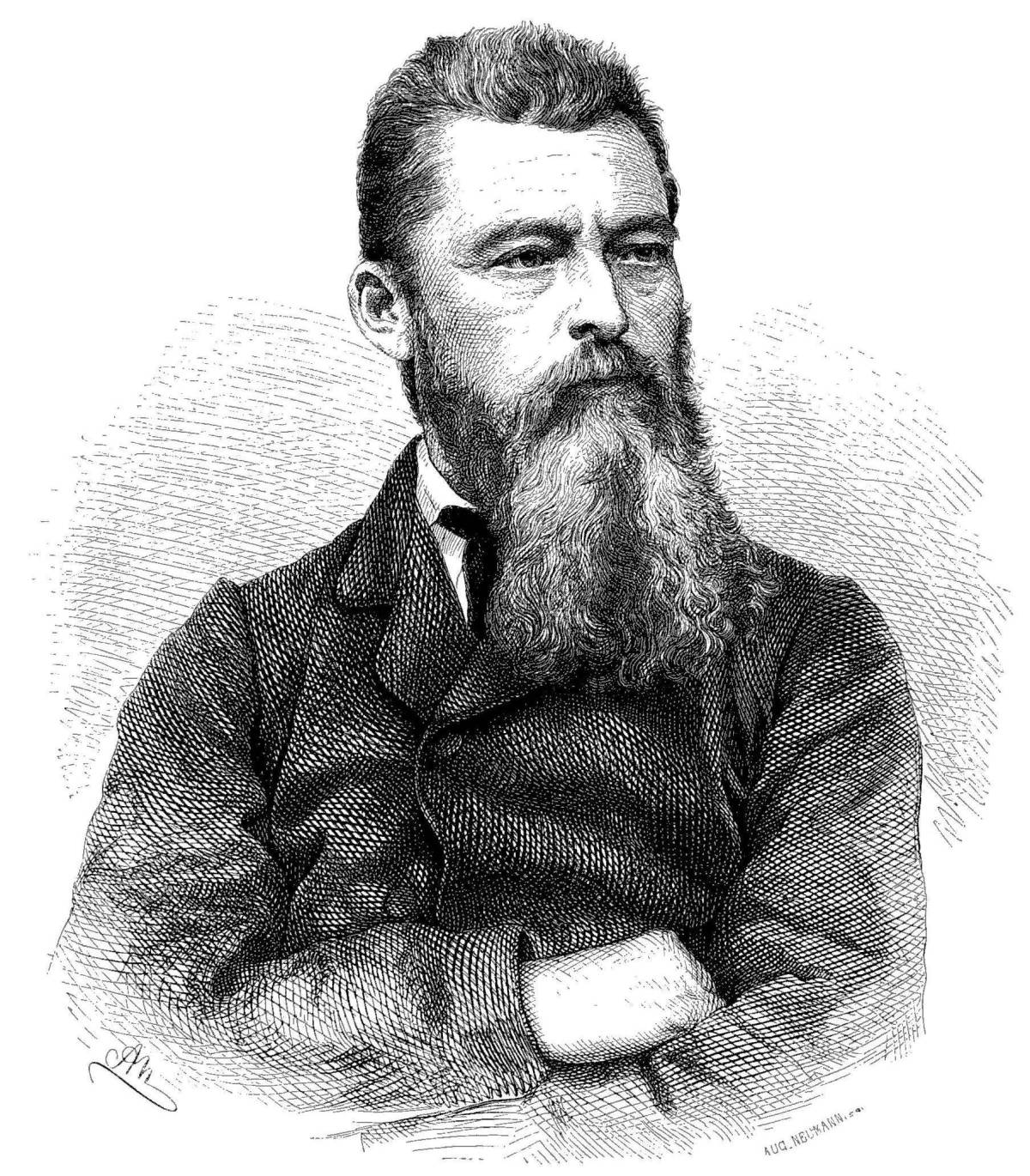
In Marilynne Robinson’s novel Gilead, John Ames is a third generation preacher following his father and grandfather. John recollects that when he was a boy his older brother Edward is sent off to Germany for an education, at the expense of the local congregation. It’s expected that he will become a preacher but he returns an atheist. Edward gives the young John a book by Ludwig Feuerbach: The Essence of Christianity. Edward teases John that he’d better keep his possession of the book hidden from their parents and probably expects that it will topple John’s faith as well. John reads the book but instead follows after his father and grandfather in the ministry. Nevertheless, in the course of the novel he quotes Feuerbach about as much as he quotes the Bible and John Calvin. For Ames Feuerbach is constructive to his faith and deepens it, though his faith is never comfortably settled or static. He allows Feuerbach to trouble him and doesn’t dismiss his critique of Christianity. Ames greatly admires Feuerbach and his thought. I get the sense in reading Gilead that the author Marilynne Robinson, herself a Christian, admires the German philosopher as well.
I read The Essence of Christianity this year and I’ve been going back through and highlighting parts. I can see why the John Ames character liked it and why, I suspect, Marilynne Robinson likes it. On the view that you can evaluate ideas by the strength of their critics Feuerbach is something of a service to Christianity. You could say he’s the kind of critic Christianity deserves. Not perfect. But quite interesting. This is a far cry from a kind of soundbite, “Religion LOL” kind of stone-casting. Feuerbach gives Christianity a serious analysis and, I think, even contributes some interesting theological interpretations of it. Reminds me of Rapoport’s rules, one of which is that “You should attempt to re-express your target’s position so clearly, vividly, and fairly that your target says, ‘Thanks, I wish I’d thought of putting it that way.'” And as I Christian I did say that while reading Feuerbach. I definitely had some disagreements, especially with the general atheistic conclusion. But some of his interpretations of Christianity I thought were quite insightful and things I want to appropriate into my own theology.
A little background on Feuerbach. Like in my previous episode on Hegel, Feuerbach is well-known for his influence on Marx, particularly Marx’s views of religion. You can see that influence and Marx’s differences with Feuerbach in Marx’s Theses on Feuerbach. Friedrich Engels said of The Essence of Christianity that it symbolically marked the end of the period of classical German philosophy that had begun sixty years earlier with the appearance of Kant’s Critique of Pure Reason. This happens to be a period in the history of philosophy that I find very interesting, for theological reasons actually. And I would highly recommend Gary Dorrien’s Kantian Reason and Hegelian Spirit: The Idealistic Logic of Modern Theology. Well, at least to those interested in German Idealism and liberal theology. Anyway, Feuerbach’s break with Hegel and idealism is quite directly stated in his Preface to the Second Edition.
“I unconditionally repudiate absolute, immaterial, self-sufficing, speculation, – that speculation which draws its material from within. I differ toto coelo from those philosophers who pluck out their eyes that they may see better; for my thought I require the senses, especially sight; I found my ideas on materials which can be appropriated only through the activity of the senses. I do not generate the object from the thought, but the thought from the object; and I hold that alone to be an object which has an existence beyond one’s own brain.”
Feuerbach is making a hard turn here toward empiricism. And Feuerbach was also an anthropologist so he is more interested in observational evidence than theoretical speculation. Fortunately he still has plenty of theory and interpretation in his book, fortunate because that makes it more interesting. But he wants to distance himself from Hegel, who saw ideas as paramount. For Hegel everything is part of a whole called Geist, which is both “spirit” and “mind”. Here’s Feuerbach again on this:
“In the sphere of strictly theoretical philosophy, I attach myself, in direct opposition to the Hegelian philosophy, only to realism, to materialism in the sense above indicated… I am nothing but a natural philosopher in the domain of mind; and the natural philosopher can do nothing without instruments, without material means.”
Where Feuerbach is going to go with this is a reduction of religion ultimately anthropology: the study of man. Feuerbach again:
“This philosophy has for its principle, not the Substance of Spinoza, not the ego of Kant and Fichte, not the Absolute Identity of Schelling, not the Absolute Mind of Hegel, in short, no abstract, merely conceptional being, but a real being, the true Ens realissimum – man; its principle, therefore, is in the highest degree positive and real.”
Here he’s contrasting his materialist philosophy with all the big names in idealist philosophy. And the critical part here is his basis in the true real – man. This is his reduction of theology to anthropology. The cliff notes version of Feuerbach is man projects his own attributes into an external being called God. In the Hegelian terms, which Feuerbach is still swimming in of course, this is an alienation of man from himself. In his end critique Feuerbach thinks we should recover our alienated attributes to ourselves, which he believes would constitute atheism and the elimination of religion. Well, maybe, maybe not.
Feuerbach is a lead in to what Paul Ricœur would later call a hermeneutics of suspicion. Ricœur called Marx, Nietzsche, and Freud the “masters of suspicion”. The basic idea of the hermeneutics of suspicion is that the reasons you think that you believe what you do are not the real reasons. Marx, for example, would give an explanation for religion based in economic forces. Religion is opiate for the oppressed. Something to distract them from their oppression and give them false hope. Or so says Marx. Feuerbach’s theory of man projecting his own attributes onto God has a similar kind of hermeneutic of suspicion to it. It’s not what we think we’re doing in our religious belief. But… there’s a useful theological tool here if we choose to use it. To what extent might these critiques have some truth? And can that help us to reevaluate our religious motivations, either to purify them or to deepen our self-understanding?
Feuerbach is quite different in his writing on Christianity than Marx, Nietzsche, or Freud. In my opinion Feuerbach is superior and more interesting theologically. One reason for that has to be that half of Feuerbach’s book aspires to be constructive. The book is divided into two parts. The first part he calls “The True or Anthropological Essence of Religion”. The second part he calls “The False or Theological Essence of Religion”. Both are interesting but I especially enjoyed the first part so most of what follows comes from that. As I went back through the book and highlighted passages I started to sort them by subject so I’ll present them in that way.
Projection
Projection is the most well-known and most important of Feuerbach’s ideas in The Essence of Christianity. Again, this is the idea that humans project their own attributes onto God, basically creating God in their own image. He says:
“Man cannot get beyond his true nature. He may indeed by means of the imagination conceive individuals of another so-called higher kind, but he can never get loose from his species, his nature; the conditions of being, the positive final predicates which he gives to these other individuals, are always determinations or qualities drawn from his own nature—qualities in which he in truth only images and projects himself.”
He also has a beautiful corporeal metaphor to describe this:
“As the action of the arteries drives the blood into the extremities, and the action of the veins brings it back again, as life in general consists in a perpetual systole and diastole; so is it in religion. In the religious systole man propels his own nature from himself, he throws himself outward; in the religious diastole he receives the rejected nature into his heart again.”
Feuerbach finds this ultimately undesirable and encourages people to stop doing that, to reinternalize the qualities we project onto God and see them in ourselves. This is on the one hand because projection diminishes our self-regard: “To enrich God, man must become poor; that God may be all, man must be nothing.” And on the other hand Feuerbach thinks our outward regard is misplaced: “All those dispositions which ought to be devoted to life, to man— all the best powers of humanity, are lavished on the being who wants nothing.”
Still, I don’t think it has to be seen in the ultimately negative way that he sees it. The becoming nothing Feuerbach talks about has a parallel in Christ, which is the Christian doctrine of kenosis, Greek for emptying. More on that later. Whether it’s with God or humanity, self-emptying opens up to receptivity, which I see in a very positive way. There’s also a corresponding exaltation with emptying. For example, from Feuerbach:
“Consciousness of God is self-consciousness, knowledge of God is self-knowledge.”
While we could read this is a kind of nothing-buttery I think it’s something Christians can endorse. It brings to mind the line from Athanasius: “For the Son of God became man so that we might become God.”
Sacred Imminence
Consistent with his desire to re-internalize what we have projected into God Feuerbach seeks to bring the sacred back down to Earth and distribute it in material things. “Let friendship be sacred to thee, property sacred, marriage sacred,—sacred the well-being of every man; but let them be sacred in and by themselves.” On this again, I don’t think the Christian need resist but can rather affirm sacred imminence. In the novel Gilead, John Ames finds Feuerbach’s reinterpretation of the sacred and Christian rituals quite edifying as a Christian minister. The best example of this is Feuerbach’s interpretation of baptism and the Eucharist.
“As, namely, the water of Baptism, the wine and bread of the Lord’s Supper, taken in their natural power and significance, are and effect infinitely more than in a supernaturalistic, illusory significance; so the object of religion in general, conceived in the sense of this work, i.e., the anthropological sense, is infinitely more productive and real, both in theory and practice, than when accepted in the sense of theology.”
“We free ourselves from these and other irreconcilable contradictions, we give a true significance to Baptism, only by regarding it as a symbol of the value of water itself. Baptism should represent to us the wonderful but natural effect of water on man.”
“Bread and wine are supernatural products,— in the only valid and true sense, the sense which is not in contradiction with reason and Nature. If in water we adore the pure force of Nature, in bread and wine we adore the supernatural power of mind, of consciousness, of man.”
“Forget not that wine is the blood of plants, and flour the flesh of plants, which are sacrificed for thy well-being!”
“It needs only that the ordinary course of things be interrupted in order to vindicate to common things an uncommon significance, to life, as such, a religious import. Therefore let bread be sacred for us, let wine be sacred, and also let water be sacred! Amen.”
And I’ve quoted extensively there because those are probably the most famous and significant lines in the book, so well worth being familiar with. I think this is great stuff. Some affinities there certainly with the object-oriented theology we talked about in a previous episode, where religion draws our attention to the here and now, but in a deeper way. I’m with the Reverend Ames on this one. I think this kind of perspective enhances appreciation of the Christian rituals.
Providence
In our previous episode on object-oriented theology the focus of Adam Miller’s book was actually grace and looking at whether grace, as a theological concept, could be “ported” into a material frame. For Adam Miller and Bruno Latour one key feature of grace is that it is an interruption in the flow of cause and effect. And Feuerbach says something similar: “Providence cancels the laws of Nature; it interrupts the course of necessity, the iron bond which inevitably binds effects to causes.” But Feuerbach sees this as occurring in Nature:
“The admiration of Providence in Nature, especially in the animal kingdom, is nothing else than an admiration of Nature, and therefore belongs merely to naturalism, though to a religious naturalism; for in Nature is revealed only natural, not divine Providence—not Providence as it is an object to religion.”
There is spontaneity in Nature, whether at an ontological or epistemological level, i.e. whether it’s genuine spontaneity or just a matter of limitations on our knowledge. But either way it’s remarkable and beautiful. Here again I don’t think an either-or is necessary. Christians can appreciate Providence both in God and in Nature at the same time. In general, I would say that the more medieval perspective, prior to William of Ockham and the nominalists, is very accommodating to the close kinship of God and Nature. Thomas Aquinas understand grace to be the sustaining operation and activity of God in Nature. So these were far from separate.
Morality
Although he doesn’t state it in the precise meta-ethical terms Feuerbach has what I would consider a meta-ethics of moral realism. He says for example: “There may be intelligent beings who are not like me, and yet I am certain that there are no intelligent beings who know laws and truths different from those which I recognise; for every mind necessarily sees that two and two make four, and that one must prefer one’s friend to one’s dog.” So there’s an objective moral reality that all intelligent beings would converge upon. This he sees as making God superfluous as a ground for morality. He says: “Love is not holy because it is a predicate of God, but it is a predicate of God because it is in itself divine. The right, the true, the good, has always its ground of sacredness in itself, in its quality.” In this he’s taking one side of the classic Euthyphro Dilemma of moral philosophy. In other words, if God commands something he commands it because it is good, apart from him. It’s not good by virtue of his commanding it.
Feuerbach believes that the alternative makes morality arbitrary: “If morality has no foundation in itself, there is no inherent necessity for morality; morality is then surrendered to the groundless arbitrariness of religion.” In this he’s basically in agreement with William of Ockham, who said that God could have willed that hating God be the moral action, if he had so chosen. But William of Ockham endorsed this view, while Feuerbach rejects it.
I got into this on a previous episode on the nature of divine law. I’m between Ockham and Feuerbach on this, though I lean more to Feuerbach. But what Feuerbach calls arbitrariness doesn’t bother me as much. I think there are objective facts about reality that are not arbitrary. And these include facts about what is conducive to the sustenance and function of a living organism, i.e. what is good for it. But taking the additional moral step to decide to seek what is good for a living organism seems not to be necessitated by the objective facts themselves. A decision or covenant seems to be required there. And that seems to be what we see in the Hebrew Bible and the Mosaic Law. Conduct was stipulated by a covenant that God and the people of Israel entered into. That seems to be how relationships work. And I don’t think that’s a problem.
Critique of Spiritual Existence
A theme that often pops up in critiques of religion is the difference between religion as popularly understand and religion as understood by the philosophers and theologians. This presents a difficulty because in critiquing anything you generally want to take the strongest version of it, both to be fair and also to be most intellectually interesting. But that also runs the risk of being irrelevant to much of religion as it’s actually practiced and understood.
Sam Harris, our contemporary in the twenty-first century basically picks one side of this and criticizes religion as popular understood. And he takes that really far, basically saying it’s the most extreme, fundamentalist views that are the real, genuine expressions of religion. Harris criticizes religious “moderates” as not being the genuine article and even enablers of the more dangerous religious radicals.
Feuerbach is more complex and, I think, more interesting. He recognizes the problem and while he does argue against the more abstract, philosophical interpretations of the theologians, he doesn’t simply dismiss or ignore them. Much of his book engages with their ideas, taking the strongest version of religion in order to critique it.
He criticizes the idea of “spiritual existence”, which is a mode or way for something to exist. Feuerbach acknowledges that things can have conceptual existence or sensational existence, i.e. things can exist only as abstract concepts or as things available to the senses. But he thinks it is only legitimate to apply to each their own standards. For example:
“The proofs of the existence of God have for their aim to make the internal external, to separate it from man. His existence being proved, God is no longer a merely relative, but a noumenal being (Ding an sich): he is not only a being for us, a being in our faith, our feeling, our nature, he is a being in himself, a being external to us,—in a word, not merely a belief, a feeling, a thought, but also a real existence apart from belief, feeling, and thought. But such an existence is no other than a sensational existence; i.e., an existence conceived according to the forms of our senses.”
So Feuerbach is saying here that proofs for God are making the case for a “sensational” existence. So God is not something ideal or abstract like a mathematical or logical truth, which would be a conceptual mode of existence. But then, he says, there’s a problem:
“But God is not seen, not heard, not perceived by the senses. He does not exist for me, if I do not exist for him; if I do not believe in a God, there is no God for me. If I am not devoutly disposed, if I do not raise myself above the life of the senses, he has no place in my consciousness. Thus he exists only in so far as he is felt, thought, believed in;— the addition “for me” is unnecessary. His existence therefore is a real one, yet at the same time not a real one;— a spiritual existence, says the theologian. But spiritual existence is only an existence in thought, in feeling, in belief; so that his existence is a medium between sensational existence and conceptional existence, a medium full of contradiction.”
So Feuerbach is saying there’s a problem of applying the wrong standards to the wrong mode of existence. If we’re going to argue that God has sensational existence the only way to confirm that is by the senses. “But God is not seen, not heard, not perceived by the senses”. This would be fine if God were merely and abstraction with conceptual existence. But not if we’re arguing for sensational existence.
I see what Feuerbach is getting at here but I don’t go all the way with him on this. And there are a few points I’d make in response.
First, I don’t think it’s correct to say that God has fully sensational existence. He does have sensational existence, particularly in Christ. But he also has conceptual existence. And it would not be appropriate to expect perception by the senses of God’s conceptual existence any more than it would be right to expect perception by the senses of mathematical or logical truth. And I don’t think that’s mere philosophical or theological over-theorizing. Scripture affirms a divine mode of existence that transcends or precedes sensational or physical modes of existence:
“I AM THAT I AM” (Exodus 3:14)
“Without him was not any thing made that was made.” (John 1:3)
“For in him we live, and move, and have our being.” (Acts 17:28)
Those aren’t things that are perceivable by the senses but are, I think, discernible through reason.
Second, to the extent that God does have sensational existence, most importantly in Christ, God was seen, heard, and perceived by the senses. Certainly directly by the people who knew him. And though we’re much farther removed from that we have access to this physical manifestation of God from the scriptural texts. Granted that’s indirect. But when you get down to it, all perception of the senses, even evidence in controlled scientific experiments is mediated to some degree; and “theory-laden” in the case of scientific experiments. That doesn’t prove the existence of God in Christ. But I think it undermines Feuerbach’s point that there’s an invalid application of standards across different modes of existence.
Religion as Distinctively Human
Now we’ll transition into some more especially theological topics and what I see as Feuerbach’s view of religious development. This starts off in first principles with the distinctive nature of human beings, as distinct from animals. Feuerbach says:
“Religion has its basis in the essential difference between man and the brute—the brutes have no religion.
Man is himself at once I and thou; he can put himself in the place of another, for this reason, that to him his species, his essential nature, and not merely his individuality, is an object of thought. Religion being identical with the distinctive characteristic of man, is then identical with self-consciousness—with the consciousness which man has of his nature.”
Self-consciousness will be a very important theme for Feuerbach it was a philosophical concept that was very much in the air at the time, not least from Hegel. What’s interesting here is that even though Feuerbach sees religion as something to be ultimately transcended he pays it the compliment of viewing it as a sophisticated activity that only advanced beings like humans can practice. And that it is even necessarily in the course of human progress.
Elevation Anthropology to Theology
Feuerbach maintains that his work is not all negative or destructive. Again, something that makes his critique more interesting I think. He says:
“But so far from giving a trivial or even a subordinate significance to anthropology,— a significance which is assigned to it only just so long as a theology stands above it and in opposition to it,— I, on the contrary, while reducing theology to anthropology, exalt anthropology into theology, very much as Christianity, while lowering God into man, made man into God.”
This is somewhat similar to the topic I referred to as sacred imminence. For Feuerbach religion is not just useless dross. It has important anthropological function and is instrumental in the realization of truth, something he sees as a process.
Religion as Process
Although he contrasts his materialism from Hegel’s idealism, there is much in Feuerbach that is still very Hegelian. This is certainly the case in his notions of process and the development of religious thought, proceeding into what he views as the eventual transcending of religion. Even if one doesn’t want to leave religion behind as he does I think there is important theological insight in seeing religion as process.
For Hegel, especially in his monumental Phenomenology of Spirit, truth is realized in a process of epic scope. And Hegel also saw religion playing a vital role in the progression of truth. Hegel had a concept of “picture thinking”, the more visceral and physical elements of religion that could ultimately be transcended for more direct access of ultimate truth, which he called Geist, “spirit” or “mind”. For Hegel this never leaves God behind but rather always proceeds toward God.
Feuerbach has similar ideas. Like Hegel he sees self-consciousness as an important phase in the process of developing knowledge. And he sees religion as instrumental to that. He says:
“Religion is the first form of self-consciousness. Religions are sacred because they are the traditions of the primitive self-consciousness.”
So religion is right there from the start at the most basic level. But things proceed from there. He says that “every advance in religion is therefore a deeper self-knowledge.” And this idea is related to projection but not entirely dependent on it. I think this is a fantastic perspective. That we use the tools provided by religion for greater self-understanding. That seems right on. Through the progress of history he sees the accoutrements gradually being stripped off toward more direct self-understanding that is also more aware of it being understanding of self.
“The course of religious development which has been generally indicated consists specifically in this, that man abstracts more and more from God, and attributes more and more to himself. This is especially apparent in the belief in revelation. That which to a later age or a cultured people is given by nature or reason, is to an earlier age, or to a yet uncultured people, given by God.”
Feuerbach sees Christianity as further along on the scale of religious progress. Hegel did as well but unlike Hegel Feuerbach doesn’t see Christianity as the terminus. But like many of his contemporaries this carried certain anti-Jewish and probably anti-Semitic views.
“The Christian religion, on the other hand, in all these external things made man dependent on himself, i.e., placed in man what the Israelite placed out of himself in God. Israel is the most complete presentation of Positivism in religion. In relation to the Israelite, the Christian is an esprit fort, a free-thinker. Thus do things change. What yesterday was still religion is no longer such to-day; and what to-day is atheism, to-morrow will be religion.”
In his view Christianity re-integrated certain of the aspects that Judaism had projected onto God back into man. I’ve mentioned in a previous podcast that there are two ways to respond to that. One is to dispute some of the claims made about ancient Israelite religion and ancient Judaism. And that’s certainly doable. Another is to point out the Judaism has also been progressing and developing for the past two millennia right alongside Christianity. So the dynamic nature of religion is present in both.
God the Father as Understanding
The remaining topics all pertain to the Trinity and we’ll start with God the Father. Feuerbach says of the Father:
“God as God— as a purely thinkable being, an object of the intellect— is thus nothing else than the reason in its utmost intensification become objective to itself.”
Here Feuerbach seems to be quite familiar with historical Christian theology and classical theism. There’s a line of thought going through Plato, Aristotle, Augustine, and Aquinas that sees God as pure intelligibility. Aristotle described God as νοήσεως νόησις, self-thinking thought. For Augustine the ultimate goal of human life and Christian faith was revelation of God in the form of intellectual vision.
The Protestant theologian Paul Tillich also spoke of the “God above God” to get at this quality of God as transcending our imagistic conceptions of him. Feuerbach has a similar idea when he says “Thus above the divine omnipotence stands the higher power of reason.”
Act and Acted Upon
Feuerbach sees thought as an essential characteristic of being an acting subject. In the language of The Book of Mormon this could be the difference between things acting and things acted upon. Feuerbach says:
“Thinking is existence in self; life, as differenced from thought, existence out of self: life is to give from oneself; thought is to take into oneself. Existence out of self is the world; existence in self is God. To think is to be God.”
That’s the thing acting, to which thought is essential. Then on the other hand:
“To be without understanding is, in one word, to exist for another,— to be an object: to have understanding is to exist for oneself,—to be a subject.”
So God the Father as thought and understanding is active in the greatest sense.
Trinity as Relation and Self-Consciousness
But in Christianity monotheism is complicated because there are three persons: Father, Son, and Holy Ghost. Leaving aside the question of how those three are one there’s another, maybe even more basic and interesting question: Why not just one? Why is it not just God the Father alone? This could be the fundamental theological Christian question and it’s on this question that I think Feuerbach does his greatest service to theology.
Feuerbach sees the need for the trinity in self-consciousness and relation. First, on self-consciousness he says:
“The objectivity of self-consciousness is the first thing we meet with in the Trinity.”
Then on relation:
“Religion is man’s consciousness of himself in his concrete or living totality, in which the identity of self-consciousness exists only as the pregnant, complete unity of I and thou.”
I’ll point out here that we’re again seeing Feuerbach swimming in the influence of Hegel. I mentioned in a previous episode on Hegel his allegory of the master and slave, which has carried so much currency in Marxism but as originally intended as thought device on the emergence of self-consciousness. The interpersonal struggle between the master and slave induces self-consciousness because one must imagine the perspective of another self-consciousness outside one’s own. Feuerbach is proposing a similar idea here, that in order to be self-conscious the Father must have another with whom to relate. And along the lines of reducing theology to anthropology and the elevation of anthropology to theology he says:
“This want is therefore satisfied by religion thus: in the still solitude of the Divine Being is placed another, a second, different from God as to personality, but identical with him in essence,— God the Son, in distinction from God the Father. God the Father is I, God the Son Thou. The I is understanding, the Thou love. But love with understanding and understanding with love is mind, and mind is the totality of man as such—the total man.”
In Feuerbach’s view this interaction within the Trinity is a more adequate projection of man’s nature.
“Only a being who comprises in himself the whole man can satisfy the whole man. Man’s consciousness of himself in his totality is the consciousness of the Trinity.”
Christ as Mediator
This multiplicity of persons allows for the concept of God to have multiple and even seemingly incompatible attributes. God the Father is understanding. But God as understanding only would be inadequate and unsatisfying since we are material beings. A second person can mediate between these two orders of reality. This Mediator is Christ.
“The God in the background of the Mediator is only an abstract, inert conception, the conception or idea of the Godhead in general.”
“The Son is the satisfaction of the need for mental images, the nature of the imaginative activity in man made objective as an absolute, divine activity.”
There are a couple levels of looking at this, one philosophical and one anthropological or psychological. Philosophically I think we can see Feuerbach situated in the influence of Immanuel Kant. This gets pretty clear when he uses Kantian terminology:
“The second Person is intermediate between the noumenal nature of God and the phenomenal nature of the world, that he is the divine principle of the finite, of that which is distinguished from God.”
For Kant noumenon is the thing in itself apart from our perceptions and phenomenon is our perception of it. In Kant’s philosophy the noumenon is always mediated by the phenomenon. We don’t have direct access to the things in themselves. For example, I don’t perceive the things I see directly. My experience of sight is the result of a chain of events including impinging photons, photochemical reactions, action potentials, etc. Kant is the most direct influence but this idea definitely goes back a long way. Certainly it’s in Plato with the allegory of the cave and the allegory of the Sun (S-U-N) in which the ultimate reality, like the sun, cannot be seen directly but indirectly because of its overwhelming brilliance, a kind of brilliant darkness.
But this philosophical idea leads into the theological one.
“No man hath seen God at any time; the only begotten Son, which is in the bosom of the Father, he hath declared him.” (John 1:18)
“He that hath seen me hath seen the Father.” (John 14:9)
We see God through Christ. Christ is that mediator. Feuerbach says:
“The psychological truth and necessity which lies at the foundation of all these theogonies and cosmogonies is the truth and necessity of the imagination as a middle term between the abstract and concrete.”
I like that way of putting it, Christ as a “middle term” that connects these two orders of reality.
The Son as Word
Along similar lines, the Son plays a role as mediator at a more conceptual level in the form of the Word, ὁ Λόγος. Feuerbach comments how language is essential to our human understanding.
“Connected with the nature of the image is another definition of the second Person, namely, that he is the Word of God. A word is an abstract image, the imaginary thing, or, in so far as everything is ultimately an object of the thinking power, it is the imagined thought: hence men, when they know the word, the name for a thing, fancy that they know the thing also. Words are a result of the imagination. Sleepers who dream vividly and invalids who are delirious speak. The power of speech is a poetic talent. Brutes do not speak because they have no poetic faculty. Thought expresses itself only by images; the power by which thought expresses itself is the imagination; the imagination expressing itself is speech.”
The word, or language, is another kind of mediation. And you could say there’s a kind of Christological semiotics here. Christ is behind all things that were made, without him was not anything made that was made. So he is in all things. And then we know and speak of these things, these referents by way of signs, and that’s the subject of the study of semiotics. The general notion of such signs is Word itself, which is Christ.
The Son as Love
Another attribute the Son contributes to the nature of God is love. Feuerbach says:
“It is true that theology, which is pre-occupied with the metaphysical attributes of eternity, unconditionedness, unchangeableness, and the like abstractions, which express the nature of the understanding,—theology denies the possibility that God should suffer, but in so doing it denies the truth of religion. For religion—the religious man in the act of devotion believes in a real sympathy of the divine being in his sufferings and wants, believes that the will of God can be determined by the fervour of prayer, i.e., by the force of feeling, believes in a real, present fulfilment of his desire, wrought by prayer.”
As intellectually satisfying as I find the Platonic/Augustinian notion of “intellectual vision” of God Feuerbach certainly has a point here that there’s a lot more to religious practice than that. Much of religious life is non-rational and emotional. The act of prayer, as he mentions, is an act of faith in God’s loving nature, in his concern for humanity. This human affection we find in Christ.
Feuerbach says “we also believe in a being, who has, if not an anatomical, yet a psychical human heart.” But with Jesus we even get the anatomical heart and affective brain of a human being.
Feuerbach sees prayer is the principal manifestation of this understanding of God. He says, “Every prayer discloses the secret of the Incarnation, every prayer is in fact an incarnation of God.” And that is because of Christ’s humanity and love.
Related to this is Christ’s self-emptying, the kenosis that I mentioned earlier. It’s true that we may lower ourselves for God’s sake but God also does the same for us:
“God, for the sake of man, empties himself of his Godhead, lays aside his Godhead.”
“How can the worth of man be more strongly expressed than when God, for man’s sake, becomes a man, when man is the end, the object of the divine love?”
And I think that’s an excellent statement of the infinite worth of human beings, which I consider one of Christianity’s most significant practical contributions to the world. We must never lose that perspective and see anyone with less than that infinite worth.
Incarnation as Manifestation of God in Man
Lastly, in the Incarnation we return to the affinity between God and man. We see this in Feuerbach’s theory of projection of course; that’s his reinterpreted, anthropological interpretation. But the idea is not dissimilar in the original conception of Incarnation. In the Incarnation God becomes human and is manifest to us as human. As Feuerbach says, “The Incarnation is nothing else than the practical, material manifestation of the human nature of God.” That seems perfectly consistent with Christianity and orthodoxy.
Feuerbach has an interest theory on this that the Incarnation presupposes a pre-existing affinity, a kind of potentiality that was already there and then actualized in the Incarnation itself.
“But the incarnate God is only the apparent manifestation of deified man; for the descent of God to man is necessarily preceded by the exaltation of man to God. Man was already in God, was already God himself, before God became man, i.e., showed himself as man.”
This is a fascinating idea and I wonder if an orthodox theological appropriation is possible. In my native Latter-day Saint religion there is a notion of every human being being a “god in embryo” from the start. So it’s not too big a leap. The Latter-day Saint belief in individuated, self-conscious pre-mortal existence helps as well.
That may be too far for traditional Christianity to stretch. But an non-individuated, non-conscious existence might be more compatible. The Hebrew Bible has the notion of tzelem (צֶלֶם), image, the image of God in which humanity is created. “Let us make man in our image, after our likeness.” (Genesis 1:26) There is a likeness, demuth (דְּמוּת), shared between God and humanity. So that when God becomes Incarnate in Christ there’s not an absolute chasm to cross to something altogether foreign. In a sense God in Christ is recovering something of himself by becoming human.
This brings up again the idea that, taking seriously the shared divinity of God and human beings we ought to reverence human beings. As C.S. Lewis has said, “There are no ordinary people. You have never talked to a mere mortal.” Feuerbach also says, “When I love and worship the love with which God loves man, do I not love man; is not my love of God, though indirectly, love of man?” Indeed it is. And this is such an important concept that needs to stick around and that Christianity, whether traditional Christianity or a Christianity that’s gone through dialectical development of the kind either Hegel or Feuerbach envision, it’s a concept that Christianity needs to continue to preach. Preach the divinity of humanity.
So whatever the ultimate nature of his intentions – and they were rather complex – I’m grateful to have Feuerbach’s writings, for him both as a worthy and productive adversary to Christian thought and even as a contributor to Christian theology.


 Todd Decker