Jared and Todd talk about ontological pluralism: What exists? How do we categorize what exists? Are those categories intrinsic or man-made? A related idea is perspectival realism. We discuss the ideas of William Wimsatt and Scott Page, among others. Is reality monistic, dualist, pluralistic? Is the question even meaningful? And what (if any) practical implications would there be?
Outline – Ontological Pluralism
People
William Wimsatt
Scott Page
Johannes Jaeger
Lawrence Cahoone
Spencer Greenberg
Ideas
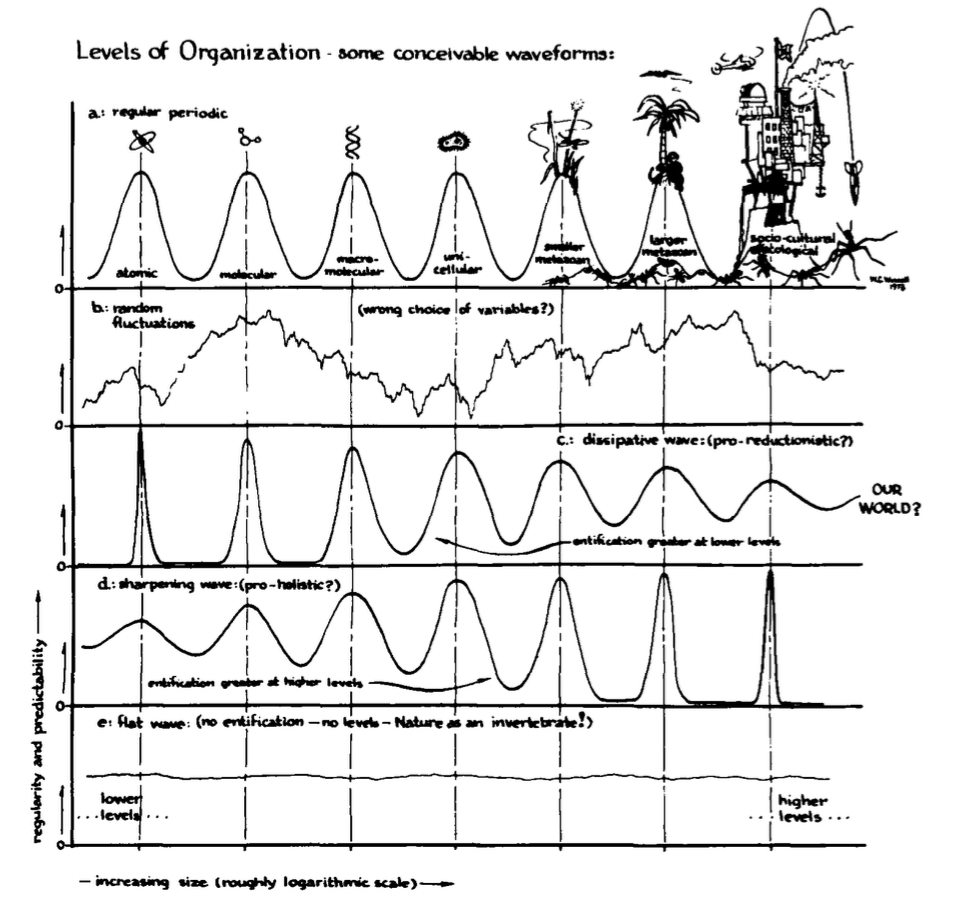
Rainforest Ontology (Wimsatt)
Realms of Truth (Greenberg)
Perspectival realism
Meta-modernism (post-postmodernism)
Ontologies
Monism
Dualism
Matter
Mind
Trialism (Penrose)
Physical world
Mental world
Platonic mathematical world
Pluralism
Reductionism
Ontological: reality is composed of a minimum number of kinds of entities and substances
Epistemological: reality is best explained by reduction to its most basic kinds of entities and substances
Todd: in-principle epistemological reductionist but not an ontological reductionist. Everything that happens in a physical system evolves according to physical laws but those physical processes don’t constitute all there is.
Can a macro-scale entity really be completely inexplicable in terms of micro-scale entities?
Micro-scale events may only make sense in terms of macro-scale events.
Ex: Enzymes and reactants
Enzyme is larger and more complex than the reactants
The speed of the reaction only makes sense by accounting for the enzyme
But the enzyme is still explained in terms of smaller-scale entities (amino acids, atoms, etc.)
Seven Realms of Truth – Spencer Greenberg
Some things “exist” in the sense that they are in physical reality, like atoms (in “Matter Space”).
Other things may “exist” in the sense that they are real experiences conscious beings have, like the taste of pineapple (in “Experience Space”).
Still, other things may “exist” in the sense that they are shared constructs across multiple minds, like the value of money (in “Consensus Space”).
Other things may “exist” in the sense of being conclusions derived from frameworks or sets of premises, like consequences of economic theories (in “Theory Space”).
Some may “exist” in the sense that they are represented in systems that store or process information, such as the information in a database (in “Representation Space”).
If universal moral truths “exist” (e.g. objective facts about what is right and wrong), then we can talk about moral rules existing (in “Morality Space”).
Finally, if supernatural entities “exist”, such as spirits (meaning that not all beings inhabit Matter Space), then these beings are in a different realm than us (in “Supernatural Space”).
Tropical Rainforest Ontology (Wimsatt)
Contra Quine
Willard van Orman Quine once said that he had a preference for a desert ontology.
Robustness
Criterion for what is real
“Things are robust if they are accessible (detectable, measurable, derivable, defineable, produceable, or the like) in a variety of independent ways.
Local
Criteria used by working scientists
“The nitty-gritty details of actual theory, actual inferences from actual data, the actual conditions under which we poised and detected entities, calibrated and ‘burned in’ instruments, identified and rejected artifacts, debugged programs and procedures, explained the mechanisms behind regularities, judged correlations to be spurious, and in general, the real complexities and richness of actual scientific practice.”
Levels
Dissipative wave (pro-reductionistic)
Sharpening wave (pro-holistic)
Perspectives
“As long as there are well-defined levels of organization, there are relatively unambiguous inclusion or compositional relations relating all of the things described at different levels of organization… But conversely, when neat compositional relations break down, levels become less useful as ways of characterizing the organization of systems–or at least less useful if they are asked to handle the task alone. At this point, other ontological structures enter, either as additional tools, or as a replacement. These are what I have called perspectives–intriguingly quasi-subjective (or at least observer, technique or technology-relative) cuts on the phenomena characteristic of a system,which needn’t be bound to given levels.”
“What I am calling perspectives is probably a diverse category of things which nonetheless appear to have at least some of the properties of being ‘from a point of view’ or to have a subjective or quasi-subjective character.”
Causal Thickets
“This term is intended to indicate a situation of disorder and boundary ambiguities. Perspectives may still seem to have an organizing power (just as viewing a thicket or shrub from different sides will reveal a shape to its bushy confusion), but there will be too many boundary disputes.”
The primacy of Logos entails that all things are intellectually structured, that the order of reality is rationally intelligible. All things come to pass in accordance with the Logos (Heraclitus) and all things were made through the Logos (John 1:3). This episode looks at Logos through the thought of Benedict XVI, who calls Logos the intellectual structure of being. The implications are significant to our general understanding of reality. Even more significant is the identification of the Logos with the person Jesus Christ.
My deep dive, theological and philosophical topic of study lately has been the Logos, a term that in Christian scripture is used to describe Jesus Christ. The Gospel of John opens, speaking of Christ, saying:
“In the beginning was the Word, and the Word was with God, and the Word was God. He was in the beginning with God. All things were made through Him, and without Him nothing was made that was made.” (John 1:1-3)
The word translated here as “Word” is Logos (Λόγος) and it’s often referred to in theology by just using the Greek term, which I’ll do in this episode. As I did with the episode on Hell, I’ve been reading the scriptures, early Church Fathers, and theologians throughout history to learn what they’ve had to say on the subject. There’s a lot there and I’d love to share it all at some point. But I eventually decided to break it down into more manageable parts.
Part of the reason for this, beyond just deciding to make it easier on myself, is that I came across a fantastic treatment of the Logos by Joseph Ratzinger, later Pope Benedict XVI, in his 1968 book Introduction to Christianity. Calling it an “introduction” may be a stretch, but regardless the book is excellent and I found that he put into words pretty much exactly what I wanted to say and understand about Logos. So with this episode I’d like to focus on Benedict’s theology of Logos in that book. And maybe, hopefully, go into more of a historical study later in another episode.
What is Logos? My own definition is that the Logos is the rational order of all things. Benedict refers to Logos as “intellectual structure”; and I love that. I’ve been trying to work out my own philosophy of structure so that description definitely gets my attention.
Logos has been a term of philosophical significance going back to at least Heraclitus (535 – 475 BC). Heraclitus said all things come to pass in accordance with the Logos (γινομένων γὰρ πάντων κατὰ τὸν λόγον, ginomenon gar panton kata ton logon). Or put another way, the Logos is what makes all things come to pass in the way that they come to pass. This is quite similar to the statement in the Prologue to the Gospel of John:
“All things were made (egeneto) through Him, and without Him nothing was made that was made.” (John 1:3)
Both Heraclitus and the Gospel writer used the word γίνομαι (ginomai): to become, to happen. All becoming, all happening, proceeds only in accordance with and not without the Logos.
As someone who is always trying to understand things I find this concept very interesting and important. And it’s a subject in which my scientific, philosophical, and theological interests converge. Every “why” and “how” question ultimately falls under the umbrella of the Logos. If you ever think about why something is the way it is or works the way it does you are pursuing the Logos. To one degree or another, everyone is pursuing the Logos. But what I find especially useful about it is that as a concept it serves as a way to unify and systematize our thinking about all these things.
Another way of describing Logos that I read recently and quite liked is as “an interlocking system of ideas”. I read that one from Edward Feser (Five Proofs of the Existence of God, 104-105, 110). That is not by any means an exhaustive description of what the Logos is. But it’s one description. An interlocking system of ideas. If you think about everything that happens what is it that makes it all happen the way it does? Just thinking of it from a purely scientific, physicalist, closed-system perspective. Laws of physics? Constraints of logic? I think that’s right. We often predict the evolution of a system over time with some set of starting and boundary conditions. Such a system is governed by an interlocking system of ideas.
So now let’s look at Benedict. First quote, he says:
“Christian faith in God means first the decision in favor of the primacy of the logos as against mere matter. Saying “I believe that God exists” also implies opting for the view that the logos—that is, the idea, freedom, love—stands not merely at the end but also at the beginning, that it is the originating and encompassing power of all being.”
Let’s break this down. Benedict is starting with the philosophical idea that Christianity holds in common with Hellenistic philosophies like Platonism, Stoicism, and Neo-Platonism. It’s a metaphysical stance. What is the nature of reality? Is it strictly material? Does reality consist only of “atoms and the void”, in the words of Democritus (c. 460 – c. 370 BC)? This would be what Benedict calls “mere matter”. The alternative is “the primacy of the logos”. Matter exists and it’s important. But it’s secondary, not primary. Logos is primary. Matter is derivative of and secondary to Logos.
Benedict calls Logos “intellectual structure”. So this means that prior to all matter there is an intellectual structure undergirding it. Why should we think this?
Let’s look at three quotes on this:
“In the old Pythagorean saying about the God who practices geometry there is expressed that insight into the mathematical structure of being which learns to understand being as having been thought, as intellectually structured; there is also expressed the perception that even matter is not simply non-sense that eludes understanding, that it too bears in itself truth and comprehensibility that make intellectual comprehension possible.”
“The intellectual structure that being possesses and that we can re-think is the expression of a creative premeditation, to which they owe their existence.”
“All our thinking is, indeed, only a rethinking of what in reality has already been thought out beforehand.”
Put briefly we ought to consider reality as intellectually structured because we can intellectually understand it. Not entirely of course. But everywhere we look, the more we look at the universe we find intelligible structure. It’s not just utter chaos but reality is actually something that we’re able to make sense of.
So the order of reality is rational and intelligibile to us. But is it more than that? Is there some kind of rational intelligibility per se. Say that there were no intelligent beings in the universe at all. Would it still make sense to call it a rational order or rational and intelligible? Maybe. Consider three possibilities:
1. The rationality of reality is a conditional property, conditional on there being intelligent beings in reality. 2. The rationality of reality is independent of any intelligent beings. 3. The rationality of reality is the rationality of a mind that grounds reality.
In the first option the rationality of reality is a conditional feature, a feature that reality would have if certain conditions are met, even if they are not otherwise actualized. Something of the form:
1. IF there are intelligent beings in reality. 2. AND IF any existing intelligent beings obtain some degree of accurate understanding of reality. 3. THEN such intelligent beings will find reality to be intelligible and rational.
This is probably the option that seems most immediately plausible and straightforward.
The second option moves away from a subjective understanding of rationality to an objective understanding. This gets a little tricky because just by talking about rationality, or anything, we’re using language and terms that are human constructions. How can you talk about something independent of thought and first-person experience when the very terms we are using to talk about it are creations of thought and first-person experience? There’s a passage from Richard Rorty that I find helpful here:
“We need to make a distinction between the claim that the world is out there and the claim that truth is out there. To say that the world is out there, that it is not our creation, is to say, with common sense, that most things in space and time are the effects of causes which do not include human mental states. To say that truth is not out there is simply to say that where there are no sentences there is no truth, that sentences are elements of human languages, and that human languages are human creations. Truth cannot be out there – cannot exist independently of the human mind – because sentences cannot so exist, or be out there. The world is out there, but descriptions of the world are not. Only descriptions of the world can be true or false. The world on its own – unaided by the describing activities of human beings – cannot.” (Rorty, Contingency, Irony, and Solidarity)
This is a very fine distinction and it can be easily confused. But it’s about the best explanation I’ve found of the problem at hand: how to talk about reality as it is independent of language, how to think about reality as it is independent of thought. Immanuel Kant’s concepts of noumena and phenomena are also useful for those familiar with them, otherwise they require some significant introduction.
So how would reality be rational per se, independent of any intelligent beings? One way of understanding rationality is consistency. For intelligent beings instrumental rationality is consistency between actions and intentions. But apart from intelligent beings we could think of consistency between states of affairs. At a most basic level, noncontradiction. For some state of affairs, S, it won’t be the case that both S and not-S.
That can get a little complicated and require different levels of states of affairs. For example, in quantum mechanics we see superpositions of states in which it might seem that both S and not-S could indeed be the case. But I think that’s resolvable by understanding any such superpositions of states as merely part of a higher-level state. In the case of a quantum superposition the relevant level of consistency would not be the superposed states, or eigenstates, but the probability amplitude of the quantum system. For more on that see my earlier episode on quantum properties (Quantum Properties, 5 Oct 2020). That might actually give reason to think that the rationality of reality is intrinsically independent of the thought and first-hand experience of intelligent beings. Because intelligent beings might mistakenly see inconsistency where there is actually unseen consistency and rational order.
The third option is that the rationality of the rational order is actually the rationality of a rational mind. Such a mind would be very unique, absolutely unique actually. This would be a mind grounding all reality. This is the view taken by Pope Benedict and many Christian theologians, that the rational order, the Logos, is the intellectual activity of God.
Benedict proposes a crucial parallelism between God’s thought and our own. All thinking is rethinking, “a rethinking of what in reality has already been thought out beforehand”. What people re-think is “the expression of a creative premeditation, to which they owe their existence”. The Creation was an act of intellect and speech, something attested in scripture, both in Genesis and in John. How did God create?
וַיֹּ֥אמֶר אֱלֹהִ֖ים יְהִ֣י אֹ֑ור וַֽיְהִי־אֹֽור׃
καὶ εἶπεν ὁ Θεός· γενηθήτω φῶς· καὶ ἐγένετο φῶς.
“Then God said, ‘Let there be light’; and there was light.” (Genesis 1:3)
God said (vayomer elohim). God’s creative activity was an act of speech. That creation was an act of intellect was a view also held by the second century Jewish philosopher Philo of Alexandria (25 B.C. – 50 A.D.) Philo was very educated in both Jewish and Greek learning. Notably in his writings he makes frequent use of a Platonic idea of the image (εἰκών, eikon), which in Platonic thought is a form after which all things are patterned. Philo understood the God of Israel to have had these kinds of images in His intellect. For example, in his commentary On the Creation:
“Now we must form a somewhat similar opinion of God, who, having determined to found a mighty state, first of all conceived its form in his mind, according to which form he made a world perceptible only by the intellect, and then completed one visible to the external senses, using the first one as a model (ἐκείνῳ, ekeino). As therefore the city, when previously shadowed out in the mind of the man of architectural skill had no external place, but was stamped solely in the mind of the workman, so in the same manner neither can the world which existed in ideas (τῶν ἰδεῶν κόσμος, ton ideon kosmos) have had any other local position except the divine reason (τὸν θεῖον λόγον, ton theion logon) which made them.” (De Opificio, 19-20)
Philo imagines the process of Creation as an act of planning things out and that the “location”, so to speak, of this planning out was in the divine reason (τὸν θεῖον λόγον, ton theion logon). It is this “creative premeditation” that Benedict understands us to retrace whenever we come to understand the workings of reality in the universe in our own minds. We can retrace the divine thought in our own minds because there is divine thought there to retrace.
Let’s look again at the three possible understandings of the rational order of reality:
1. The rationality of reality is a conditional property, conditional on there being intelligent beings in reality. 2. The rationality of reality is independent of any intelligent beings. 3. The rationality of reality is the rationality of a mind that grounds reality.
All three can be interpreted theistically, i.e. in terms of God. We can think of the first two options, especially the second, as describing a kind of “God of the philosophers”. A God who is not especially personal or much like God as we read about Him in the Bible. More like an abstract principle.
The third view is Philo’s and also that of Judaism and Christianity. Philo shared many ideas about God, or the Logos, as held by the Hellenistic philosophies of his day, like Stoicism, Platonism, and Neo-Platonism. But he also affirmed more than this. Philo held the third view, that the rationality of reality is the rationality of a mind that grounds reality. The God of Israel is more than the God of the philosophers.
Pope Benedict stresses this point:
“It becomes easy to see the barrier to equating the ‘God of faith’ and the ‘God of the philosophers’ constituted by a narrow and insufficiently pondered concept of person.”
“The mathematician discovers the mathematics of the cosmos, the being-thought-ness of things; but no more. He discovers only the God of the philosophers.”
“Because in its investigations it [physics] abstracts, in accordance with its nature, from the aesthetic feeling and from the moral attitude, questions nature from a purely mathematical point of view, and consequently can also catch sight only of the mathematical side of nature.”
I think it’s quite remarkable and significant that “the mathematician discovers the mathematics of the cosmos, the being-thought-ness of things”. Let’s not downplay that. That’s a big deal. That kind of intellectual vision of transcendent, immaterial realities is an important breakthrough. It was something along these lines that helped Augustine of Hippo (354 – 430) in his intellectual development and eventual conversion to Christianity, when he read “certain books of the Platonists” and “having read then those books of the Platonists, and thence been taught to search for incorporeal truth” he saw the “invisible things, understood by those things which are made.”
That’s important. But it doesn’t get us all the way to the personal Father, Son, and Holy Spirit. Disciplines do what they are intended to do. You find what you’re looking for. Many phenomena lend themselves to mathematical description and modeling. Models don’t intend or claim to capture everything. They’re maps not replications. As Benedict says, aesthetic feelings and moral attitudes don’t factor into the investigations of physics because they don’t have to. We all know that they are there. But for some tasks we don’t have to consider them. But for other tasks we do. For other tasks aesthetic feelings and moral attitudes are central. And so thinking about them requires different techniques that don’t abstract away from them. Mathematics and the sciences do bring us to God. It’s a kind of communion. But there is further communion to be had, to recognize the personal God we find in scripture and in Jesus Christ.
Benedict makes an important connection between intellectual structure and the act of intellect that can be understood to underlie it:
“The world is objective mind; it meets us in an intellectual structure, that is, it offers itself to our mind as something that can be reflected upon and understood. From this follows the next step. To say ‘Credo in Deum—I believe in God’ expresses the conviction that objective mind is the product of subjective mind and can only exist at all as the declension of it, that, in other words, being-thought (as we find it present in the structure of the world) is not possible without thinking.”
This is an interesting idea. I don’t think it’s exhaustively proven here but it makes a lot of sense in my opinion. Benedict connects three ideas:
1. Intellectual structure 2. Objective mind 3. Subjective mind
Intellectual structure is the intelligibility of reality. We can think about it and make sense of it in our intellect. There is at least an “as-if” quality to the intelligibility of reality. It is structured “as if” rationally constructed. Let’s call this objective mind. But is it just that? Or is there actually a subjective mind behind the objective mind that is actually doing the thinking, so that it is not merely thinking “as if” but thinking “in-fact”? That’s the move Benedict makes.
Benedict then takes this idea and places it in the context of three major metaphysical systems. Metaphysics concerns the ultimate nature of reality; the question of all questions:
“The question to which everything finally leads could be formulated like this: In all the variety of individual things, what is, so to speak, the common stuff of being—what is the one being behind the many ‘things’, which nevertheless all ‘exist’?”
Benedict then looks at three possible answers to this question; three metaphysical systems:
1. Materialism 2. Idealism 3. Christianity
“The many answers produced by history can finally be reduced to two basic possibilities. The first and most obvious would run something like this: Everything we encounter is in the last analysis stuff, matter; this is the only thing that always remains as demonstrable reality and, consequently, represents the real being of all that exists—the materialistic solution. The other possibility points in the opposite direction. It says: Whoever looks thoroughly at matter will discover that it is being-thought, objectivized thought. So it cannot be the ultimate. On the contrary, before it comes thinking, the idea; all being is ultimately being-thought and can be traced back to mind as the original reality; this is the ‘idealistic’ solution.”
What Benedict has been saying up to this point, making the case for the intellectual structure and mind behind all reality fits quite well with idealism. But he will argue that idealism is not the final stop. There is more to reality than just idea:
“The Christian belief in God is not completely identical with either of these two solutions. To be sure, it, too, will say, being is being-thought. Matter itself points beyond itself to thinking as the earlier and more original factor. But in opposition to idealism, which makes all being into moments of an all-embracing consciousness, the Christian belief in God will say: Being is being-thought—yet not in such a way that it remains only thought and that the appearance of independence proves to be mere appearance to anyone who looks more closely. On the contrary, Christian belief in God means that things are the being-thought of a creative consciousness, of a creative freedom, and that the creative consciousness that bears up all things has released what has been thought into the freedom of its own, independent existence. In this it goes beyond any mere idealism.”
This is a fascinating idea. This is what moves Christianity beyond Platonism. In a sense, it brings us back to the material world, but with a renewed and richer understanding of it; no longer “mere matter”. The material world and, what is especially important, our physical bodies are not just illusions or mental projections. They are real. Logos, the divine intellect, is generative not only of all things but also of more intellects with powers to think on their own. And Benedict actually makes this kind of freedom foundational:
“In the Christian view what supports it all is a creative freedom that sets what has been thought in the freedom of its own being.”
“At the beginning of all being it puts not just some kind of consciousness but a creative freedom that creates further freedoms. To this extent one could very well describe Christianity as a philosophy of freedom. For Christianity, the explanation of reality as a whole is not an all-embracing consciousness or one single materiality; on the contrary, at the summit stands a freedom that thinks and, by thinking, creates freedoms, thus making freedom the structural form of all being.”
What I see as one of the essential features of Christian thought is an insistence on the reality, importance, and goodness of matter and physical bodies. This is especially evident in the doctrines of Incarnation and resurrection. In the Incarnation Christ became human with a material body. Not only that, but after he died he was resurrected and became embodied again. And that is our ultimate destiny as well. We humans are physically embodied beings. Our bodies are not meant to be escaped and transcended. Our bodies are essential to who we are. And so our salvation necessarily consists in our eventual resurrection as individual, embodied beings. We have our own personal identities and freedom. Benedict places this kind of individuality and freedom, along with Logos, into a primary position:
“If Christian belief in God is first of all an option in favor of the primacy of the logos, faith in the preexisting, world-supporting reality of the creative meaning, it is at the same time, a belief in the personal nature of that meaning, the belief that the original thought, whose being-thought is represented by the world, is not an anonymous, neutral consciousness but rather freedom, creative love, a person.”
“Accordingly, if the Christian option for the logos means an option for a personal, creative meaning, then it is at the same time an option for the primacy of the particular as against the universal. The highest is not the most universal but, precisely, the particular, and the Christian faith is thus above all also the option for man as the irreducible, infinity-oriented being. And here once again it is the option for the primacy of freedom as against the primacy of some cosmic necessity or natural law.”
There are three things here that Benedict gives primacy:
1. Logos 2. The Particular 3. Freedom
This brings together some concepts that at first glance seem contrary: order and freedom. On the one hand reality is rationally ordered. Things happen according to laws and patterns in ways that are intelligible. On the other hand reality is replete with animate life, both at its foundation in God and in its products in intelligent created beings. Benedict proposes that these ideas in apparent tension are not only compatible but mutually necessary:
“Moreover, it can be shown that the first option—for the primacy of the logos as opposed to mere matter—is not possible without the second and third, or, to be more accurate, the first, taken on its own, would remain mere idealism; it is only the addition of the second and third options—primacy of the particular, primacy of freedom—that marks the watershed between idealism and Christian belief, which now denotes something different from mere idealism.”
The implications from this are far-reaching and recur back to the foundations and redefine it. The Logos of Christianity, because it is coupled with the particular and with freedom, is radically distinct from the logos of Stoicism and other Hellenistic philosophies.
“But if the logos of all being, the being that upholds and encompasses everything, is consciousness, freedom, and love, then it follows automatically that the supreme factor in the world is not cosmic necessity but freedom. The implications of this are very extensive. For this leads to the conclusion that freedom is evidently the necessary structure of the world.”
Again this paradox. Freedom and necessity would seem not to fit well together. But Benedict calls freedom “the necessary structure of the world”, working freedom into necessity. Freedom is not only possible but absolutely necessary.
“The Christian sees in man, not an individual, but a person; and it seems to me that this passage from individual to person contains the whole span of the transition from antiquity to Christianity, from Platonism to faith.”
Let’s review some of the transitions Benedict outlines in all this. I see three transitions, each with three parts.
First, there’s the transition of:
Intellectual structure → Objective mind → Subjective mind
Second, there’s the transition of:
Materialism → Idealism → Christianity
And third, there’s the transition, or mutual primacy of:
Logos → The Particular → Freedom
These are all related and follow a transition, as Benedict describes it, from Platonism to faith.
Conversion to Christianity is a work of the Holy Spirit, something that’s not simple to characterize. Jesus said it’s like the wind, that “blows where it wishes” where you “cannot tell where it comes from and where it goes” (John 3:8). But as best we can discern, it can manifest in both emotional and intellectual forms. Or sometimes even as silence (hesychia, ἡσυχία). But the intellectual form is one manifestation of the Spirit. And it’s one that I focus on a lot.
As far as I know there aren’t too many people calling themselves Platonists these days but I think many technically and intellectually inclined people hold Platonist ideas, even if they don’t think of them in that way. And I’m interested in working with that. I see Platonism as a kind of “gateway drug” to Christianity. At least for the intellectually inclined. So as a ministry let’s see if we can convince people of Platonism first, appealing to the intellect, and then move from there to Christianity, through these transitions Benedict lays out.
In a way these concepts kind of work in a cycle, getting us back where we all start off. Before we ever get too sophisticated it’s natural to think of a world filled with free, thinking individuals whose decisions have meaning and value. Later we come to notice, or are taught about, the regularity of nature. And that regularity is extremely useful. We can do a lot of stuff with science and technology using our understanding of the order and regularity of things. That’s the value of empirical methods: experiments and data. All important parts of a material perspective. But there’s more to be gained and appreciated by still further abstraction, abstracting away the material components of systems to the patterns and structures themselves. Mathematical structures and algorithms have even more generalized utility and power. And their immaterial, substrate-neutral natures are especially amenable to the mental. It’s a perspective at the level of ideas. This is, in a sense, the goal of all education, to get us to be able to comprehend the intelligible structure of things. And I think that’s right, as far as it goes. It’s basically Plato’s model for education outlined in the Republic. But from an existential perspective there’s still more. And that is to consider, not just the ideas themselves but also the thinkers thinking and producing these ideas. Both the one great mind, the Logos, thinking all of reality into being and the multiple created beings living in the created order. And that brings us back to a world filled with free, thinking individuals whose decisions have meaning and value, as measured by the standards of the transcendent Logos. It ends up in much the same spot but picks up a great deal of insight through the process. More of an ascending helix than a circle.
Like Pope Benedict I take this all the way out to Christianity. But in my intellectual activity and conversations I tend to occupy the idealist space, being interested in both the transition into it and through it. I think a lot of intellectuals find materialism convincing. And I’m interested in the move from materialism to idealism, how to make a case for it, and to understand the difficulties and problems with making that move. I think that’s very interesting and challenging. The realm of intellectual structure is where a lot of exciting and interesting stuff is happening. More difficult but even more important is the move from idealism to faith. To understand Logos not only as order and intellectual structure but also as the person Jesus Christ.
Jakob and Todd discuss the philosophy of statistics. Frequentist and Bayesian approaches. Fisher, Neyman, and Pearson and statistical methods for evaluating hypotheses. Deborah Mayo and statistical inference as severe testing. Proper and improper uses of p-values. The pitfalls of data dredging and p-hacking. Conditions under which prior probabilities make Bayesian approaches particularly useful. The utility of Bayesian concepts like priors, posteriors, updating, and loss functions in machine learning. Bayes’ Theorem versus Bayesianism as a statistical philosophy. An algorithmic ‘method of methods’ for when to apply various statistical tools as an AI-complete problem. Important test cases in statistics like the Higgs Boson observation, the Eddington experiment for General Relativity, and the causal link between smoking and cancer. The problem of induction. Inferring the direction of causation for correlated variables. Karl Popper, falsification, and the impossibility of confirmation. What counts as evidence. Randomness as a limitation on knowledge and as a feature of reality itself. The ontological status and nature of a probability distribution, of classical values and as a quantum property.
Models are critical tools that enable us to think about, qualify, and quantify features of many processes. And as with any kind of tool, different kinds of models are better suited to different circumstances. Here we look at two kinds of models for understanding transport phenomena: causal and emergent models. In a causal process there is some kind of distinct, sequential, goal-oriented event with an observable beginning and end. In an emergent process there are uniform, parallel, independent events with no beginning or end but in which observable patterns eventually emerge.
For the video version of this episode, which includes some visual aids, see on YouTube.
Since my university studies I’ve been fascinated by the ways we use models to understand and even make quantitative descriptions and predictions about the world. I don’t remember when exactly, but at some point I really began to appreciate how the pictures of chemical and physical processes I had in my head were not the way things “really” were (exactly) but were useful models for thinking about things and solving problems.
Conceptual models in science, engineering, economics, etc. are similar to toy models like model cars or model airplanes in that they aren’t the things themselves but have enough in common with the things they are modeling to still perform in similar ways. As long as a model enables you to get the information and understanding you need it is useful, at least for the scale and circumstances you’re interested in. Models are ubiquitous in the sciences and one of the major activities in the sciences is to improve models, generate new models, and create more models to apply to more conditions.
Something to bear in mind when working with a model is the set of conditions in which it works well. That’s important because a model may work very well under a certain set of conditions but then break down outside those conditions. Outside those conditions it may give less accurate results or just not describe well qualitatively what’s going on in the system we’re trying to understand. This could be something like being outside a temperature or pressure range, extremes in velocity or gravitational field strength, etc. And often it’s a matter of geometric scale, like whether we’re dealing in meters or nanometers. The world looks different at the microscopic and molecular scale than at the macroscopic scale of daily life.
I’m really a pluralist when it comes to models. I’m in favor of several types to meet the tasks at hand. Is a classical, Newtonian model for gravity superior to a relativistic model for gravity? I don’t think so. Yeah, a Newtonian model breaks down under certain conditions. But it’s much easier and intuitive to work with under most conditions. It doesn’t make sense to just throw away a Newtonian model after relativity. And we don’t. We can’t. It would be absurdly impractical. And practicality is a major virtue of models. That’s not to say there’s no such thing as better or worse models. A Newtonian model of planetary motion is better than a Ptolemaic one because it’s both more accurate and simpler to understand. So I don’t embrace pluralism without standards of evaluation. I suppose there’d be an infinite number of really bad models in the set of all possible models. Even so, there are still multiple that do work well, that overlap and cover similar systems.
I studied chemical engineering in the university and one of my textbooks was Transport Phenomena by Bird, Stewart, and Lightfoot, sort of a holy trinity of the discipline. Transport phenomena covers fluids, heat, and diffusion, which all share many features and whose models share a very similar structure. One of the ideas I liked in that book is its systematic study of processes at three scales: macroscopic, microscopic, and molecular. I’ll quote from the book for their explanations of these different scales.
“At the macroscopic level we write down a set of equations called the ‘macroscopic balances,’ which describe how the mass, momentum, energy, and angular momentum in the system change because of the introduction and removal of these entities via the entering and leaving streams, and because of various other inputs to the system from the surroundings. No attempt is made to understand all the details of the system.”
“At the microscopic level we examine what is happening to the fluid mixture in a small region within the equipment. We write down a set of equations called the ‘equations of change,’ which describe how the mass, momentum, energy, and angular moment change within this small region. The aim here is to get information about velocity, temperature, pressure, and concentration profiles within the system. This more detailed information may be required for the understanding of some processes.”
“At the molecular level we seek a fundamental understanding of the mechanisms of mass, momentum, energy, and angular momentum transport in terms of molecular structure and intermolecular forces. Generally this is the realm of the theoretical physicist or physical chemist, but occasionally engineers and applied scientists have to get involved at this level.”
I came across an interesting paper recently from a 2002 engineering education conference titledHow Chemical Engineering Seniors Think about Mechanisms of Momentum Transport by Ronald L. Miller, Ruth A. Streveler, and Barbara M. Olds. It caught my attention since I’ve been a chemical engineering senior so I wanted to see how it compared to my experience. And it tracked it pretty well actually. Their idea is that one of the things that starts to click for seniors in their studies, something that often hadn’t clicked before, is a conceptual understanding of many fundamental molecular-level and atomic-level phenomena including heat, light, diffusion, chemical reactions, and electricity. I’ll refer mostly to the examples from this paper by Miller, Streveler, and Olds but I’ll mention that they base much of their presentation on the work of Michelene Chi, who is a cognitive and learning scientist. In particular they refer to her work on causal versus emergent conceptual models for these physical processes. Her paper on this is titledMisconceived Causal Explanations for Emergent Processes. Miller, Streveler, and Olds propose that chemical engineering students start out using causal models to understand many of these processes but then move to more advanced, emergent models later in their studies.
In a causal process there is some kind of distinct, sequential, goal-oriented event with an observable beginning and end. In an elastic collision for instance, a moving object collides with a previously stationary object and transfers its momentum to it. In an emergent process there are uniform, parallel, independent events with no beginning or end but in which observable patterns eventually emerge. Electricity, fluid flow, heat transfer and molecular equilibrium are examples of emergent processes. Miller, Streveler, and Olds correlate causal and emergent explanations with macroscopic and molecular models respectively. As Bird, Stewart, and Lightfoot had said in their descriptions of their three scales, it’s at the molecular level that “we seek a fundamental understanding of the mechanisms.” But at the macroscopic scales we aren’t looking at so fundamental an explanation.
Miller, Streveler, and Olds use diffusion, i.e. mass transport, as an example to show the difference between causal and emergent explanations. Say we have a glass of water and we add a drop of color dye to it. The water is a solvent and the color dye is a solute. This color dye solute starts to diffuse, or spread, into the water solvent and we can explain this diffusion process in both causal and emergent ways; or we could also say in macroscopic and molecular ways.
First, a quick overview of diffusion. The mathematical model for diffusion is Fick’s Law of Diffusion. The equation for this is:
J = -D(dC/dx)
Where, J is the diffusion flux C is concentration x is position D is diffusivity, the applicable constant of proportionality in this case
The basic logic of this equation is that the diffusion of a solute is proportional to the gradient of the concentration of that solute in a solvent. If the solute is evenly distributed in the solution the concentration is the same everywhere in the solution, so there is no concentration gradient and no diffusion. But there is a gradient if the solute concentration is different at different positions in the space, for example, if it is highly concentrated at one point and less concentrated as you move away from that point. The diffusion flux is proportional to the steepness of that decrease, that gradient. If a drop of dye has just been placed in a glass of water the flux of diffusion is going to be very high at the boundary between that drop and the surrounding water because there is a huge difference in the concentration of the dye there.
So that’s the logic of Fick’s Law of Diffusion. But why does this happen? And here we can look at the two different kinds of explanations, causal and emergent explanations.
Here are a few examples of both:
Causal Explanation: “Dye molecules move towards water molecules.” Emergent Explanation: “All molecules exercise Brownian motion.”
Causal Explanation: “Dye molecules flow from areas of high concentration to areas of low concentration.” Emergent Explanation: “All molecules move at the same time.”
Causal Explanation: “Dye molecules are ‘pushed’ into the water by other dye molecules.” Emergent Explanation: “Molecules collide independently of prior collisions. What happens to one molecule doesn’t affect interactions with other molecules.”
Causal Explanation: “Dye molecules want to mix with water molecules.” Emergent Explanation: “The local conditions around each molecule affect where it moves and at what velocity.”
Causal Explanation: “Dye molecules stop moving when dye and water become mixed.” Emergent Explanation: “Molecular interactions continue when equilibrium is reached.”
This is gives something of a flavor of the two different kinds of explanations. Causal explanations have more of a top-down approach, looking for the big forces that make things happen, and may even speak in metaphorical terms of volition, like what a molecule “wants” to do. Emergent explanations have more of a bottom-up approach, looking at all the things going on independently in a system and how that results in the patterns we observe.
I remember Brownian motion being something that really started pushing me to think of diffusion in a more emergent way. Brownian motion is the random motion of particles suspended in a medium, like a liquid or a gas. If you just set a glass of water on a table it may look stationary, but at the molecular scale there’s still a lot of movement. The water molecules are moving around in random directions. If you add a drop of color dye to the water the molecules in the dye also have Brownian motion, with all those molecules moving in random directions. So what’s going to happen in this situation? Well, things aren’t just going to stay put. The water molecules are going to keep moving around in random directions and the dye molecules are going to keep moving around in random directions. What kind of patter should we expect to see emerge from this?
Let’s imagine imposing a three-dimensional grid onto this space, dividing the glass up into cube volumes or voxels. Far away from the drop of dye, water molecules will still be moving around randomly between voxels but those voxels will continue to look about the same. Looking at the space around the dye, voxels in the middle of the drop will be all dye. Voxels on the boundary will have some dye molecules and some water molecules. And voxels with a lot of dye molecules will be next to voxels with few dye molecules. As water molecules and dye molecules continue their random motion we’re going to see the most state changes in the voxels that are different from each other. Dye molecules near a voxel with mostly water molecules can very likely move into one of those voxels and change its state from one with few or no dye molecules to one with some or more dye molecules. And the biggest state changes will occur in regions where voxels near to each other are most different, just because they can be so easily (albeit randomly) changed.
This is a very different way of looking at the process of diffusion. Rather than there being some rule imposed from above, telling dye molecules that they should move to areas of high concentration to low concentration, all these molecules are moving around randomly. And over time areas with sharp differences tend to even out, just by random motion. From above and from a distance this even looks well-ordered and like it could be directed. The random motion of all the components results in an emergent macro-level pattern that can be modeled and predicted by a fairly simple mathematical expression. The movement of each individual molecule is random and unpredictable, but the resulting behavior of the system, the aggregate of all those random motions, is ordered and highly predictable. I just think that’s quite elegant!
Miller, Streveler, and Olds give another example that neatly illustrates different ways of understanding a physical process at the three different scales: macroscopic, microscopic, and molecular. Their second example is of momentum transport. An example of momentum transport is pumping a fluid through a pipe. As a brief overview, when a fluid like water is moved through a pipe under pressure the velocity of the fluid is highest at the center of the pipe and lowest near the walls. This is a velocity gradient, often called a “velocity profile”, where you have this cross-sectional view of a pipe showing the velocity vectors of different magnitudes at different positions along the radius of the pipe. When you have this velocity gradient there is also a transfer of momentum to areas of high momentum to areas of low momentum. So in this case momentum will transfer from the center of the pipe toward the walls of the pipe.
The model for momentum transport has a similar structure to the model for mass transport. Recall that in Fick’s Law of Diffusion, mass transport, i.e. diffusion, was proportional to the concentration gradient and the constant of proportionality was this property called diffusivity. The equation was:
J = -D(dC/dx)
The corresponding model for momentum transport is Newton’s law of viscosity (Newton had a lot of laws). The equation for that is:
τ = -μ(dv/dx)
Where
τ is shear stress, the flux of momentum transport v is velocity x is position μ is viscosity, the applicable constant of proportionality in this case
So in Newton’s law of viscosity the momentum transport, i.e. shear stress, is proportional to the velocity gradient and the constant of proportionality is viscosity. You have higher momentum transport with a higher gradient, i.e. change, in velocity along the radius of the pipe. Why does that happen?
So they actually asked some students to explain this in their own words to see on what geometric scales they would make their descriptions. The prompt was: “Explain in your own words (no equations) how momentum is transferred through a fluid via viscous action.” And they evaluated the descriptions as one being of the three scales (or a mixture of them) using this rubric. So here are examples from the rubric of explanations at each of those scales:
Macroscopic explanation: The pressure at the pipe inlet is increased (usually by pumping) which causes the fluid to move through the pipe. Friction between fluid and pipe wall results in a pressure drop in the direction of flow along the pipe length. The fluid at the wall does not move (no-slip condition) while fluid furthest away from the wall (at the pipe centerline) flows the fastest, so momentum is transferred from the center (high velocity and high momentum) to the wall (no velocity and no momentum).
Microscopic explanation: Fluid in laminar flow moves as a result of an overall pressure drop causing a velocity profile to develop (no velocity at the wall, maximum velocity at the pipe centerline). Therefore, at each pipe radius, layers of fluid flow past each other at different velocities. Faster flowing layers tend to speed up [and move] slower layers along resulting in momentum transfer from faster layers in the middle of the pipe to slower layers closer to the pipe walls.
Molecular explanation: Fluid molecules are moving in random Brownian motion until a pressure is applied at the pipe inlet causing the formation of a velocity gradient from centerline to pipe wall. Once the gradient is established, molecules that randomly migrate from an area of high momentum to low momentum will take along the momentum they possess and will transfer some of it to other molecules as they collide (increasing the momentum of the slower molecules). Molecules that randomly migrate from low to high momentum will absorb some momentum during collisions. As long as the overall velocity gradient is maintained, the net result is that momentum is transferred by molecular motion from areas of high momentum to areas of low momentum and ultimately to thermal dissipation at the pipe wall.
With these different descriptions as we move from larger to smaller scales we also move from causal to emergent explanations. At the macroscopic level we’re looking at bulk motion of fluid. At the microscopic scale it’s getting a little more refined. We’re thinking in terms of multiple layers of fluid flow. We’re seeing the gradient at a higher resolution. And we can think of these layers of fluid rubbing past each other, with faster layers dragging slower layers along, and slower layers slowing faster layers down. It’s spreading out a deck of cards. In these explanations momentum moves along the velocity gradient because of a kind of drag along the radial direction.
But with the molecular description we leave behind that causal explanation of things being dragged along. There’s only one major top-down, causal force in this system and that’s the pressure or force that’s being applied in the direction of the length of the pipe. With a horizontal pipe we can think of this force being applied along its horizontal axis. But there’s not a top-down, external force being applied along the vertical or radial axis of the pipe. So why does momentum move from the high-momentum region in the center of the pipe to the low-momentum region near the pipe wall? It’s because there’s still random motion along the radial or vertical axis, which is perpendicular to the direction of the applied pressure. So molecules are still moving randomly between regions with different momentum. So if we think of these layers, these cylindrical sheets that are dividing up the sections of the pipe at different radii, these correspond to our cube voxels in the diffusion example. Molecules are moving randomly between these sheets. The state of each layer is characterized by the momentum of the molecules in it. As molecules move between layers and collide with other molecules they transfer momentum. As in the diffusion example the overall pattern that emerges here is the result of random motion of the individual molecular components.
So, does this matter? My answer to that question is usually that “it”, whatever it may be, matters when and where it matters. Miller, Streveler, and Olds say: “If the macroscopic and microscopic models are successful in describing the global behavior of simple systems, why should we care if students persist in incorrectly applying causal models to processes such as dye diffusion into water? The answer is simple – the causal models can predict some but not all important behavioral characteristics of molecular diffusional processes.” And I think that’s a good criterion for evaluation. I actually wouldn’t say, as they do, that the application of causal models is strictly “incorrect”. But I take their broader point. Certainly macroscopic and causal models have their utility. For one thing, I think they’re easier to understand starting off. But as with all models, you have to keep in mind their conditions of applicability. Some apply more broadly then others.
One thing to notice about these transport models is that they have proportionality constants. And whenever you see a constant like that in a model it’s important to consider what all might be wrapped up into it because it may involve a lot of complexity. And that is the case with both the diffusion coefficient and viscosity. Both are heavily dependent on specific properties of the system. For the value of viscosity you have to look it up for a specific substance and then also for the right temperature range. Viscosity varies widely between different substances. And even for a single substance it can still vary widely with temperature. For diffusivity you have to consider not only one substance but two, at least. If you look up a coefficient of diffusivity in a table it’s going to be for a pair of substances. And that will also depend on temperature.
At a macroscopic scale it’s not clear why the rates mass transport and momentum transport would depend on temperature or the type of substances involved. But at a microscopic scale you can appreciate how different types of molecules would have different sizes and would move around at different velocities at different temperatures and how that would all play into the random movements of particles and the interactions between particles that produce, from that molecular scale, the emergent processes of diffusion and momentum transport that we observe at the macroscopic scale.
Once you open up that box, to see what is going on behind these proportionality constants, it opens up a whole new field of scientific work to develop – you guessed it – more and better models to qualify and quantify these phenomena.


 Todd Decker