The People Inside the Balloon

Story by Todd Decker and his daughter
Illustrated by Todd’s daughter


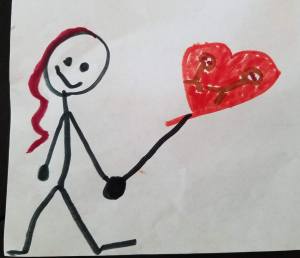
Anna went to a restaurant with her Mommy. They had chicken sandwiches and milkshakes. And best of all, she got a big, red, shiny balloon in the shape of a heart. She was so excited to get a balloon. They were her favorite. She loved the way they floated and bounced around. But there was something really special about this balloon. There were two little people floating inside it. The people at the restaurant told her about the little people but she thought that they were joking. That would be so silly. How could there be people inside a balloon?

They walked outside the restaurant and to the car. Anna held on really tight to the balloon. She didn’t want it to float away.

When they got home she ran inside pulling her balloon by its string. The balloon floated up to the ceiling. But she wanted to pop it. So she pulled it back down by the string. Then she got a tooth pick from the kitchen. It was one of the toothpicks that Mommy and Daddy used to check the bread when they were cooking to make sure it was done. But today it was going to be used to pop a balloon.

Anna pulled the balloon down toward her. And nervously she brought the toothpick toward it. Then she counted. One. Two. THREE! And she poked the balloon with the the toothpick and it made a big POP! Then two little people popped out.

Anna couldn’t believe her eyes. There really were two little people inside this balloon. The little people were frightened and they started to run away. But Anna chased them and picked them quickly. And then she carried them over to her box and threw them inside. Anna was just a little girl and she was still a little rough with animals and toys. So she was a little rough with little people too. But she did make a window on the side of the box so the little people could see outside. But she covered the window with glass panes so that they couldn’t get out even though they could see through them.

Anna’s mommy saw her over by the box and asked, “What do you have there Anna?” “Oh, nothing,” said Anna. But Mommy came over to see anyway. And she peaked through the window and saw the two little people. “Oh my goodness!” said Mommy. “Where did those two little people come from?” Then she remembered what they had said at the restaurant about the balloon. “Oh, there really were two little people in that balloon. Anna, did you pop it?”

Anna just shrugged her shoulders and said nothing. But Mommy looked around the room and saw little pieces of balloon. She picked them up and put them back together and saw that it was the balloon from the restaurant. She also saw her toothpick from the kitchen. “Ah, you did pop the balloon, Silly.” Anna was embarrassed but Mommy told her, “It’s OK, you didn’t know that there were people in there. But let’s see if we can make them more comfortable.”

Mommy went over to the box and propped up the cardboard top into a triangle to make a roof. Then she cut out some more pieces to make a door and more windows. Then she said, “It’s OK, little people. You can come out and in whenever you want. This is you’re home now.” The little people said nothing. They were still very shy. But they were happy to be in this home inside a bigger home with people who seemed pretty nice. Even if the little girl was a little rough.

THE END

The Sneaky Piano

The family piano had an strange habit of sneaking around the house when no one was watching. It couldn’t just sit still the way a proper piano should. Not that it was a bad piano. It was upright and usually stayed in tune. Most guests found its music pleasant. By all the usual pianistic standards no one would have any complaints. But you wouldn’t usually think to ask whether a piano remained stationary.

The girls were the first to notice. Daddy asked, “Who put your shoes in the middle of the floor? That’s not where they go.” “I don’t know. Maybe it was the piano.” Kids have a way of figuring these things out that grownups tend to miss.

They noticed other oddities. Things in the house that would “wander”. Toys thrown into the middle of the floor. Socks and dresses pulled from their drawers and dressers. It was quite a mess. They didn’t wander by themselves of course. That would be ridiculous. It was the piano that moved them. And it seemed to follow the girls around the most.

Being a piano, it was musical in its mischief. For stealthy accompaniment it might play Henry Mancini’s “Pink Panther”. Or Arnold Schoenberg’s “Pierrot lunaire”, plunked out in slow staccato. It would pause or trill on long fermatas as it peaked around the corner to make sure no one was there. And as soon as anyone returned it slunk right back to its spot.

Mom and Dad found it kind of irritating that the piano left its messes for everyone else to pick up. But also mildly entertaining that it was the piano that had done it. It was unique at least. No one else had a moving piano. They tried to get the girls to do most of the clean up, since it was their stuff that was thrown around. But mom and dad helped out a little. After all, the kids weren’t the ones who’d made the messes. It was the piano.

Imagination and Reality in Borges’s “The Circular Ruins”

You are enrolled in a class with the highest of stakes. The payoff for success is your existence. Or so it seems. This is a classroom conjured up, along with you and all its other pupils, in the imagination of the man in the circular ruins. Like many of Jorge Luis Borges’s short stories, “The Circular Ruins” explores the boundary between imagination and reality. How much of what we perceive as reality is the product of imagination? And what kind of reality do the objects of our imagination have? What is the nature of the boundary between imagination and reality?

The man in the circular ruins is preoccupied with one great task: “He wanted to dream a man; he wanted to dream him in minute entirety and impose him on reality.” What an audacious task! There would seem to be an immense ontological gulf between these two categories. Reality is the realm where things exist independent of our imagination. Objects in the real world actually have mass and extension in space. The tree falls in the forest whether anyone is there to hear it or not. But imagination is a realm fully dependent on the mind. Our dreams don’t actually exist. How can these dreams possibly pass from the imagination into reality?

But maybe the divide isn’t as sharp as it seems. The tree falling in the forest is the classic, overused and parodied example of the dependence of certain phenomena on a perceiving subject. Does it make a sound without anyone there to hear it? There are vibrations in the surrounding air but these noumena would not become the phenomena of sound to any person because sound is an experience, a quale of a conscious subject. What we perceive as the real world is composed of such qualia and that’s our only way of perceiving it. In other words we only experience reality through our imagination.

From the other side, artifacts like tools, art, music, and literature begin as dreams in the imagination. Through a creative process we give these objects physical form in the real world. A sculpture takes form in stone, a musical composition takes form in thermal energy, a painting takes form in the arrangement of pigments on a canvas. Even then these physical objects require the imagination of the perceiving subject to be understood as more than just objects occupying space, to be perceived as art and artifacts. The dreams of imagination and objects of the physical world overlap.

An eccentric but intriguing idea thrown around among the cognoscenti these days is the possibility that our universe is actually a simulation created by intelligent life in some “higher” universe. What would that make us? Does that mean we don’t live in the “real” world? Borges explores a similar concern in “The Circular Ruins” but in a less technological guise. His version of a simulation is the dream. If you are a subject in someone else’s dream what kind of existence do you really have? One way to collapse the problem is to say that to be the kind of being who can even ask such a question, to be anxious about the nature of your own existence, is to exist in the most significant sense already. Once you are a self-aware entity who can worry about your own existence you simply do exist, in the most meaningful sense. What more could be added to that to make your existence real?

This Borgesian idealism is explored in many of his other works, most explicitly in “Tlön, Uqbar, Orbis Tertius”, in which Borges refers to the idealist thought of George Berkeley. A classic problem of modern philosophy is what could be called either the hard problem of consciousness or the hard problem of matter, depending on how you approach it. How does our seemingly non-physical consciousness interact with the physical world? The more popular route is to reduce or eliminate consciousness to the material so that there is no more troublesome dualism. The seemingly non-physical aspects of consciousness are illusory, epiphenomena, useful fictions, etc. Another route, taken up be Berkeley is to dispense with the notion of matter instead, to see mind as primary and view matter as the useful fiction. In “Tlön, Uqbar, Orbis Tertius” Borges imagines a world in which people take Berkeley’s idea seriously, in a kind of reductio ad absurdum, to the point that they speak in a language lacking nouns.

Among the entities in the dreams of the man in the circular ruins there seems to be a spectrum of autonomy. Some of his dreamed up entities do no more than parrot his instruction while others challenge him and demonstrate capacity for independent thought. He sees this as a key criterion for assessing their worthiness to be instantiated in reality. “He could expect nothing from those pupils who accepted his doctrine passively, but that he could expect something from those who occasionally dared to oppose him.” Borges makes the intriguing statement that the more autonomous of his dreamed entities “preexistían“; they “pre-existed to a slightly greater degree”. In other words the self-aware ideas in this idealism have some kind of independent existence that the man in the circular ruins apprehends in his imagination. The more autonomous of his dreams are not fully his own creation but existed in some ideal form prior to his dreaming of them.

Where did these ideas come from before he imagined them? One answer available in Borges’s universe is that they existed in “The Library of Babel”, another of Borges’s short stories and probably his most famous. One way to think of the Library of Babel is as a reified, physical instantiation of platonic forms as texts in a library. The library is filled with books of every possible combination of characters. In Borges’s library the books are limited to a certain set and number of characters. But it’s possible to throw out that constraint and imagine a library of infinite possibility where every possible combination of characters is produced in some book somewhere in the library. This would mean that anything you could possibly dream would simply be a reflection of some book somewhere in the Library of Babel. Everything pre-exists there. But crucially, most of the books are absolute nonsense. Hidden among the nonsense there are books with intelligible, meaningful text. But the share of meaningful text in the Library of Babel is infinitesimal.

The autonomous entities dreamed up by the man in the circular ruins, who are able to oppose him, would seem to have a special kind of character that enables them to act independently. They are among the infinite number though infinitesimal portion of books in the Library of Babel with sufficient complexity and coherent structure to endow them with consciousness and self-awareness. What then does it take to impose these entities onto reality? If they pre-existed and already have some kind of independent capacity for thought and anxiety over their own existence what more could be added to make them real? What is it that breathes fire into them to make them living souls?

Steven Hawking asked a similar question of the mathematical structure of the universe. “What is it that breathes fire into the equations and makes a Universe for them to describe?” Max Tegmark posits something analogous to the Library of Babel in abstract space, an infinite library of “mathematical structures” of every possible form, one of which is our own universe. What breathes fire into a mathematical structure and endows it with physical existence are “self-aware substructures” inside the mathematical structure that perceive elements of the structure as physical reality. In other words, the presence of self-aware entities creates what they perceive as physical reality. Nothing more is required than this condition of self-awareness.

The man in the circular ruins labors countless hours to dream a man in the most minute detail. To endow this man with physical existence he must make special supplication to the deities of the ruins. But what is it that the deities can do to make the man more real than he already is? There seems to be one crucial step. Before supplicating the deities “He dreamed an entire man – a young man, but who did not sit up or talk, who was unable to open his eyes. Night after night, the man dreamt him asleep.” After he makes his request to the deities “In the dream of the man that dreamed, the dreamed one awoke.” This awakening is the crucial step. There’s no clothing in earth or matter. It’s simply the awakening of self-awareness. At that point the dreamed one is imposed on reality.

The deities eventually require that the dreamed one be sent off to another temple to repeat the same task as the man in the circular ruins, to create a man of his own. But the man worries that the dreamed one will discover that he is a dream. To all other men the dreamed one appears as a man like any other. Only fire knows his true nature and only fire can reveal it: fire will not consume him. The story concludes when fires approach the circular ruins and the man, having completed his life’s work, submits himself to the flames but then discovers that they do not consume him and that he is himself someone else’s dream. What does this mean for his existence? Is he any less real because someone else is dreaming him? What if the one who is dreaming him is also someone else’s dream and so on, as Borges implies?

What seems crucial in this story is that the capacity for imagination is its own reality. To be the kind of thing that can imagine and be self-aware is already to exist and nothing more is required to breathe life into it. Speculations about our universe as a simulation include the idea that we are several layers below “base reality”. That our simulators are part of a simulation whose simulators are also part of a simulation and so on up to base reality. But what would distinguish this base reality from any other simulated reality? In what sense would entities in that base reality exist that we do not? What is it that makes their physical reality more real than ours? Certainly there would be a difference of some kind but it wouldn’t seem to be a difference in the nature of our self-awareness. That would seem to be the same in all levels of reality.

It may just be that we are the dreamers, dreaming ourselves into existence. If the idea of the conscious self is a useful fiction it is certainly quite useful indeed. Perceptions are undoubtedly occurring and it’s much easier for these perceptions to have some single, stable reference point to give them continuous and coherent structure.

The problem of course is that this is viciously circular. How can an entity dream itself into existence as unified prior to its unification? Some form of pre-existence seems to be necessary, on some kind of stable substrate from the outside. If the universe is a simulation the information content of our self-aware substructures subsists in this simulation. In traditional Christianity, supplemented by Neoplatonic thought, we subsist as ideas in the mind of God. And in Borges’s universe these same ideas subsist as books on the shelves of the Library of Babel. In the end the differences between these metaphors are perhaps less significant than their similarities. Among the books stacked in the shelves of the Library of Babel some infinitesimal but infinite number will have the complexity and coherence to dream and dream of themselves as living souls.
Review of Sexual Desire: A Philosophical Analysis


Carl Sagan said in his classic television series, Cosmos, “If you wish to make an apple pie from scratch, you must first invent the universe.” That line kept coming to mind as I read Roger Scruton’s Sexual Desire: A Philosophical Investigation. If you wish to understand sexual desire, you must first understand human nature. Scruton investigates sexual desire by developing an understanding of its foundation in our lived experience, our first-person perspective. The essential feature of sexual desire in Scruton’s view is its interpersonal nature.

Scruton begins by distinguishing his approach from what could be called the third-person perspective of science, particularly evolutionary science, in its approach to sexuality. Scruton is emphatically not opposed to the scientific approach and accepts as fact humanity’s evolutionary heritage. Humans are animals and can be understood as products of physical, biological, and genetic factors. But this view of human nature does not exhaust everything that can be said about it. Science may look at human behavior and posit explanatory theories without looking into the reasons humans give for their own behavior. But human behavior can also be understood from a first-person perspective and a second-person perspective. Why am I doing what I am doing? Why are you doing what you are doing? And this is the natural way we understand our own behavior and interact with each other. This kind of first-person approach is in the philosophical tradition of phenomenology and Scruton calls this world of lived experience the Lebenswelt, (life-world) a term used by the founder of phenomenology, Edmund Husserl. In another work Scruton has named this approach of seeing one reality in two ways “cognitive dualism”, which he contrasts with ontological dualism. While these two approaches may be largely non-overlapping there are instances in his view where one may intrude onto the other illegitimately. Sociobiology and Freudian psychology are two fields he believes commit this error by attempting to explain away the first-person perspective through excessive reduction.

The experience of sexual desire from this first-person perspective is grounded in the interpersonal encounter. Sexual desire is not merely a need for mechanical stimulation of erogenous zones in the body. It is rather dependent on an awareness of the self-consciousness of another person. The look of desire is imbued with a sense of reflexivity in “me seeing you seeing me”. Further, Scruton takes Hegel’s view that this kind of exchange between two persons is the ultimate basis for self-consciousness, we develop a sense of self when confronted with the otherness of another self. Because of this, sexual desire is tied to our deepest source of self-identity, a point which heightens its moral significance. The body is not unimportant in sexual desire. It is of critical importance. But rather than being the singular focus of sexual desire the body is the way a person is desired. Scruton refers to this as “embodiment”. A body is not desired for its own sake but is desired as the self-conscious person.

Scruton’s phenomenological, first-person perspective is by nature subjective. This is both its strength and weakness. The weakness is that the lived experience it points to is not something accessible by methods of science, with its standards of testability and falsifiability. The account he gives relies on the reader to weigh it against his own lived experience. This may not be as satisfying as the objective features of the world which we can measure, irrespective of who is doing the measuring. But there is no other way to talk about such things. And this is the strength of the approach. The features of the life-world Scruton picks out are not objective but they are, if an accurate description of that experience, incorrigible; your immediate experience cannot be inaccurate about your immediate experience, whatever else it may be inaccurate about. Scruton is at pains to stress that he is not endorsing a completely separate inner world that is only comprehensible to the individual, what Wittgenstein called a “private language”. But he does avail himself of the notion that one’s own first-person perspective is authoritative for that perspective. It may be possible still to be dishonest when communicating that experience to others but it is not possible to be mistaken about immediate experience. That is a strength for his argument if his account is accurate.

If it is true to lived experience that the interpersonal encounter is the core of sexual desire this has certain implications for sexual well-being and morality. And sexual well-being and morality are essentially coincident with each other. Sexual experiences that lack this interpersonal character are at least deficient compared to those that have it. At worst, sexual activities divorced from interpersonal interaction can be harmful to one’s ability to have or enjoy the deeper interpersonal interactions of healthy sexuality. Inferior sexual behavior can be literally impersonal, such as with masturbation, or effectively impersonal, as when a person is treated not as a self-conscious subject but as an object, as with pornography for example.

Scruton arrives at fairly conservative positions on sexual morality and sexuality generally. But his approach is neither theological nor traditional by necessity. He contends that the norms of traditional sexual morality need not be absurd even though there may be no God who forbids them. But although his approach is not theological it is not atheistic either. Rather, he seeks to build a logical argument for sexual morality independent of theology and tradition, though he admits that these are the means through which they are almost always learned in practice. Though he does not put it this way explicitly it could be said that he is getting behind the norms of theology and tradition to illuminate the reasons for them; God’s reasons for willing what He wills, as one scholar has put it.

This gets to what I see as the value of this kind of investigation. No one needed a philosopher to tell them that sexuality is important. But beyond that fact there is a lot of confusion about the role of sex in human life. It is not clear that reliance on tradition or theology will any longer be adequate for various reasons. For one thing, both religion and tradition are open to challenge. The multiplicity of religions and traditions in a globalized world are also incompatible and lead to different conclusions. For example, both monogamy and female genital mutilation are traditionally and religiously enjoined, but I believe the second of these is horribly wrong. There needs to be some way to understand sexuality and communicate about it across different religions and traditions. A philosophical investigation, working down to the first-person human experience is a method to start from something as general, but foundational, as human nature and understand sexuality in that context.